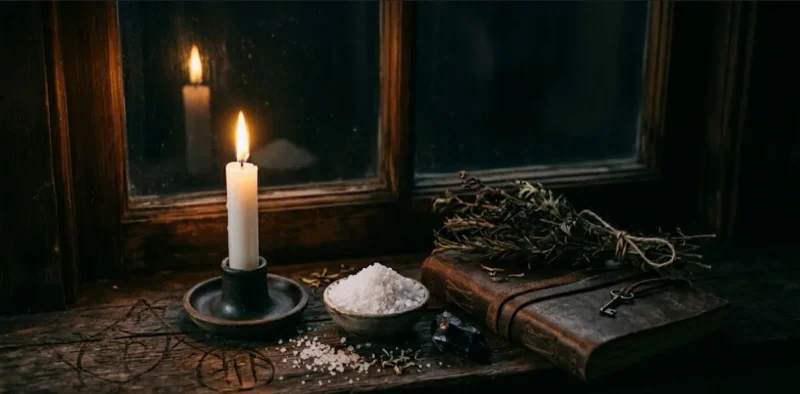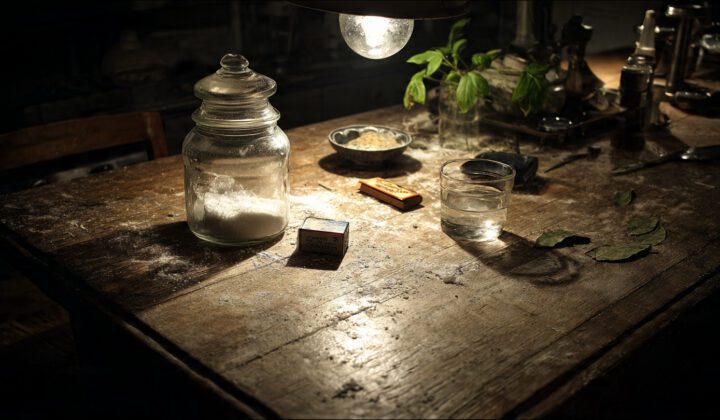
Every beginner resource on this topic eventually does the same thing. It spends a paragraph telling you that you do not need special tools, and then lists a white candle, a specific crystal, or an herb that is probably not in your kitchen. By the end you have a shopping list, which is what the people selling these things were hoping for.
Traditional folk magic was built entirely from what was already in the house. The people who developed and preserved these practices across generations were largely illiterate, had no access to a spiritual goods market, and would not have been able to afford one if it had existed. Everything that survived, every technique that worked well enough to be passed down, was made from salt, water, ash, kitchen herbs, and spoken words.
The Actual Starting Kit
The honest list is short: attention, your voice, salt, water, and the threshold of your front door. Attention means the ability to hold a clear intention without it dissolving the moment something distracts you. Voice matters because speaking forces you to be specific, and specificity is the mechanism, not an optional bonus.
That covers the foundation of protective and cleansing work. Everything else is refinement, not prerequisite.

Grounding: Two Minutes, Nothing Required
Grounding is the foundation of everything else, and it costs nothing and requires nothing except your body and a floor. You stand or sit with your feet flat, breathe slowly, and visualize roots extending from the soles of your feet downward through the floor and into something stable and ancient far below you, something completely unaffected by anything happening in your life right now.
Two to three minutes done properly produces a stable foundation that holds under real pressure throughout the day. Most people do thirty seconds and wonder why nothing feels different. The difference is not technique but how long you actually hold the visualization before moving on.
Skip this and everything else underperforms. Most failures in more complex practices trace back to this step being done poorly or not at all.

Breath as a Zero-Cost Tool
Most practitioners underestimate breath, but it is one of the most practical tools available. There is a reason that in Hebrew, Tibetan, Sanskrit, Greek, and Latin, the same word covers both breath and spirit: practitioners across traditions noticed that the two are not as separate as they appear.
A simple practice before a difficult interaction or a cleansing session: breathe in deeply, filling the lower lungs first so the belly expands before the chest, hold for a moment, and exhale completely. Three rounds of this done slowly before beginning any intentional work settles the nervous system and creates a noticeably different quality of attention than starting cold.
You can also breathe in while visualizing protective or cleansing energy entering with the air, and breathe out visualizing what you are releasing leaving the body with the exhale. This costs nothing and is available in any room, in any situation, without preparation.
Spoken Intention: The Most Underestimated Tool
The most powerful zero-cost practice in the folk tradition is also the one most consistently dismissed as too simple. You speak your intention out loud, in your own words, toward whatever you are doing.
When you place salt in a corner, you tell it what you are asking it to do. When you wash your hands, you tell the water what you want it to carry away. The words do not need to be poetic or scripted, because what makes them work is honesty and specificity, not performance.
Vague language sounds obviously vague when you hear it said out loud. “I want good things” is easy to think, but it sounds hollow when you say it to a bowl of salt, and you will naturally replace it with something more precise because you can hear how incomplete it is, which is exactly why the spoken component works.
Salt: What It Does and How to Use It
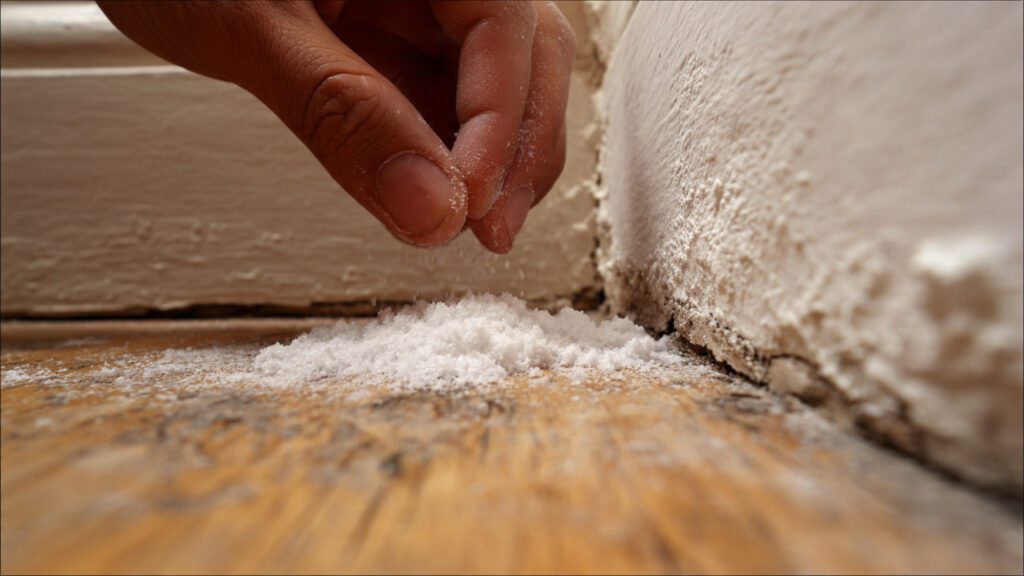
Sea salt is preferable but table salt works, and you already have one or the other. A pinch placed in each corner of a room, with spoken intention about what you are asking it to absorb, provides passive ongoing protection without requiring your active attention after placement. You swap it out every few days and dispose of it outside, because what the salt has absorbed should leave the building rather than sit in your indoor trash.
If you want to assess the energetic state of a space before cleansing it, heat a dry pan until quite hot, add a generous handful of salt, and watch what happens over fifteen minutes. Salt that stays light indicates a space in reasonable condition, while salt that darkens significantly or crackles aggressively indicates heavy buildup, and the heating process itself draws out and neutralizes what it contacts. The pan you already own and the salt you already have are sufficient for both the diagnostic and the cleansing.
Water: More Useful Than Most People Realize
Water has absorptive properties that practitioners across traditions have observed for centuries, and your tap produces it continuously. The difference between tap water used mechanically and water used with intention is not the chemical composition but what has been consciously directed into it.
Before washing your hands after a difficult interaction, set the intention and speak it: “This water carries away everything that does not belong to me.” Wash deliberately and visualize what you are releasing leaving with the water. Done consistently after every difficult interaction, this single practice changes how much you carry home from hard days, and it requires nothing you do not already do.
One practice we use regularly that costs nothing: a bowl of water placed in a room where an argument is happening actively reduces the intensity of the exchange. It sounds too simple to mention, but it is documented across folk practice and it works. The water absorbs the emotional charge building in the air.
For something slightly more involved, a jar of water left overnight on a windowsill under a full moon charges it for cleansing and protective use. A waning moon charges water particularly well for removal and release. You use it to spray corners, mop floors, or add to washing water, and the only cost is remembering to put the jar out the night before.

Kitchen Herbs That Are Already There
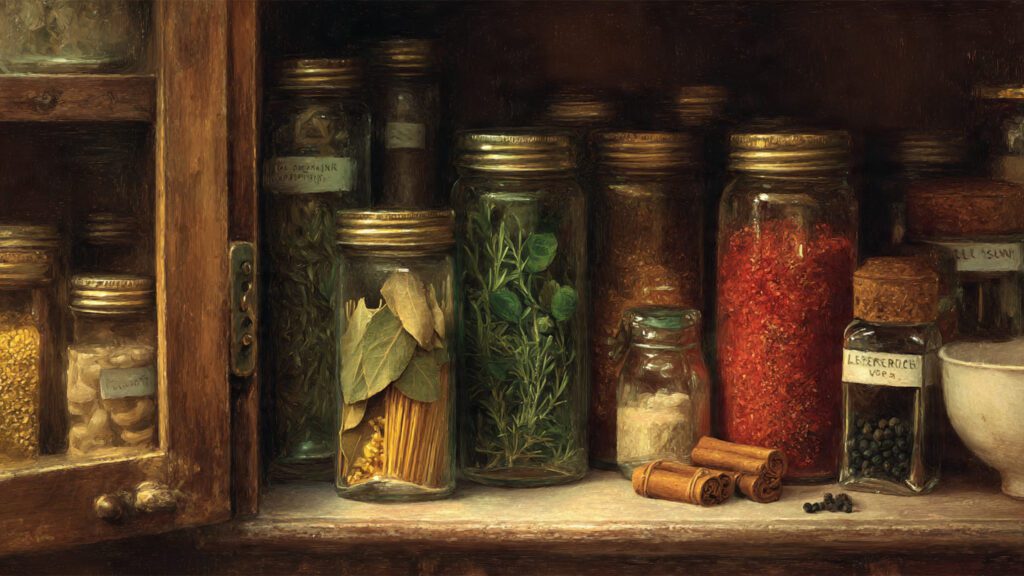
Most kitchens contain at least one plant with documented protective and cleansing properties, and using it costs nothing beyond changing how you relate to what is already on your shelf.
Rosemary is one of the oldest documented cleansing incenses in the world, predating most of what gets marketed as ancient today. A few sprigs burned over a heatproof dish move energetic residue out of a space as effectively as anything you would purchase specifically for that purpose, and if you cook with it you already have it.
Bay leaf sits under Sun and Fire in every serious herbalism reference, which means it carries protective and purifying energy along with its culinary uses. Writing a clear intention on a dry bay leaf and burning it is a zero-cost working that has survived in folk practice across Mediterranean, South American, and Eastern European traditions simultaneously. If you have a jar in your spice cabinet, you have everything this requires.
Cinnamon has a long-documented history of drawing positive energy and calming hostility, which is why a thin dusting of cinnamon mixed with talcum applied to the sternum makes a genuinely effective daily protection against envy and hostile projection. This comes from folk practice documented across multiple Central European and Mediterranean traditions. The sternum sits directly over the solar plexus, which is where most envy-based energetic interference enters, and cinnamon applied there addresses that vulnerability for the cost of what is already in your kitchen.
The Doorway Ritual: The Most Sustainable Daily Practice
The doorway ritual is the most consistently effective daily practice we know of, and it takes about five minutes total split between leaving and returning home.
When you leave in the morning, you pause at the door, breathe and ground briefly, set your protective intention, and cross the threshold consciously rather than mechanically. When you return home, you take your shoes off at the door as a deliberate energetic boundary between what is outside and what is yours, then wash your hands and forearms with cold water while speaking your intention to release what you picked up during the day.
The threshold matters in folk tradition because it is the most energetically permeable point of any dwelling, the place where inside and outside meet, and crossing it deliberately rather than unconsciously is itself a form of energetic hygiene. You are already doing this every day. The only change is doing it with awareness rather than on autopilot.
Protection During Difficult Interactions
You can protect your field during a difficult conversation without any tool, preparation, or previous experience. Maintain the visualization of a thick pane of clear glass between you and the other person, through which you can see, hear, and respond but through which energy does not pass in either direction. When you feel a pulling sensation at your solar plexus, reinforce the glass rather than letting the conversation draw you further in.
Crossing your arms over your solar plexus and keeping your feet touching creates a closed energetic circuit that serves the same function physically. This is a natural posture that looks unremarkable in any social context and significantly reduces how much energy you lose in draining interactions. You can do this in any room, at any moment, with no warning and no preparation at all.
One thing Fortune documents that most people skip: do not let yourself get too hungry during periods of sustained difficult contact. The psychic centers of the body are significantly more open when the stomach is empty, and eating something small before a difficult interaction is a genuine form of protection, not a metaphor for it.
The One Thing Worth Spending Money On
Books. Specifically, books written by people who actually practiced what they describe rather than books assembling second-hand information into beginner-friendly packages.
Primary sources on folk practice, traditional herbalism, and esoteric technique cost the price of a paperback and teach you far more about how these things actually work than any collection of purchased tools could. The understanding of why what you are doing works cannot be purchased, faked, or replaced with good intentions, and that understanding is what separates a practitioner who gets real results from one who creates a beautiful aesthetic and wonders why nothing changes.
The Real Beginner Mistake
Most people who come to this practice spend the first several months acquiring things and then wonder why the things are not doing anything. The mistake is not caring about the practice but misidentifying where it lives.
It lives in your attention, your consistency, and the specificity of what you speak out loud when you place salt in a corner or wash your hands after a hard day. Those things cannot be purchased, which is why they never appear in shopping lists, and why so many beginners end up with beautiful shelves and a practice that does not quite feel real.
What makes it real is doing it consistently and daily, without waiting until the right supplies arrive.
FAQ
The foundation of any protective or cleansing practice requires only salt, water, your voice, and the ability to hold a clear intention. Every technique that survived in traditional folk magic was built from what was already in the house, because the people who developed these practices had no access to a spiritual goods market and no need of one.
Grounding is a two-to-three minute practice done standing or seated with feet flat on the floor, breathing slowly while visualizing roots extending downward from the soles of your feet into something stable and ancient below you. It produces a stable foundation that holds under pressure throughout the day and is the step most failures in more complex practices trace back to being skipped or rushed.
Place a pinch of sea salt in each corner of a room with spoken intention about what you are asking it to absorb, then replace it every few days and discard it outside. To assess how much buildup a space holds, heat a dry pan until quite hot, add a generous handful of salt, and watch for fifteen minutes: salt that stays light indicates a space in reasonable condition, while salt that darkens or crackles aggressively indicates significant accumulated residue.
Writing a clear intention on a dry bay leaf and burning it is a folk practice documented across Mediterranean, South American, and Eastern European traditions simultaneously, which is itself a reason to take it seriously. Bay leaf sits under Sun and Fire in traditional herbalism, meaning it carries protective and purifying energy alongside its culinary use.
Maintaining a visualization of a thick pane of clear glass between yourself and the other person allows you to see, hear, and respond without energy passing through in either direction. Crossing your arms over your solar plexus and keeping your feet touching creates a closed energetic circuit that serves the same function physically and is unremarkable enough in any social setting that it requires no explanation.