
Somewhere around my third or fourth crystal purchase, I realized I had no idea what I was doing. Not in a spiritual crisis way, more in the way you realize you have been using a tool backwards for months and everything suddenly makes sense when someone explains what it is actually for.
The available information collapsed every stone into the same vague category of “protective and healing” without explaining what those words mean in practice, why a black tourmaline is not interchangeable with an obsidian, or why placing clear quartz near a stone you have not cleansed in three months might be making things worse rather than better. Nobody mentioned that part, and I had to figure it out the slow way, which cost me both time and stones that were doing nothing.
Crystals in Magic: What the Historical Record Actually Shows
Every serious source on stone use in magical practice, from Agrippa to the Egyptian lapidaries, treats crystals as tools with specific jobs, not objects that generally improve the atmosphere. The wellness version of crystal work dropped this distinction entirely, and it is the most consequential thing it dropped.
Definition: In the lapidary tradition, a stone’s virtus (from the Latin, meaning virtue or capacity) referred to its specific functional quality in a given context. Stones were assigned virtues based on observed effects, planetary correspondences, and documented use across generations of practice. A stone’s virtue was what it reliably did, not what it symbolized.
Ancient Egyptian use of crystals was almost entirely protective and apotropaic, meaning oriented toward warding off harm. Carnelian, lapis lazuli, and green feldspar appear in funerary amulets from the Old Kingdom period, each with a specific assigned function. Judy Hall documents in The Crystal Bible (2003) that carnelian was used to protect the dead on their journey to the afterlife, and was carried near the front door of homes to invoke protection and invite abundance.
Agrippa’s Three Books of Occult Philosophy (1531) systematized the European magical stone tradition by assigning stones to planets, which then correspond to specific functions: Saturn stones for banishing and binding, Mars stones for courage and protection, Sun stones for vitality and clarity. The Picatrix, an eleventh-century Arabic text translated into Latin in medieval Europe, treats crystals the same way: as materials with specific functional capacities that can be directed through intention, timing, and proper use.
What the wellness industry dropped from all of this is the specificity. When everything becomes “healing energy,” the practitioner has no framework for evaluating what is working or why, which makes improvement impossible.

The Three Functional Categories of Crystals
Knowing which of these three categories a stone belongs to is more useful than memorizing its listed properties. Most crystal guides never give you this framework, which is why so many people end up with a shelf full of stones and no clear understanding of what any of them are doing.
Absorption Stones: Which Crystals Draw In Energy
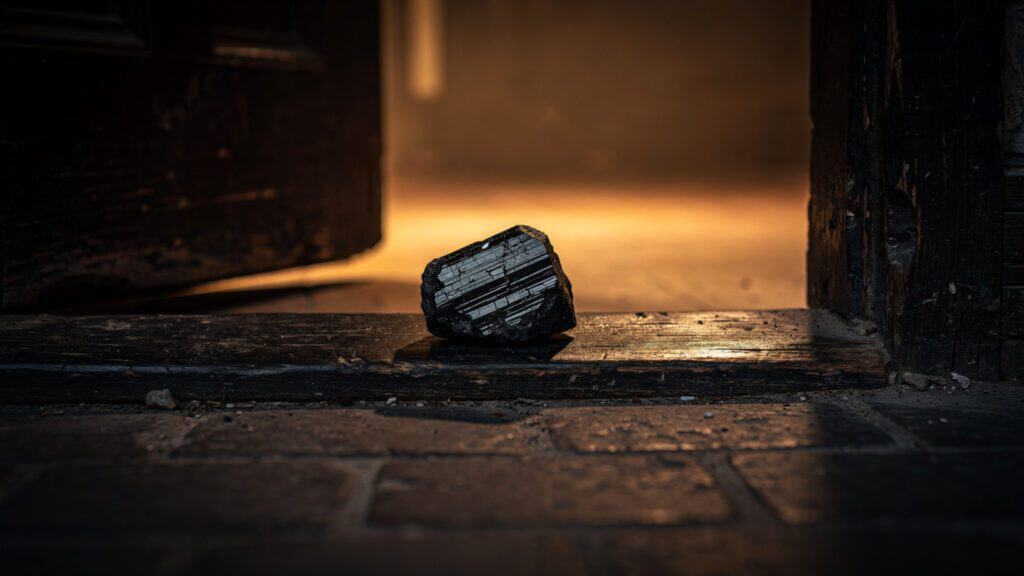
Absorption stones take in hostile, stagnant, or disruptive energy and hold it. Black tourmaline (schorl) is the clearest example. Placed at thresholds or room corners, it draws in what enters rather than redirecting it. Hall notes in The Crystal Bible that black tourmaline placed point-out from the body draws off negative energy in healing contexts, and that wearing it around the neck defends against debilitating environmental and electromagnetic stress.
The practical consequence of absorption is saturation, which is the part nobody mentions in the shop. A stone that has been doing active work fills up over time and needs cleansing or it stops functioning at full capacity. The black tourmaline I placed at my front door and ignored for four months was not protecting much of anything by the end, and I had to learn that from experience rather than from anything I read.
Other absorption stones include smoky quartz, which transmutes what it takes in rather than simply storing it, and hematite, which grounds absorbed energy through its iron content and disperses it downward. Black onyx carries a strong banishing quality alongside its absorption, and jet, which is fossilized wood rather than a mineral in the technical sense, has a 6,000-year documented history in protective use across British, Mediterranean, and Near Eastern traditions.
Practical rule: Cleanse absorption stones every two to four weeks when they are actively working. Dry sea salt burial for deeper clearing, moonlight for lighter maintenance. Running water works for most of them, with exceptions noted in the placement section.

Deflection Stones: Which Crystals Redirect Energy
Deflection stones redirect what comes at them rather than taking it in. Obsidian is the primary example, and its function is categorically different from black tourmaline despite both appearing in every “best protective crystals” list. What contacts a deflection stone is turned away from the protected space or person, often back toward its source.
The distinction matters practically. If you are dealing with accumulated ambient energy in a space, something that has built up over time from high traffic or sustained emotional intensity, absorption is more appropriate. If something feels directed at you specifically, deflection addresses that situation more precisely. I use both, but not as if they are the same thing.
John Dee’s black mirror, used in his scrying and ritual work in the sixteenth century, was polished obsidian, which connects the deflection function to a much older understanding of obsidian as a material that reflects and reveals rather than absorbs. Mirror magic in folk tradition operates on the same principle: mirrors placed facing outward in windows return what is sent, and the stone works identically.
Other deflection stones include labradorite, which Hall describes as forming a barrier that prevents energy leakage from the aura and deflects unwanted external energies, and pyrite, whose iron sulfide composition connects it to the iron protection principle documented across European folk magic traditions. Tiger’s eye was carried by Roman soldiers in battle for courage and protection in combat.
Amplification Stones: Which Crystals Increase What Is Already There
Amplification stones increase the effect of whatever is already present, which makes them both the most flexible and the most easily misused type. Clear quartz does not inherently protect, heal, or attract anything on its own. It amplifies the intention or the properties of what is near it, including other stones, which is why it belongs at the center of crystal arrangements rather than at the edges.
The logical consequence of this, which took me an embarrassingly long time to understand, is that placing clear quartz near an absorption stone that has not been cleansed amplifies whatever that stone has accumulated. If the tourmaline is full of what it has been drawing in for the past month, the clear quartz makes that louder.
Selenite amplifies similarly and has the additional property of not requiring cleansing in the way absorption stones do. Hall documents its use in creating protective grids around homes, placed in corners to establish a stable atmosphere that does not require constant maintenance. Melody notes in Love is in the Earth that clear quartz functions as a bridge between conscious intention and the energy being directed, which is a useful description of how amplification works more broadly: it increases the signal, whatever the signal is.
One thing to know about selenite before anything else: it dissolves in water. Do not cleanse it with any liquid method, which is the opposite of almost every other stone listed here.

Crystal Reference Table: 25 Stones by Function
Organized by functional category rather than alphabet, because that is how you actually need to think when choosing. Historical notes give at least one named source or documented tradition. Where the record is thin or primarily contemporary, that is stated.
Absorption Stones
| Stone | Primary Use | Where to Place or Carry | Historical Note |
| Black Tourmaline (Schorl) | Absorbs environmental and directed hostile energy | Thresholds, four room corners, or on the body; cleanse every 2-4 weeks | Agrippa: Saturn correspondences for banishing; Roman protective amulet tradition; Hall documents healing layout use |
| Smoky Quartz | Absorbs and transmutes; converts rather than stores | Spaces with dense accumulated energy; rooms where conflict has occurred | Scottish Highland cairngorm tradition; used in sword hilts and as protective amulets |
| Hematite | Grounds and disperses absorbed energy through iron content | Carry on body; place at feet during protective work; use dry cleansing only, not water | Roman soldiers carried it in battle; iron protection principle documented across European folk magic |
| Black Onyx | Absorption with a strong banishing quality | Banishing work and grief processing; effective at the base of protective setups | Agrippa: Saturn stone; medieval lapidaries document use in protective and banishing amulets |
| Jet | Among the most historically documented absorption stones | Carry or wear; effective for grief and psychic protection | 6,000-year history in British Isles; Roman and Viking protective jewelry; Whitby jet tradition |
| Amethyst | Absorbs mental noise and psychic debris | Place near the head for sleep; useful in spaces where mental stress accumulates | Greek amethystos: not drunk; Pliny documents protective use; Hall: protects against psychic attack and ill-wishing |
Deflection Stones
| Stone | Primary Use | Where to Place or Carry | Historical Note |
| Obsidian | Deflects directed hostile energy; reveals what is hidden | Face outward toward source of concern; use for scrying and cord-cutting | John Dee’s scrying mirror was polished obsidian; Hall notes it removes hooks and ties from the aura |
| Labradorite | Deflects psychic intrusion and unwanted attention | Wear or carry in public or during psychic work | Inuit tradition attributes protective properties; Hall: forms a barrier preventing energy leakage from the aura |
| Pyrite | Deflects psychic attack; strengthens the energetic field | Place in workspace or carry; pairs well with black tourmaline | Iron sulfide composition links to iron protection principle; folk magic protective amulet use across European traditions |
| Tiger’s Eye | Deflects deception; sharpens discernment | Carry when navigating situations requiring clear judgment | Roman soldiers carried it for courage and protection; documented in ancient Roman amulet use |
| Turquoise | Protective carry stone with a long documented history | Wear against the skin | Egyptian, Native American, and Persian use spans thousands of years; Pliny mentions protective properties |
Amplification Stones
| Stone | Primary Use | Where to Place or Carry | Historical Note |
| Clear Quartz | Amplifies intention and properties of adjacent stones | Center of crystal arrangements; cleanse before pairing with anything | Picatrix and medieval lapidaries: receptivity to impression; Melody: bridge between conscious intention and directed energy |
| Selenite | Amplifies and stabilizes; self-cleansing; dissolves in water | Room corners for atmospheric protection; use to cleanse other stones | Named for Selene; Hall documents protective grid use in homes |
| Carnelian | Amplifies vitality, courage, and protective force; can cleanse other stones | Carry during confrontational situations; place near front door | Egyptian funerary amulets from Old Kingdom; Agrippa: Mars and Sun for strength; Hall: near the front door invokes protection |
Attunement and Specialized Stones
These stones attune, open, or connect rather than absorb, deflect, or amplify in the primary sense.
| Stone | Primary Use | Where to Place or Carry | Historical Note |
| Rose Quartz | Love work; emotional attunement; Venus magic | Relationship areas of a space; hold during emotional processing | Medieval lapidaries assign pink and red stones to Venus; love talisman use documented by Judika Illes in Encyclopedia of 5,000 Spells |
| Lapis Lazuli | Truth; authority; communication with higher forces | Ritual work requiring clarity of intention | Egyptian and Mesopotamian use spans thousands of years; Agrippa: Jupiter stone for authority and wisdom |
| Moonstone | Lunar attunement; intuition; dream work | During lunar phases; near the bed | Roman lapidary tradition documents its changing appearance with lunar cycles; Indian tradition of moonstone as sacred |
| Malachite | Transformation; protective during periods of change | During deliberate change; surface-sensitive, avoid water | Egyptian protective amulets; Pliny notes protective properties; copper content links to Venus correspondences |
| Garnet | Vitality; regeneration; sustained protective carry stone | Carry for sustained protection; historically used in signet rings | Medieval European signet rings and protective jewelry; Agrippa: Mars stone |
| Bloodstone (Heliotrope) | Among the most documented protective stones in the Western tradition | Carry for protection; courage work | Pliny documents extensive use; medieval lapidaries name it among the most powerful protective stones; Renaissance talisman work |
| Citrine | Solar energy; confidence; prosperity work | Work related to clarity and abundance | Important: most commercial citrine is heat-treated amethyst. Natural citrine is pale yellow and rare. Solar correspondences apply to natural citrine specifically. |
| Fluorite | Mental clarity; psychic hygiene | Sustained mental work or study | Limited pre-twentieth century documentation; primarily contemporary in use |
| Rhodonite | Emotional balance; grief processing | Hold during emotional clearing work | Contemporary use primarily; limited historical documentation |
| Green Aventurine | Growth; earth and Venus correspondences | Prosperity or growth-oriented practice | Contemporary use primarily; loosely corresponds to Venus and Earth associations |
Which Crystal Do You Actually Need?
Start with the function, not the feeling. Decide what the situation requires before you decide which stone, because most mismatches between a crystal and its result come from choosing based on aesthetics or a property list rather than actual need.
- Accumulated energy in a space: a room that feels heavy, stagnant, or persistently uncomfortable after cleansing. Absorption is the first move. Black tourmaline or smoky quartz at the perimeter.
- Something directed at you specifically: a conflict with a particular person, a situation where hostile intent is involved. Deflection is more precise than absorption here. Obsidian facing outward, or labradorite worn on the body.
- Sustaining a setup already in place: you have protective work going and want to extend or stabilize it. Amplification through clear quartz or selenite serves this, but only after the stones they are amplifying have been cleansed.
What About Choosing by Intuition?
Intuitive selection is how most beginners end up choosing, and it is not wrong exactly, though it tends to produce better results once you have enough experience to distinguish genuine response from wishful thinking. Melody makes a strong case in Love is in the Earth that the practitioner who attunes to stones before working with them produces more consistent results, because selection becomes informed rather than random. My honest position is that working consistently with a small number of stones for a few months teaches more than rotating twenty stones based on mood, and that intuition is more reliable when it has something real to work from.
How to Place Crystals and Keep Them Working
Protection Setup for a Room or Home
Black tourmaline at the four corners of a room creates a perimeter that draws in accumulated or incoming hostile energy before it reaches the center. Selenite placed alongside it at each corner stabilizes the setup and reduces how often the tourmaline needs cleansing, because selenite’s amplification sustains the protective quality of the space without accumulating what it processes.
Deflection stones belong at points of entry rather than at the corners. An obsidian piece at the main entrance, oriented outward, redirects what comes through rather than absorbing it at the threshold. I use both in my own space: tourmaline at the corners and obsidian facing out at the front door, which is more thorough than either approach alone.
How Do You Place Crystals on the Body?
Hall notes in The Crystal Bible that placement in laying-on-of-stones work matters more than beginners usually realize, because the same stone at the head versus the feet interacts with different energetic centers and produces different results. Absorption stones placed at the extremities draw energy outward and down. Amplification stones at the chest or solar plexus increase the quality of whatever intention is being held.
Melody’s approach in Love is in the Earth treats the stones as active participants rather than passive objects: the practitioner attunes to the stones before placing them, the subject continues conscious breathing during the arrangement, and the session involves deliberate engagement rather than placement and waiting. That is more demanding than putting stones on a nightstand, but it is also what the tradition actually describes.
Cleansing Crystals
Selenite is the most practical cleansing tool because it restores without accumulating what it draws out. Placing absorption stones on or near a selenite plate overnight handles light maintenance, and it is the method I use most often because it requires nothing except remembering to do it. Dry sea salt burial handles deeper clearing after heavy use. Moonlight works for most stones and requires no preparation at all.
Do not use water on selenite (it dissolves), malachite (surface-sensitive), or other porous or soft specimens. Running water is fine for most hard stones, including black tourmaline, obsidian, and clear quartz.
FAQ
Black tourmaline absorbs hostile and environmental energy inward and holds it, making it the right choice for accumulated ambient energy in a space or general personal protection, while obsidian deflects directed energy back toward its source rather than taking it in. If the problem is a specific person directing hostile intent at you, obsidian facing outward is more precise than tourmaline, and John Dee’s scrying mirror was polished obsidian specifically because of this reflective and deflecting quality.
Black tourmaline placed at the four corners of a room creates a perimeter that absorbs incoming hostile energy before it reaches the center, and obsidian at the main entrance oriented outward redirects what comes through rather than absorbing it at the threshold. Selenite placed alongside the tourmaline at each corner stabilizes the setup and reduces how often the tourmaline needs cleansing, because it amplifies the protective quality of the space without accumulating what it processes.
Clear quartz amplifies the intention or properties of whatever is near it rather than carrying a specific protective or healing function of its own, which is why Melody describes it in Love is in the Earth as a bridge between conscious intention and directed energy. Placing clear quartz near an absorption stone that has not been cleansed amplifies whatever that stone has accumulated, which is why it belongs at the center of a crystal arrangement rather than adjacent to stones in active use that have not been recently cleared.
Selenite is the most practical everyday cleansing method: placing absorption stones on a selenite plate overnight handles light maintenance without requiring any preparation. Dry sea salt burial handles deeper clearing after heavy use, moonlight works for most stones without preparation, and running water is appropriate for hard stones including black tourmaline, obsidian, and clear quartz, but should never be used on selenite, which dissolves, or malachite, which is surface-sensitive.
Selenite dissolves in water and must be cleansed only with dry methods, either moonlight or placement near other selenite. Malachite is surface-sensitive and should avoid water contact, and any soft or porous stone carries a similar risk, so the default rule is dry sea salt or moonlight for anything you are uncertain about.