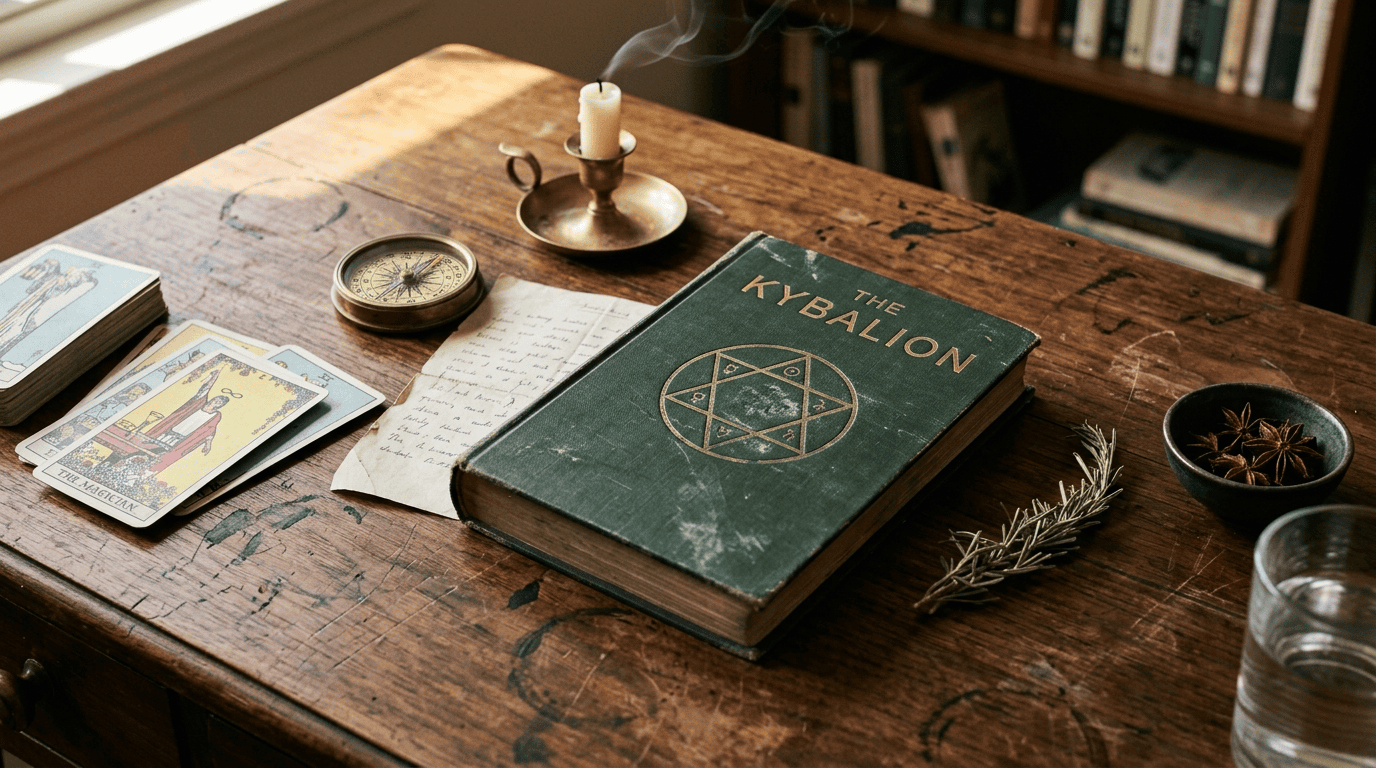
Editions of The Kybalion still sell it as the wisdom of an Egyptian sage who lived before Moses, and the book makes the same claim in its opening chapter. It was in fact written in Chicago and published in 1908.
That date leaves its seven hermetic principles intact, and a few of its techniques hold up well as daily practice. If you finished the book unsure how much of it to believe, the answer splits between where it came from and what it asks you to do.
Key Takeaways
- The Kybalion appeared in Chicago in 1908 under the pseudonym Three Initiates, and scholars widely attribute it to the New Thought writer William Walker Atkinson.
- It presents itself as ancient Egyptian teaching, a claim scholarship had already set aside for the older Hermetic texts in 1614.
- Its seven principles are mentalism, correspondence, vibration, polarity, rhythm, cause and effect, and gender.
- The most usable technique in it is polarisation, where you work on an unwanted state by cultivating its opposite rather than fighting it.
- It reads best as a short modern practical text, with the older Hermetic writings as the next step.
What Is The Kybalion?
Definition: The Kybalion is a short book on Hermetic philosophy first published in Chicago in 1908 under the pseudonym “Three Initiates”. It arranges its teaching into seven principles about how mind, matter and change relate, and it presents them as working laws a reader can apply to their own mental states.
Of its fifteen short chapters, the first two carry most of the weight by setting out all seven principles. The rest of the book expands each one, and the closing chapter gathers them into axioms with commentary.
On its final page comes a warning against what the authors call mental miserliness, meaning knowledge collected and never used. Its purpose, in other words, is practical rather than historical.
Most readers reach it through manifestation writing, because its first principle, that the universe is mental, sits underneath much of that material. This link is the first clue to where the book came from.

Who Wrote The Kybalion?
No person is named on the title page, only “Three Initiates”. In 1908 it came out from the Yogi Publication Society of Chicago, a press that belonged to William Walker Atkinson.
Atkinson was a lawyer turned writer and one of the most productive voices of the New Thought movement. Scholarly consensus now gives him the book, either as its sole author or as the main hand behind it.
That attribution is strong rather than certain, since no signed manuscript has ever surfaced. It rests on the style of the prose, on the circle of people around Atkinson, and on his habit of using other names.

The same press, for instance, published his books on breathing and yoga in 1908 under the name Yogi Ramacharaka. Philip Deslippe’s Definitive Edition of The Kybalion sets out this history at length and collects the background in one place.
New Thought explains the book’s tone better than any Egyptian source. That movement held that thought shapes circumstance and that a trained mind can change its own condition. A book of mental laws for daily use fits that outlook closely.
Is The Kybalion Ancient Hermetic Wisdom?
The book claims to be ancient, although that claim had failed for the older Hermetic texts long before 1908. It places Hermes Trismegistus in Egypt in the earliest dynasties, as a contemporary of Abraham who lived three hundred years.
According to the same chapter, he was later worshipped as the god Thoth. A first-time reader has no reason to doubt any of this, because the prose is confident and the name Hermes carries real history.
Part of that history is genuine, since writings attributed to Hermes Trismegistus do exist. Best known among them are the Greek treatises now called the Corpus Hermeticum, and Renaissance scholars treated them as older than Plato.

In 1614 the Geneva-born philologist Isaac Casaubon read their Greek closely and showed it could not be nearly that old. Modern scholarship places the treatises roughly between 100 and 300 CE. When The Kybalion appeared in 1908, it revived a claim scholars had set aside almost three centuries earlier.
One part of the question stays open, because Hermetic writings found at Nag Hammadi in 1945 led some scholars, Jean-Pierre Mahé among them, to argue for older Egyptian material behind the treatises. That debate concerns texts from the second century and does nothing to make a 1908 book ancient.
Even the seven-principle scheme is widely regarded as the book’s own arrangement. Scholarly accounts describe The Kybalion as a modern synthesis that organises Hermetic themes through a New Thought lens. Its numbered list belongs to Atkinson’s Chicago rather than to Alexandria.
What Are the Seven Hermetic Principles?
The seven principles are mentalism, correspondence, vibration, polarity, rhythm, cause and effect, and gender. Each gets a short axiom and an explanation, and the table below sets them side by side.
| Principle | The Book’s Axiom | What It Claims |
| Mentalism | “The Universe is Mental.” | Reality is at root mental, the creation of one universal mind |
| Correspondence | “As above, so below.” | The same patterns repeat across every level of existence |
| Vibration | “Everything vibrates.” | Things differ from one another by their rate of vibration |
| Polarity | “Everything is Dual.” | Opposites are two ends of one quality, differing only in degree |
| Rhythm | “Everything flows, out and in.” | Every state swings back toward its opposite, like a pendulum |
| Cause and Effect | “Every Cause has its Effect.” | Nothing happens by chance, and chance is only a law not yet recognised |
| Gender | “Gender is in everything.” | Masculine and feminine principles work on every plane, including the mind |
Mentalism
Mentalism, in the book’s words, is the master key, and the other six hang from it. Its claim is that matter, energy and life are all creations inside one infinite living mind that the authors call The All.
Understanding this, they argue, lets a student apply mental laws on purpose rather than by accident. Law of attraction and law of assumption writing inherited this principle more directly than any other.
Correspondence
“As above, so below” is the most quoted line in the book and also the oldest idea in it. It comes from the Emerald Tablet, a far older Hermetic text.
Here it supports the argument that you can reason from what you know on one level to what you cannot see on another. As an example, the book says that studying the single unit lets you understand the archangel.
Vibration
Everything is in motion, says this principle, and matter, energy, mind and spirit differ only in how fast they vibrate. Spirit sits at so high a rate that it seems still, the way a fast wheel does.
Polarity and Rhythm
These two carry most of the practical work, and they belong together. Polarity treats opposites such as fear and courage, or heat and cold, as one quality measured at two degrees.
Its case rests on the point that nobody can say where heat ends and cold begins, only that there is more or less of one thing. Rhythm adds that any state you reach swings back toward its opposite, and almost every technique in the next section comes from these two.
Cause and Effect, and Gender
Cause and effect holds that chance is only the name for a law nobody has recognised yet. In the book’s account, the trained student moves from being pushed by causes to becoming one.
Gender, the seventh principle, says masculine and feminine principles work on every plane. In the book it serves mainly as a model of how the mind generates and receives ideas.
How Do You Use the Seven Hermetic Principles in Practice?
The principles are meant for use, and three of the book’s techniques work without its claims about Egypt or a mental universe. These are reflective exercises for ordinary moods, and when anxiety or low mood runs heavy and lasts, a doctor or someone you trust is the right first step.

Polarisation, Working From the Opposite Pole
Polarisation is the technique the book returns to most often. Its instruction is to stop fighting an unwanted state and cultivate its opposite, since both are the same quality at different degrees.
For this it borrows the image of a dark room, where the way to deal with the darkness is to open the shutters and let the light in.
- Name the state you want to shift as precisely as you can, such as fear of one particular conversation rather than fear in general.
- Name its opposite on the same scale, in this case courage about that same conversation.
- Turn your attention to the opposite, recalling a time you felt it or picturing how it would feel, rather than arguing with the original state.
- Hold your attention there, bringing it back each time it drifts to the old state.
- Repeat the exercise on following days, since the book describes the change as gradual rather than immediate.
No fixed duration appears anywhere in the book for any of this, and I would rather leave that gap open than invent a number it does not supply.
Changing a Mood Through Attention
One of the closing axioms reads “To change your mood or mental state, change your vibration”, and the commentary turns it into something practical. Will directs attention and attention changes the state, and the skill being trained is placing your attention where you choose and keeping it there.
Stripped of the vibration language, this is a plain instruction to stop rehearsing the state you want to leave. Settling the mind first makes it far easier, and that groundwork overlaps with ordinary meditation practice.
Neutralisation, Refusing the Swing Back
Rhythm says every high is followed by a low, and the book does not claim you can abolish that swing. Instead it describes the law of neutralisation, where you hold the point you want to rest at and decline to swing back with the pendulum.
In practice this means noticing the familiar slide after a good stretch and choosing not to follow it. Treating the dip as optional rather than inevitable is the whole of the skill.
The Law of Use
Its final chapter frames everything with one demand, that knowledge without action is a vain and foolish thing, like hoarded metal. For anyone who has read the book twice and changed nothing, it is the most useful sentence in it.
Should You Trust The Kybalion Once You Know Its Date?
A book that invents its own ancient pedigree hands you a reason to doubt everything else in it, and a careful reader is right to press that point. I think it changes how the book should be used rather than whether it should be.
Its historical claims fail and can be set aside. Because the techniques make no historical claim at all, they stand or fall on what they do for the person trying them over a week or two.
Where the book overreaches is its larger promise, since working on your own state through attention is a modest claim anyone can test. A universe rearranging itself around your thoughts is the book’s own conviction, and nothing in its exercises demonstrates it.
Read as a short practical text from 1908, its ideas sit together better than they do when presented as ancient. The Corpus Hermeticum and the Emerald Tablet are the older texts to read next, and they belong near the start of any serious occult reading list.
FAQ
It appeared in Chicago in 1908 under the pseudonym “Three Initiates”, and scholars widely attribute it to William Walker Atkinson. He was a New Thought writer who ran the press that issued it. No signed manuscript has surfaced, so the attribution rests on his style and his many pen names.
No, since it was written and published in 1908. Its claim of Egyptian antiquity echoes an older belief about the Corpus Hermeticum, and Isaac Casaubon had already dated those texts to the early Christian era in 1614.
Mentalism, correspondence, vibration, polarity, rhythm, cause and effect, and gender. In the book’s account they describe reality as mental, patterned alike across every level, always in motion, and built from opposites that swing back and forth.
In my view it is, as long as you read it as a short practical book from 1908 rather than as ancient revelation. Polarisation is the most usable idea in it, and the older Hermetic writings make a better second book than another modern summary.
The phrase comes from the Emerald Tablet, a short Hermetic text far older than The Kybalion. The 1908 book borrowed it as the axiom for its principle of correspondence, where it stands for the idea that the same patterns repeat on every level of existence.