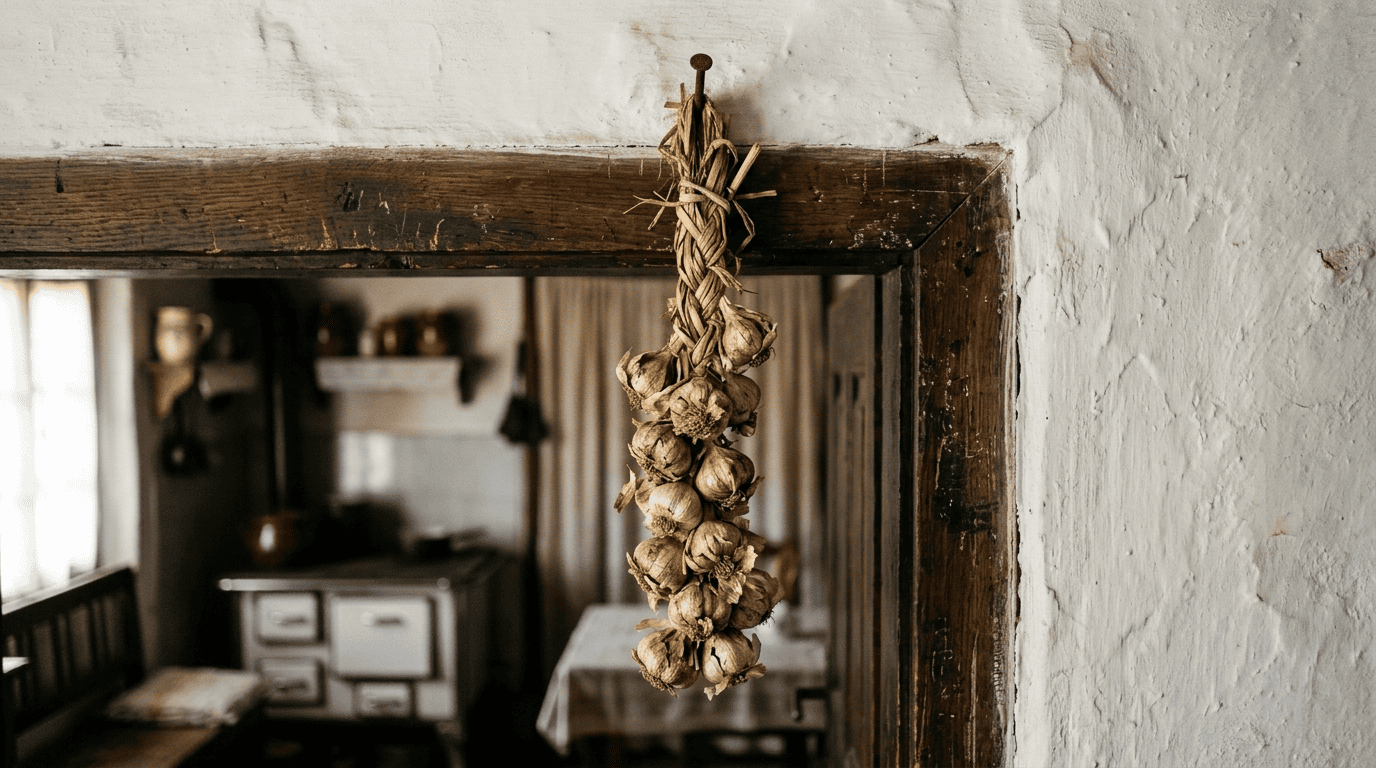
A braid of garlic hangs above my kitchen door, and it has been there long enough that I stopped seeing it.
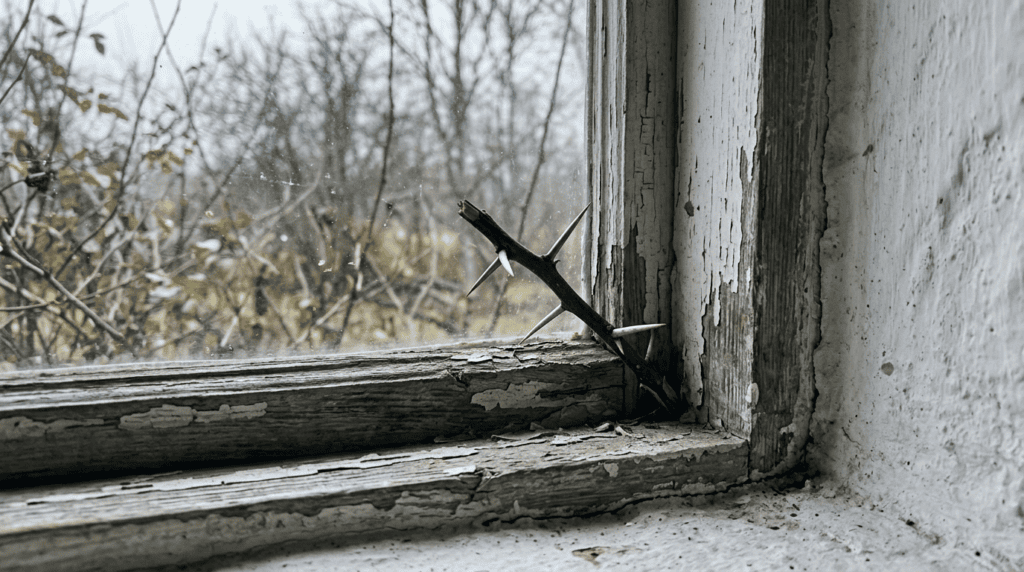
In my grandmother’s house it hung in the same spot, next to a sprig of thorn she pushed into the window frame every autumn. Neither one got treated as magic so much as upkeep, sitting there alongside the latch and the dog.
Everything below comes out of that world, meaning Serbian and wider Balkan practice as the old collections record it, read against what I keep at home.
I write from the tradition I was raised around rather than from a survey of every practice on earth, so these are the plants a Serbian household kept, at the doors it kept them on and the dates it kept them for.
Key Takeaways
- Garlic and hawthorn carry the heaviest protective reputation in the Serbian records, and both cost nothing.
- The plants chosen as guards share a pattern, since nearly all are thorned, sharp-smelling, bitter, red, or made of countable seed.
- Rue, basil and ivy belong to children, going into swaddling and cradles rather than onto the door.
- A large part of the tradition guards livestock rather than people, and most of it happens on one day of the year.
- Hanging a plant and drinking it are separate decisions, because several of these are toxic taken internally.
What Protective Herbs Are For
Definition: Protective herbs are plants placed at a door, in a cradle, on an animal, or on the body to guard against harm believed to come from outside the natural order, such as the evil eye, a cast spell, or the restless dead. The records describe them as barriers put up in advance rather than cures applied afterwards.
Everything here works ahead of the problem, and once something has already settled on a person or a house you have moved into removal work instead. I cover that ground in my guides to psychic attack and entity attachment.
None of this replaces a doctor, and folk tradition put rue in a baby’s swaddling while also losing plenty of babies. Take the plants as culture and as something to handle, rather than as treatment for anything a physician should be looking at.
Why These Particular Plants
Read enough of the old entries and the choices stop looking random, since the plants that became guards are rarely the pleasant ones.
The grouping below is my own reading rather than something the sources state outright, though the pattern is hard to miss once you have seen it a few hundred times.
| Quality | Plants | The thinking behind it |
| Thorned | Hawthorn, blackthorn, bramble | A barrier that stops an animal was taken to stop worse |
| Sharp-smelling | Garlic, onion, rue, incense | A smell that drives people back drives back what you cannot see |
| Bitter | Rue, wormwood | What the mouth rejects, the spirit rejects |
| Red | Madder, red pepper | Red carried protective weight on its own, and red plants picked it up |
| Countable | Poppy, flax, millet | A demon was believed unable to leave a seed uncounted |
That last row is the one I find most interesting, because it describes a trap rather than a wall.
Čajkanović records the formula spoken while scattering flaxseed around a sheepfold, and it runs roughly that once you have counted all of this, then you may harm my livestock.
Poppy did the same job around a stable, and a person chased by witches was told to scatter poppy or millet behind them as they ran.
Protective Herbs for the House and Doorway
Doors carry the most weight in this tradition, and if you only do one thing in a house, you do the door.
Garlic
Čajkanović calls garlic the most universal protective plant there is, noting the belief that no unclean force will come near it.
A braid hung above the doorway year round, went into the midsummer wreath, and during the unbaptised days between Christmas and Epiphany people carried cloves at the belt rather than leaving the house without them.
One detail from Karadžić tells you how far this went. The strongest amulet of all was a clove of garlic that had grown up through the skull of a killed snake. That kind of specification only appears where a belief is taken seriously.
My own use is duller than any of that, since the braid goes up, it dries out over a year, and I replace it when it starts to crumble.
Hawthorn
Hawthorn does the heavier work here, and a twig of black hawthorn at the doors and windows was believed to stop a vampire from entering.
A branch stayed in the house for a night after a death, and anyone walking after dark carried a hawthorn staff and was said to have nothing to fear on the road.
What surprised me reading these entries was how far the practice ran past the stake-through-the-heart version everyone knows. Showing the thorn counted as enough to turn something back, and the plant appears in the records as a presence rather than as a weapon.
Blackthorn
Blackthorn runs on the same logic and was considered good to keep in the house at all times.
Near Trebinje, wedding guests pushed a piece of black thorn into their clothes on the wedding day so witches could not touch them, and a man carrying a blackthorn staff could go wherever he pleased.
Ivy
Ivy is the one most people miss, and Karadžić records that witches flee from it. Doors and windows were decorated with ivy on Christmas Eve, and in Herzegovina and the coastal region it was wound around the badnjak, the oak log burned that night.
Incense
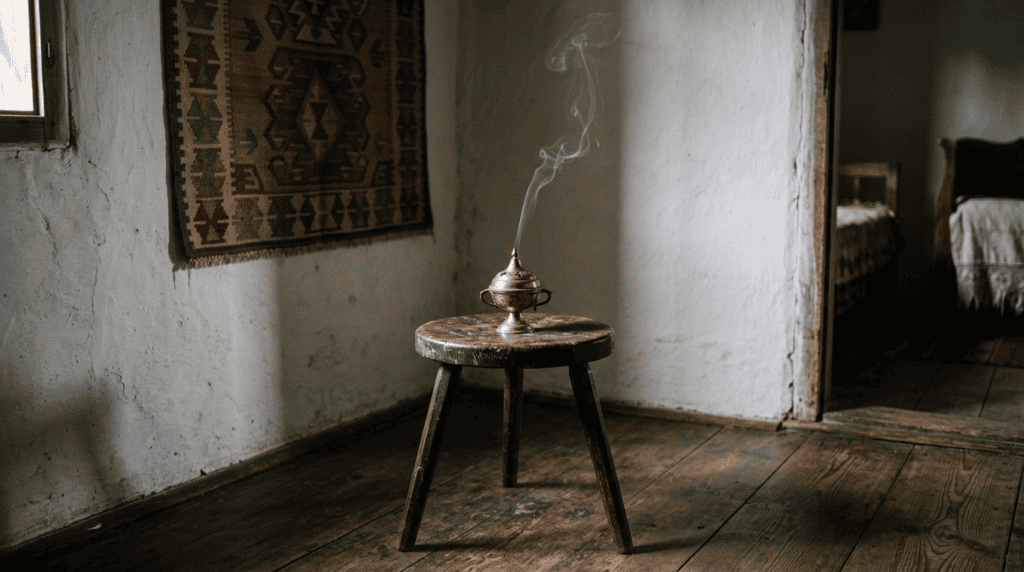
Incense covers what a twig at the door cannot, since smoke fills a room instead of blocking a line.
On Epiphany, when witches were thought to be at their strongest, blessed incense went into all four corners of a room, and a room where small children slept was censed before bed so they would not wake frightened.
That habit sits close to the approach in my guide to cleansing a home.
Protective Herbs for a Child and a New Mother
Children and women in the forty days after birth carried the highest risk in folk belief, and they get the gentlest plants, and that tells you something about how the system was built.
Rue
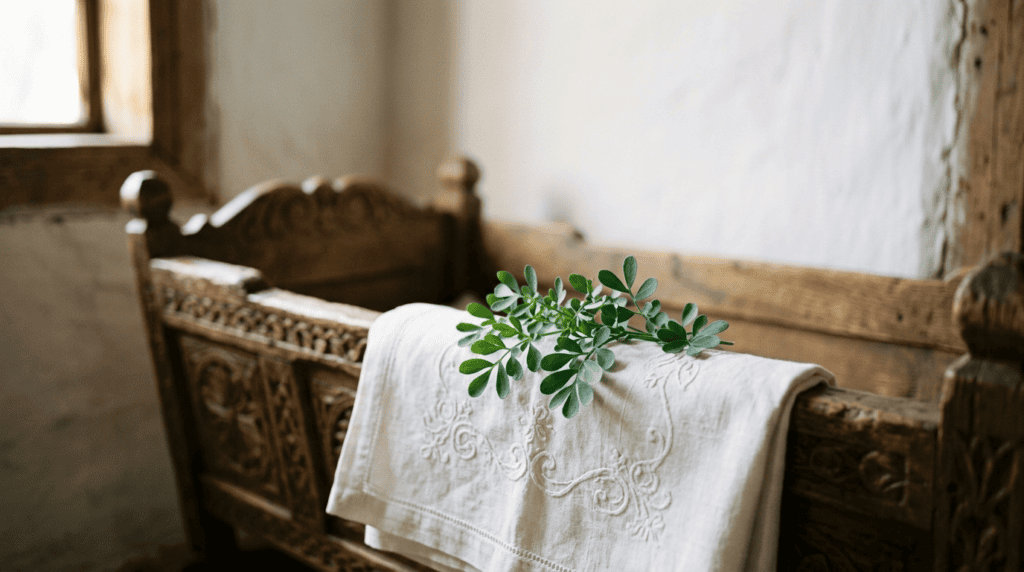
Rue went straight into a baby’s swaddling clothes, and Karadžić gives the reason in the villagers’ own words, that a witch will not come near that smell.
A child heading out of the house got a sprig so it would not be struck by the evil eye.
If a child was thought to be hit already, rue was cut crosswise into holy water and given to it, and on Christmas Eve church doors decorated with rue were believed to trap witches either inside or out.
Basil
Basil works at the pillow instead of the door.
A cross was drawn on a newborn’s forehead with soot from burnt basil, aimed at the babice, the demons believed to go after mothers and infants in the forty days after birth. Basil was also laid around a baby’s head so it would sleep.
In the Homolje collection, one of the fullest records of Serbian custom, basil comes up fifty-five times, more than any other object of any kind.
If you want a single plant that carries the whole household tradition, that is the one, and my guide to kitchen herbs covers its everyday side.
Ivy and Nettle
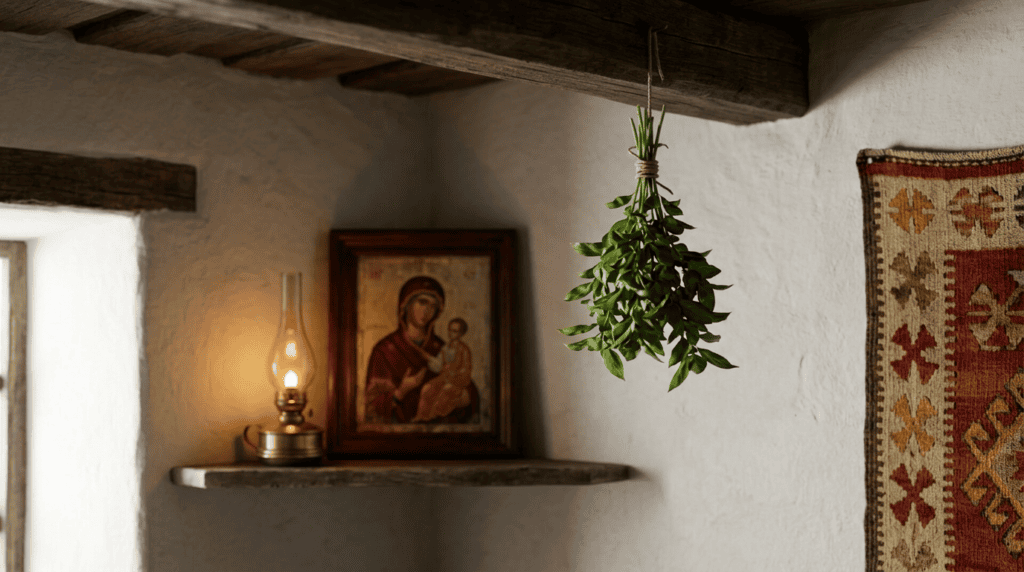
Ivy went into children’s cradles, particularly around St George’s Day, on the same reasoning that kept it at the door. Nettle was placed under a new mother’s pillow to guard her against the senka, a female demon that troubled women after childbirth.
Red Pepper
Karadžić describes a small assembly hung beside a woman who had just given birth, made up of a red pepper, a bulb of garlic and a ring.
It was put there so the child would be kept from the evil eye and so witches and other evil spirits would not approach.
Red pepper turns up alongside garlic often enough in these records that its protective role looks settled rather than incidental.
Protective Herbs for Livestock and Milk
A large part of this tradition has nothing to do with people, and it is the part that gets dropped from every modern retelling.
In a village where a cow was the household’s working capital, the fear that someone could take the milk was as practical as a fear of theft. Plants answering that fear make up some of the fullest entries in the whole record.
Most of it happens on one day, since St George’s Day, Đurđevdan on the sixth of May, is the hinge of the protective year, and Čajkanović’s entries return to it more than to any other date.
| Plant | What was done | Against what |
| Nettle | Udders rubbed with nettle at St George’s Day, and in some places on the first of March | Milk being taken by a činilica |
| Garlic | Udders smeared with garlic, a clove tied round a calf’s neck, garlic added to the seed scattered around the fold | The evil eye on the animal, and milk being taken |
| Flax | Flaxseed mixed with ash and scattered around the fold on St George’s Eve | Anyone coming for the milk, held off by the counting |
| Poppy | Scattered around the stable when a cow calved | Witches taking the milk before every seed was gathered |
| Gourd | A nail driven into a gourd, then dried in the hearth smoke | Forcing a witch to give back milk she had lifted |
The gourd deserves a closer look, because Karadžić records it as a remedy rather than a ward. Where the other entries keep trouble away, the gourd and the nail were held to compel a return, putting it closer to the coercive end of the tradition than anything else here.
Cattle were also driven between two candles at Christmas while scalded flaxseed was scattered, and at St George’s Day a milkmaid drove the cows between two bundles containing garlic. A garlic belt went round the milking pail itself on the same day.
Protective Herbs to Carry
What people carried was lighter and more portable, though it followed the same logic as the door.
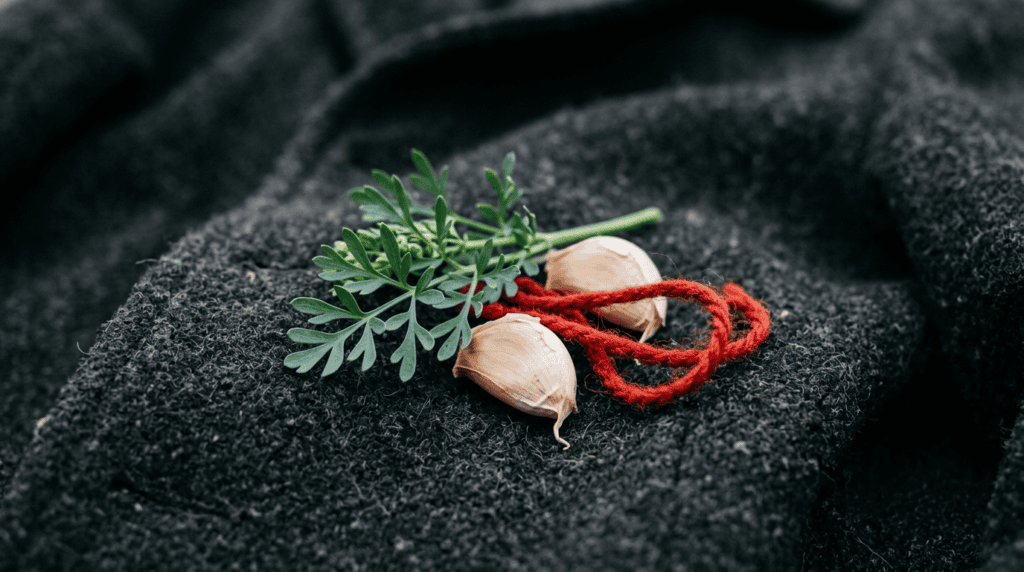
- Garlic at the belt on dangerous nights, and rubbed onto children against witches and, in the phrasing of the records, every evil breath.
- A blackthorn or hawthorn staff for walking after dark, treated as full cover rather than as a precaution.
- A sprig of rue worn on the person, and at the belt specifically on St George’s Day.
- Immortelle, the small yellow smilje, strewn along the path of a procession on the coast as a ward against witches.
- Basil and garlic together in eastern Serbia, where people would not leave the house without both while the conjurers were working.
If you want something permanent instead of assembling it each time, the same thinking sits behind my guide to making a protection amulet.
Herbs Used Against the Evil Eye
Urok has its own short list, and these are the plants that show up wherever it is the complaint.
Rue and basil do most of the work here, as above. Beyond them, the flower of clematis, called bela loza, was burned as a fumigant against the evil eye, against a child crying for no reason, and against strava, the fright sickness that follows a shock.
Madder belongs to this group through its colour, since the root gave the red dye used across the Slavic world and red carried protective force on its own.
A saying about vampires, that his road should hold madder and hawthorn thorns, puts the two strongest guards in the tradition into one line.
The Protective Calendar
Most of these plants were not hung whenever someone felt uneasy, and the records tie them to fixed dates. Knowing the calendar explains why a given plant appears in one entry and not another.
| Date | What was done |
| Christmas Eve | Ivy on doors and windows, ivy wound round the badnjak, rue on church doors |
| Christmas | Cattle driven between two candles with scalded flaxseed scattered |
| Between Christmas and Epiphany | Garlic carried at the belt through the unbaptised days |
| Epiphany | Blessed incense in all four corners of the room, when witches were held to be strongest |
| First of March | Nettle on the udders in some regions |
| St George’s Eve and Day, 6 May | Flaxseed and ash round the fold, nettle and garlic on udders, rue at the belt, ivy in cradles |
| Midsummer | Garlic plaited into the wreath hung over the doorway |
Reading these together, the year has two heavy points rather than a steady drip of protection. Midwinter guards the house, and St George’s Day guards the animals and the milk, in step with the farming year.
What the English-Language Tradition Adds
Three plants carry weight in English sources that they do not carry here, and it is worth naming the difference rather than blending the two.
Rosemary appears in Cunningham’s entry hung on doorposts against thieves and placed under the pillow against bad dreams, and it burns as one of the oldest cleansing smokes on record.
It grows well on the Dalmatian coast and turns up in wedding customs there, though inland it never took the central place hawthorn already held.
Rowan carries the folk name witchbane across northern Europe and serves as the standard witch-ward there. Its Serbian counterpart, oskoruša, appears in Čajkanović almost entirely as medicine for stomach complaints rather than as a guard.
That is a clean example of one plant doing different work a few hundred miles apart.
Mugwort is protective in the English books and is chiefly a dream and divination herb, placed in a pillow for vivid dreams. If you want it for that rather than for warding, it belongs with the tools in my guide to spell jars.
The Full List
| Plant | Serbian | Guards against | How it was used |
| Garlic | beli luk | Every unclean force, witches, the evil eye | Braid above the door, cloves at the belt, smeared on udders and children |
| Hawthorn | glog | Vampires, witches, disease demons | Twig at door and window, staff at night, stake at a grave |
| Blackthorn | crni trn | Witches, devils, evil spirits | Kept in the house, pushed into clothing, carried as a staff |
| Rue | ruta | Witches, the evil eye | In swaddling, given to children, at the belt, cut into holy water |
| Basil | bosiljak | Babice, night fear, illness | Soot cross on the forehead, laid at the pillow, held during charms |
| Ivy | bršljan | Witches | Doors and windows at Christmas Eve, in cradles at St George’s Day |
| Nettle | kopriva | Milk being taken, the senka | Rubbed on udders, under a new mother’s pillow |
| Incense | tamjan | Witches, babice, demons of darkness | Four corners of the room, burned before sleep |
| Flax | lan | Whoever would take the milk | Seed and ash scattered round the fold |
| Poppy | mak | Witches taking milk, pursuit | Scattered round the stable, thrown behind while fleeing |
| Red pepper | paprika | The evil eye on a newborn | Hung by the mother with garlic and a ring |
| Madder | broć | Vampires, the returning dead | Red dye, strewn on a path |
| Immortelle | smilje | Witches | Strewn along a path, worn in a bridal cap |
| Clematis | bela loza | Evil eye, crying, fright sickness | Flowers burned as a fumigant |
| Gourd | tikva | Used to force stolen milk back | Nail driven in, dried in hearth smoke |
| Rosemary | ruzmarin | Nightmares, theft | Smoke, doorpost, under the pillow |
How to Gather and Keep Them
Nearly everything in this article grows wild in the Balkans or sits in a kitchen already, and the records assume you are picking rather than buying. A few practical points carry across all of them.
Cut thorn in autumn or winter, once the wood has hardened and the leaves have dropped, because a green summer twig goes limp within days while a hardened one holds its thorns for a year or more. Hawthorn and blackthorn both grow in hedgerows and field margins, and a single short piece is enough for a window.
Pick leafy herbs before they flower, in the morning after the dew has dried, since that is when the oils sit strongest in the leaf. Rue, basil and rosemary all behave this way.
Dry them upside down in the dark, tied in small bunches and hung somewhere airy and out of direct light, and the whole process usually takes one to two weeks. A bunch dried in sunlight loses colour and scent together, and scent is the working part of most of these.
Wear gloves for rue and nettle. Rue can leave the skin sensitive to sunlight in some people, and nettle needs no explanation.
Store in paper or cloth rather than plastic, because trapped moisture turns a dried bunch mouldy, and replace anything hanging at a door once a year.
Where buying is easier, garlic braids, dried rosemary and basil are all ordinary market goods, though the thorn you will have to cut yourself.
What Not to Bring Indoors
One entry runs the other way and is worth knowing. Black hellebore, called glavobolka, was not to be carried into a house at all, since people believed it brought on headaches and stopped the hens laying while it stayed under the roof.
That prohibition matters because the tradition sorted plants in both directions, and a plant could be unwelcome rather than merely useless.
What Is Safe to Handle and What Is Not
Hanging a plant and swallowing it are two different decisions, and the line between them gets blurred constantly.
| Plant | Hang or carry | Take internally |
| Garlic | Yes | Yes, it is food |
| Basil | Yes | Yes, it is food |
| Rosemary | Yes | Yes in cooking amounts |
| Nettle | Handle with gloves | Cooked only, never raw |
| Hawthorn | Yes | It interacts with heart medication, so not without medical advice |
| Rue | Yes | No |
| Ivy | Yes | No, the berries are poisonous |
| Black hellebore | No | No, it is poisonous |
Standard herbals also list plants that can bring on a miscarriage, naming blue cohosh, ergot, golden seal, tansy oil and valerian, and separately list outright poisonous ones including aconite, bloodroot, greater celandine, foxglove and mistletoe berries.
None of those belongs in a cup whatever a correspondence table says about its protective value.
Most cases sort out on a single question about whether the plant ever went into a cooking pot in a village kitchen. If it did, it is food, and if it only ever hung on a door, it stays on the door.
How to Start
Working from the records rather than from a shop, the order below follows what the tradition itself weighted most heavily.
- Hang garlic above the main door, since that is the single most attested practice in the whole body of Serbian material, and replace the braid once a year when it dries out.
- Push a thorned hawthorn or blackthorn twig into a window frame, cut from a hedge in autumn when the thorns have hardened.
- Add basil at the bedside if there is a small child in the house, or ivy in the cradle if you would rather follow the older entries.
- Burn something once a season, incense or dried rosemary, working through the rooms rather than standing in one spot.
- Leave the rest alone until the first four feel ordinary, because the tradition was never a shopping list and a household usually kept two or three of these rather than sixteen.
When Herbs Are Not the Answer
A plant at the threshold does nothing about an ordinary human problem, and most of what people bring to protection work turns out to be that kind of problem.
Before you reach for hawthorn, rule out the month of bad sleep, the relationship going wrong, and the health issue nobody has looked at, because the folk tradition assumed you had already handled the obvious.
There is a fair objection to all of this, and I would rather raise it than let it sit.
Almost everything above is inherited rather than tested, and the same plant can mean opposite things a few hundred miles apart. The rowan that guards a Yorkshire doorway turns into a stomach remedy by the time you reach Šumadija.
If a plant’s meaning moves that far with the map, the meaning may belong to the culture rather than to the plant.
Half of that objection lands and I would not argue with it, although I keep the practice anyway, partly because separate traditions with no contact between them arrived at the same few plants for the same job.
Garlic and rue turn up as guards from Serbia to Britain to the eastern Mediterranean, which settles nothing on its own, though it is not the pattern you would expect if the choices were arbitrary.
Garlic and hawthorn, in that order, since both sit at the centre of the tradition and both cost nothing. Hang a garlic braid above the door and push a thorned hawthorn twig into the window frame, then add rue or basil once those feel settled.
Rue and basil are the main two, with rue given to children going outdoors and basil used at the pillow. Burning clematis flowers as a fumigant was also recorded against the evil eye, against a child crying without cause, and against fright sickness.
No, and the protective uses never called for drinking it. Rue belongs in swaddling, at the door, and cut into water for washing, so keep it external and use garlic or basil if you want something you can take internally.
At the entry points first, because that is where the tradition puts its weight. Doors, then windows, then the cradle if there is a small child, and only after that anything worn on the body.
