Most people who follow their horoscope for years run into the same quiet wall. It can describe their temperament and warn them about a rough week, but it never quite reaches the thing they keep circling back to, which is what any of it is actually for. If you have ever read an accurate description of your Sun sign and still felt like the real question went untouched, that gap is exactly where esoteric astrology lives.
I came to astrology through protection work rather than stargazing, and I was slow to trust the soul-centered version because a lot of it gets wrapped in language designed to sound deeper than it is. What changed my mind was doing what I do with any subject, working through the primary occult literature instead of the summaries, which is where the actual method turned out to be hiding. Esoteric astrology and a regular horoscope use the same wheel, the same twelve signs, and the same planets to answer two completely different questions.
What Esoteric Astrology Is
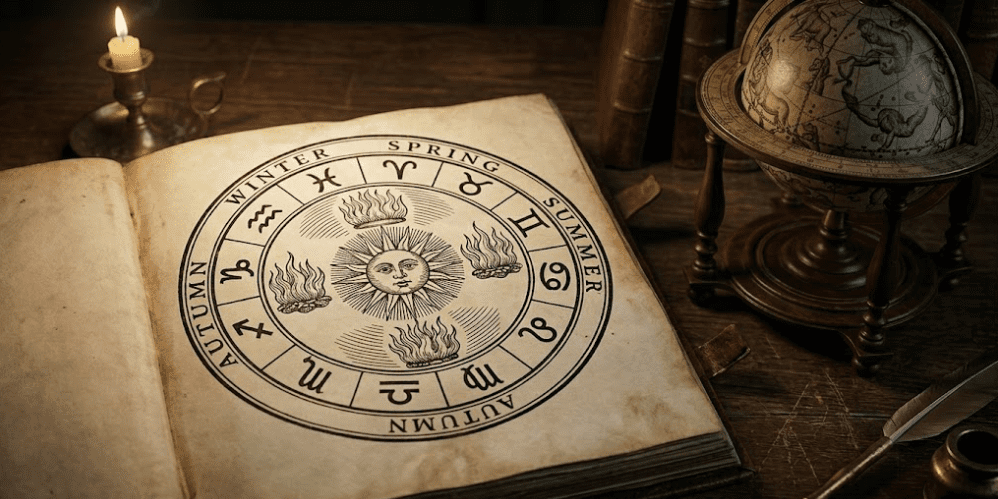
Esoteric astrology reads a birth chart from the point of view of the soul and its long development, rather than the personality and a single lifetime. Everything else in the system grows out of that one starting point.
Definition: Esoteric astrology is the reading of a horoscope as a record of the soul’s purpose and stage of growth, on the assumption that the soul reincarnates and that the chart shows the work it has taken on this time around. It is also called soul-centered astrology.
The split goes back to a simple idea in Alan Leo’s work: the Sun stands for the part of you that lasts, the soul or the deeper self, while the Moon stands for the temporary self that forms in one life and dissolves with the body. Leo called these the Individuality and the Personality. A regular reading mostly describes the personality, which is useful but small, and that smallness is what sends people looking for something else.
The emotional pull here is real and worth naming. People rarely arrive at this material because they want more horoscope content. They arrive because the personality reading stopped being enough and they wanted to know what their life was pointing at.
Esoteric Astrology vs a Regular Horoscope
A regular horoscope and esoteric astrology divide on almost every point in the chart, from which placement matters most down to what the reading is even for. A horoscope asks what will happen to you and what kind of person you are, while the soul-centered reading asks what you came here to become and what to do with whatever happens. That single split then cascades through the rest of the chart.
| Part of the chart | Regular horoscope | Esoteric astrology |
| Core question | What will happen to me? | What is this life for? |
| Most important point | Sun sign | Rising sign (the Ascendant) |
| The Sun | Your core identity | Your personality and its tools |
| The Moon | Emotions and instincts | The past and inherited limits |
| The planets | Fixed influences on events | Influences that fade as you grow |
| Sign rulers | One ruler per sign | Up to three rulers per sign |
| Time frame | This single life | Many lifetimes |
| Main use | Description and prediction | Growth, purpose, and service |
One idea sits under that whole table, and it is the part that surprises people most. In this tradition the planets really do steer the average person’s life, the way a current carries a swimmer who is not paying attention, and what changes as someone lives more consciously is the grip those placements have. The chart stays exactly the same while the person’s relationship to it shifts, so the same Mars that once just made you reactive becomes something you can aim.
There is also a wider field at work than the ten planets a horoscope uses. Esoteric astrology treats the chart as one small node in a web of forces that reaches out to the constellations and, in Bailey’s account, to sources as distant as the Great Bear, the Pleiades, and Sirius. You do not need to take the cosmology literally to use the practical part, but it explains why the system keeps insisting the chart is about relationship and not isolated fate.
This keeps resurfacing right now for a reason that is mostly about timing. The framing that astrology itself is shifting from a personality tool toward a soul tool is tied to the slow turn into the Age of Aquarius, and that idea is doing a lot of work in the current wave of interest.
How the Sun, Moon, and Rising Sign Change Roles
In esoteric astrology the rising sign holds the purpose of this lifetime, which is the single most useful thing to take from the whole system. The Sun and Moon stay in the chart but get demoted from where a horoscope puts them.
Read this way, the three points form a kind of timeline rather than a personality sketch:
- Rising sign (the Ascendant): the direction the soul intends for this life, what you are growing toward. This is where the chart points forward.
- The Sun: the personality and the equipment you have to work with, your raw material rather than your destination.
- The Moon: the past, including inherited conditioning and old habits, described in the older texts as the place where the soul sits in its “prison.” This is what you are meant to outgrow.
A horoscope leads with the Sun because the Sun describes who you are now. The soul reading leads with the Ascendant because it describes where you are headed, and those are not the same question.
In my own chart work the rising sign almost never behaves like a prediction and almost always makes sense in hindsight. People can usually trace the thread their Ascendant describes running through the choices that actually mattered, even though it told them nothing useful about next week. I hold that loosely, but it has been steady enough that I stopped opening a soul reading with the Sun a long time ago.
The Three Rulers of Each Sign
Each sign in esoteric astrology can have three planetary rulers instead of one: the familiar ruler for ordinary life, an esoteric ruler that comes online as the soul develops, and a hierarchical ruler that works at a cosmic level. A sign means different things depending on which level a person is living from.
The familiar ruler describes the sign at the surface, the way a horoscope uses it. The esoteric ruler points to the higher purpose hidden inside the everyday traits, and it tends to read true only once a person is genuinely reaching for that higher version.
The full ruler table
This is the standard soul-centered model, drawn from Bailey’s work, listing the ordinary ruler, the ruler for someone on the path, and the cosmic or hierarchical ruler.
| Sign | Ordinary ruler | Esoteric (soul) ruler | Hierarchical (cosmic) ruler |
| Aries | Mars | Mercury | Uranus |
| Taurus | Venus | Vulcan | Vulcan |
| Gemini | Mercury | Venus | Earth |
| Cancer | Moon | Neptune | Neptune |
| Leo | Sun | Sun | Sun |
| Virgo | Mercury | Moon | Jupiter |
| Libra | Venus | Uranus | Saturn |
| Scorpio | Mars | Mars | Mercury |
| Sagittarius | Jupiter | Earth | Mars |
| Capricorn | Saturn | Saturn | Venus |
| Aquarius | Uranus | Jupiter | Moon |
| Pisces | Jupiter | Pluto | Pluto |
A few patterns in that table tell you how the system thinks. Leo keeps the Sun on all three levels, which marks it as central to soul growth, while Scorpio and Capricorn keep their everyday ruler at the soul level, which casts the ordinary struggle of those signs as the spiritual work itself.
The hidden-planet problem
One entry in that table should make a careful reader stop, and it is Vulcan, the esoteric ruler of Taurus. Vulcan is not a planet that exists. Nineteenth-century astronomers proposed it to explain wobbles in Mercury’s orbit, the searches turned up nothing, and Einstein’s relativity later accounted for those wobbles without it.
Esoteric astrology kept Vulcan anyway and treats it as a real but hidden body, which is a genuine fork in the road where you either accept the metaphysics or you do not. In actual practice it is a headache, because you cannot calculate a clean position for a planet astronomers abandoned, and the people who use it work from approximations near the Sun. I would rather say that plainly than smooth it over, since pretending the awkward parts are settled is how trust gets lost later.
The esoteric ruler also does not switch on for everyone. For someone clearly wrestling with the higher version of their sign it reads true and useful, and for someone living comfortably at the surface it describes a setting that simply is not active yet, which produces a flattering reading that falls apart on contact.
The Seven Rays
The Seven Rays are seven basic energies that, in this system, lie behind everything in existence, and an esoteric reading tries to work out which ray a soul is built on. Each planet and sign channels one or more of them, so the rays sit underneath the rulers as a second layer of meaning, and the whole system is sometimes called Seven Ray astrology because of them.
The seven, with the quality each carries:
- Ray 1, Will or Power: drive, leadership, the energy that breaks down what is finished.
- Ray 2, Love-Wisdom: understanding, teaching, the pull toward unity.
- Ray 3, Active Intelligence: strategy, adaptability, working through complexity.
- Ray 4, Harmony through Conflict: art, tension and resolution, growth by struggle.
- Ray 5, Concrete Knowledge: science, analysis, precise understanding of how things work.
- Ray 6, Devotion: idealism, faith, intense commitment to a cause.
- Ray 7, Ceremonial Order: ritual, structure, bringing spirit into form.
The rays predate this tradition and reach back into Hindu thought, which is one of several places the Western and Eastern lines of the subject quietly meet. Most people working with a chart for the first time can leave the rays alone, since pinning down a soul ray is advanced work that depends on far more than the Sun sign.
The Crosses and the Reversal of the Wheel
The twelve signs sort into three “crosses” of four signs each, and each cross describes a stage of the soul’s journey rather than a personality type. This is how the tradition maps where someone sits on the long road, from ordinary life to spiritual maturity.
- The Mutable Cross (Gemini, Virgo, Sagittarius, Pisces): ordinary life and repeated incarnation, learning through change and mass experience.
- The Fixed Cross (Taurus, Leo, Scorpio, Aquarius): the cross of the disciple, where the real inner struggle and transformation happen.
- The Cardinal Cross (Aries, Cancer, Libra, Capricorn): the level of initiation, the soul’s largest purpose and its widest service.
There is a memorable detail attached to two of those signs. In Bailey’s account every soul takes its first human incarnation in Cancer, called the doorway into life for those who must know death, while Capricorn is the doorway for those who have moved beyond it. The same Cancer-Capricorn axis runs through the Rosicrucian material as the gates of birth and death.
The wheel reversal is the part that genuinely confuses people, and some of the confusion lives in the source itself. An ordinary person is said to travel around the zodiac in one direction across many lives, while a person on the spiritual path turns and travels it in reverse, ending in Pisces as a kind of world server.
Where it gets tangled is the direction itself, since the texts contradict each other on which way is which and at one point even admit the wheel turns every way at once. What survives all of that is simple enough: the direction flips when a person stops being pushed by circumstance and starts moving on purpose.
The Eastern and Rosicrucian Roots
Esoteric astrology is not one tradition with one author. It runs through at least three streams that grew up separately and landed on the same idea, that the chart belongs to the soul, and two of those streams sit outside the popular Western version most people meet first.
The Vedic stream: karma and the nakshatras
In the Hindu approach, set out for English readers by Bepin Behari, the chart is read through karma and reincarnation, and astrology itself counts as a Vedanga, a limb of the Vedas and part of sacred study. The starting question is the one that bothers anyone honest about the subject: why is one person born into ease and another into suffering, and why do decent people sometimes struggle while cruel ones prosper.
The answer this stream gives is that the chart records the soul’s accumulated karma and the journey it has set for itself, so the point of reading it is insight into purpose rather than a forecast of money or status. Its signature tool is the nakshatras, the twenty-seven lunar mansions that divide the zodiac by the Moon’s path instead of the Sun’s, giving a much finer grid than the twelve signs. Behari’s standing rule is one I wish more of the field shared: test any conclusion against your own life rather than swallowing it on the authority of even the oldest scripture.
The Rosicrucian stream: the chart as a record of past lives
Max Heindel, writing with Augusta Foss Heindel from the Rosicrucian teaching, treats the horoscope plainly as a ledger of the soul’s past lives, a record of lessons carried over rather than a sentence of fate. The chart shows what you arrived with, including the debts and the unfinished work.
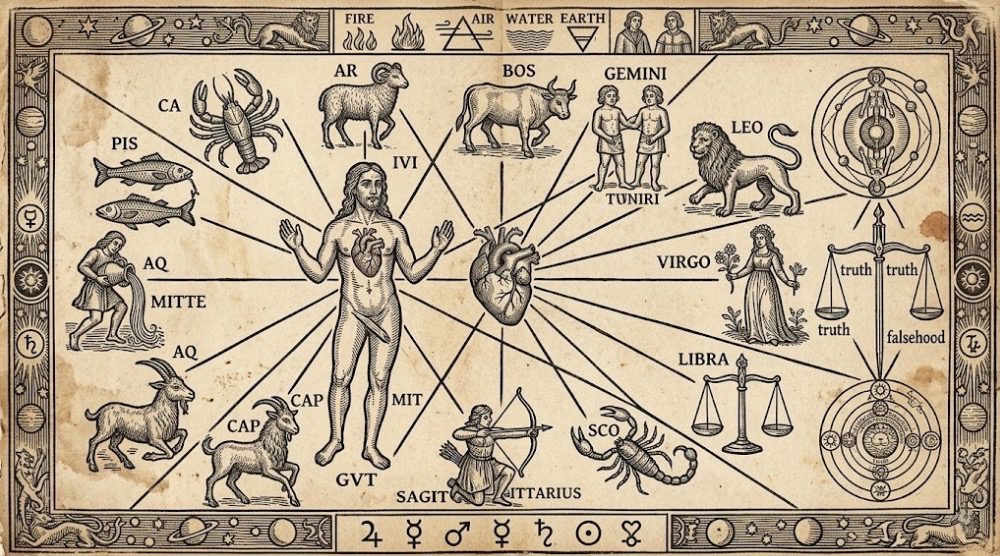
This stream also does something the popular version skips, which is read the chart for the body. Heindel’s medical astrology maps the signs onto parts of the body and uses the chart to spot where a person is constitutionally weak, on the principle that physical trouble often expresses a deeper pattern the soul is working through.
How the signs map to the body
The basic head-to-toe mapping that medical astrology uses runs down the body in zodiac order:
- Aries rules the head and face.
- Taurus rules the throat and neck.
- Gemini rules the lungs, arms, and hands.
- Cancer rules the stomach and chest.
- Leo rules the heart and spine.
- Virgo rules the digestive system.
- Libra rules the kidneys and lower back.
- Scorpio rules the reproductive and eliminative organs.
- Sagittarius rules the hips and thighs.
- Capricorn rules the knees, bones, and skin.
- Aquarius rules the circulation and lower legs.
- Pisces rules the feet.
A planet under stress in a given sign was read, in this older system, as a signal of where the body might give trouble and where the underlying lesson sat. This is the oldest practical use of the chart, and it is the part of the tradition I have practiced least, so I pass it on as something to study rather than something I lean on daily.
How to Read Your Chart Esoterically
You can start a soul-centered reading with placements you already know, then add one new step. The aim is a picture of direction, not a forecast, so treat each piece as a question to test rather than a verdict to accept.
A workable order to go in:
- Take your rising sign as the soul’s intended direction for this life.
- Find that sign’s esoteric ruler in the table above.
- Look at where that ruler sits by sign and house, which shows where the higher purpose of your Ascendant is meant to express itself.
- Read your Sun as the personality and tools you have, and your Moon as the past you are working to outgrow.
- Much later, if you go deep, consider the ray your chart leans on.
If your rising sign is Aries, for example, the esoteric ruler is Mercury, so the sign and house of your Mercury show where that Aries drive is supposed to turn from raw force into clear thought and communication.
The honest way to use any of this is to ask whether the description of your direction rings true against the actual shape of your life. If you want certainty about events and timing, this is the wrong tool, and an ordinary horoscope will serve you better. If you want a frame for the long arc, the soul reading gives you one, and it tends to reward people who already sense there is a long arc to read.
What Esoteric Astrology Is Good For
Esoteric astrology is a tool for understanding direction and purpose, not for predicting events, and being clear about that line is what keeps it useful. By its own logic, the more consciously you live, the less the placements determine, which makes it weak as a forecasting engine on purpose.
It earns its place in a few specific situations:
- Making sense of the long arc of a life rather than the next few weeks.
- Reframing a recurring difficulty as the curriculum of the sign you are working through.
- Working with the rising sign when the Sun sign reading feels too thin.
- Sitting with a sense of purpose when that is the thing actually missing.
What it does not do is tell you when you will meet someone or whether to take the job, and trying to force those answers out of it is how people end up disappointed. It is also a poor first system, since the rising-sign and three-ruler logic only makes sense once you can already read a basic chart.
The metaphysics behind it, the rays and the hidden planets and the unseen hierarchies, is a framework I work with and hold loosely on the question of mechanism. Reading a chart as a story with a direction changes how people relate to their own difficulties, and that change holds up whether or not you take every piece of the cosmology literally.
FAQ
No single person founded it. Alan Leo wrote the first major English book on the subject before Alice Bailey developed the three-ruler soul model, and both drew on the Theosophical Society that Helena Blavatsky founded in 1875. Parallel versions grew in Hindu and Rosicrucian circles at around the same time.
Your exoteric ruler is the familiar planet that rules your sign at the personality level. Your esoteric ruler is a second planet that becomes active as you develop spiritually and points to the higher purpose inside the same sign. Aries, for instance, is ruled by Mars exoterically and Mercury esoterically.
Yes, the rising sign carries the soul’s purpose for this lifetime, while the Sun describes the personality and the Moon describes the past. This reverses the usual horoscope, where the Sun sign leads.
It works as a tool for understanding your soul’s direction, not for predicting events. By its own logic the placements lose their grip the more consciously you live, so anyone after reliable forecasts is better served by ordinary astrology. As a frame for the long arc of a life, many people find it genuinely useful.