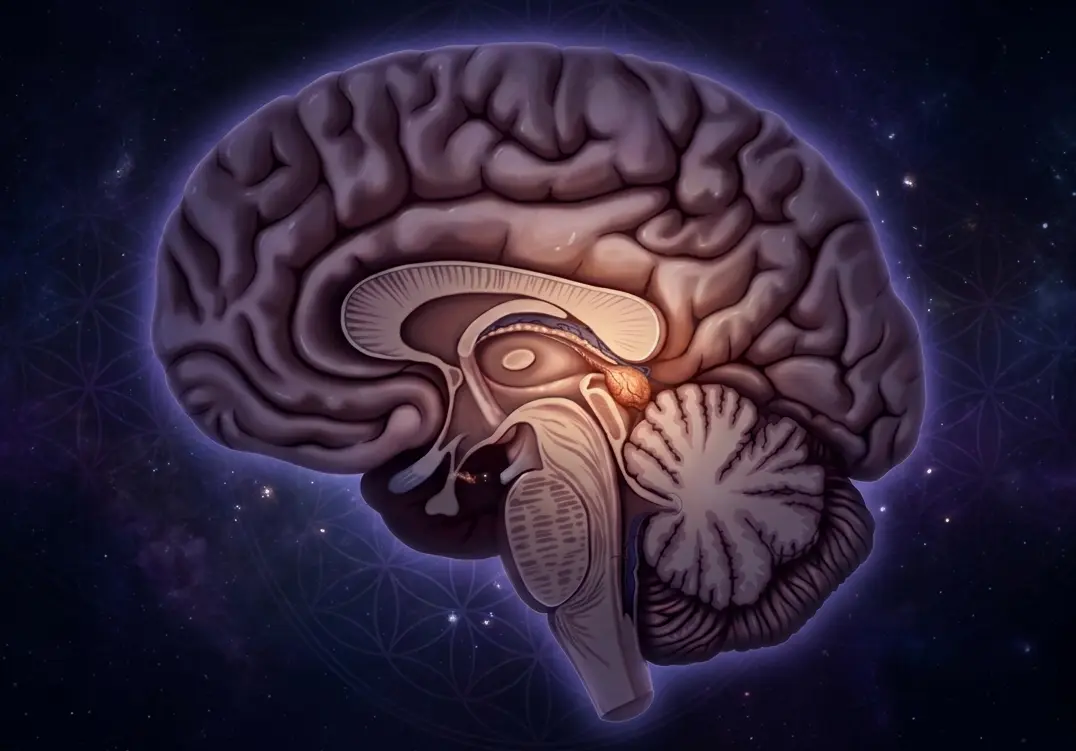
Deep in the center of your skull sits a gland the size of a grain of rice, and nearly every tradition that ever mapped the inner world marked that exact spot as a doorway. The Egyptians drew it as the eye of Horus. The yogis called it Ajna.
Descartes named it the seat of the soul. They were all pointing at the same place your two ordinary eyes cannot look, the place where inner vision is said to begin.
This guide is about what that place is, why it sits at the heart of real spiritual work, and how you actually open it. I have kept the tradition and the practice in the foreground, since that is where the value lives.
The short version is this – a developed third eye is the quiet engine underneath visualization, manifestation, lucid dreaming, and astral travel, and when you open that center, the rest of your practice deepens with it.
What Is the Pineal Gland?
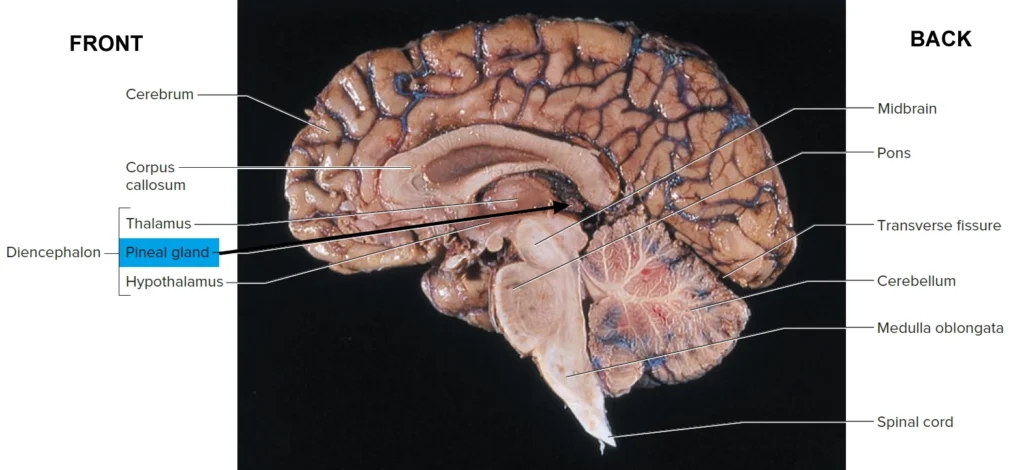
The pineal gland is a small endocrine gland at the center of the brain that produces melatonin and governs your rhythm of sleep and waking. It is shaped like a tiny pine cone, which gave it its name. The pineal gland produces DMT (dimethyltryptamine), a neurotransmitter and hormone that is believed to play a role in activating altered states of consciousness. This process is thought to occur during sleep, when we dream and the pineal gland is most active.
It rests deep between the two hemispheres, almost exactly at the center of the head. Its daily job is timekeeping, since melatonin rises in darkness and tells the body that night has come.
That role runs deeper than sleep. Melatonin is also a strong antioxidant, and its output rises and falls with the seasons the way daylight does. That is part of why the dark months can weigh on your mood.
The gland reads light through a chain that starts at your eyes. So even buried in bone, it stays tied to the sun and the turning of the day.
Definition: The pineal gland is a small endocrine gland at the center of the brain that produces melatonin, the hormone governing the sleep-wake cycle and the body’s daily and seasonal rhythms. In esoteric tradition it is regarded as the physical seat of the third eye.
One detail of its biology is the hinge the whole mystical tradition hangs on. The pineal holds cells descended from the same light-sensing lineage as the photoreceptors in your eyes, and responding to light is its central task.
An organ that sits at the center of the head and quietly answers to light was always going to draw the attention of people mapping inner vision. And it did, for thousands of years before anyone measured a hormone.
Why the Pineal Gland Is Called the Third Eye
The pineal gland became the third eye for three reasons that line up almost too neatly. It sits at the center of the brain, it carries light-sensitive cells, and it occupies the exact spot the Ajna chakra has marked for centuries.
Mystics located a center of inner vision behind the brow long before anatomy could say what lived there. The gland turned out to sit right where they had been pointing.
René Descartes gave the West its most quoted line when he named the gland the seat of the soul, the meeting point of body and spirit. He was chasing an intuition the old anatomists had already circled.
Herophilus described the gland as a regulator of the flow of thought, and Galen treated it as a gate the mind moved through. This obscure little organ pulled thinkers toward it for centuries before its melatonin work was understood.
The tantric tradition set the Ajna chakra at the same point and gave it the same office of inner sight. Ajna means command, and yogic teaching treats it as the eye that perceives what the physical two cannot. I hold the precise mechanism loosely, and yet the overlap between where the mystics pointed and where the gland actually sits is why this link has survived every age of doubt.
The Third Eye Across the Ancient World
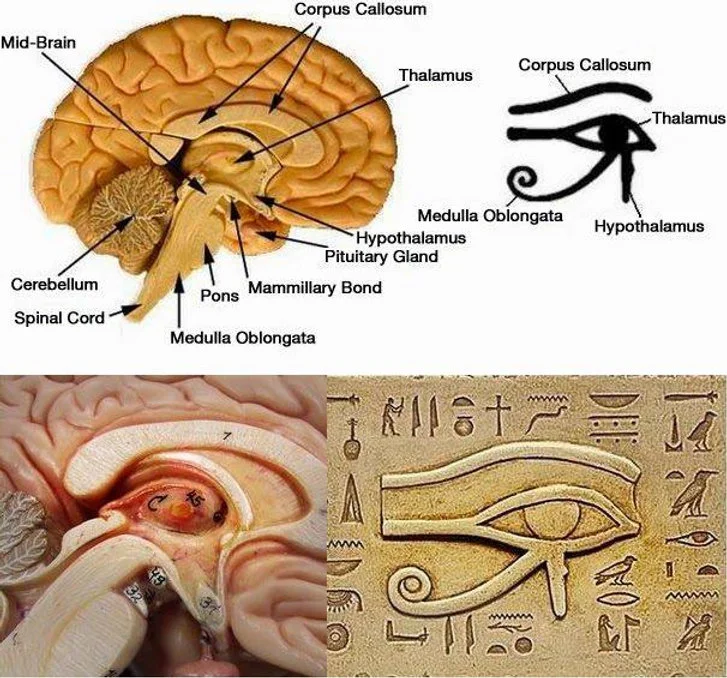
The third eye surfaces in nearly every tradition that mapped the inner life, always standing for a sight that reaches past the physical eyes. It runs from the eye of Horus in Egypt to Ajna in the tantric yogas. The symbol appears in cultures with no contact between them, which is one of the things that first pulled me into studying it seriously.
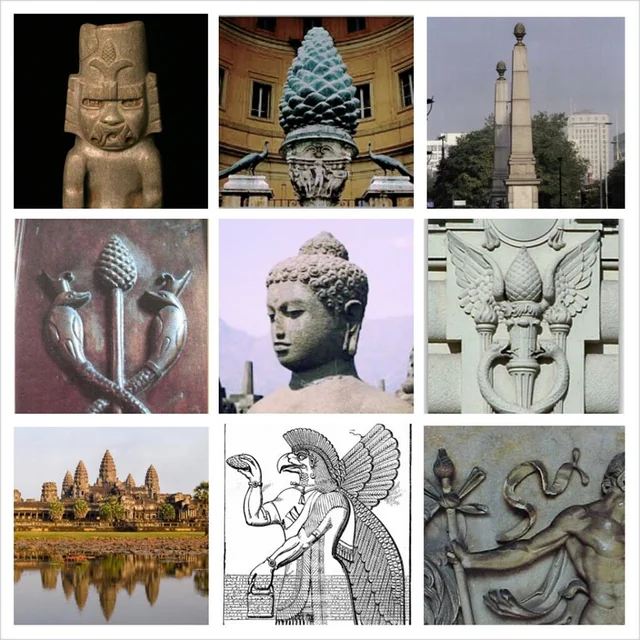
In Egypt the eye of Horus carried protection and inner vision, and its proportions map onto the midbrain where the gland sits. Hindu tradition names the third eye the gyananakash, the eye of knowledge, and marks the brow with a tilak or bindi to shield and focus that center. The pine cone recurs as its emblem across the ancient world, from the staff of the Egyptian god Osiris to the towering bronze pinecone that still stands in the Vatican courtyard.

Behind the symbol lies a physiology the old texts described in their own language. Tantric texts trace two energy channels, ida and pingala, spiraling up the spine and meeting at the brow along the central channel called sushumna.
The tradition holds that balancing those two awakens the eye between them. Whether you take the channels as literal currents or as a precise map of attention, the practices built on them are the ones that endured.
Why Your Third Eye Is the Center of All Spiritual Work
Here is the heart of it, and the reason this small gland deserves more than idle curiosity. In the esoteric model the third eye is not one ability sitting beside the others. It is the ground the others grow from, because it governs the faculty of inner seeing that every deeper practice draws on.
Once you understand that, the whole map of spiritual development reorganizes around this one center. The reason becomes obvious the moment you look at what each practice actually asks of you.
Visualization begins here
Start with visualization, since it runs underneath so much of the rest. The old teaching calls the brow center the seat of imagination, the place where you form and hold an inner image.
The strength of that image rises and falls with the strength of this center. A dull third eye gives you dim, flickering pictures that scatter the moment you reach for them.
An awakened one gives you images so stable and vivid they feel lived rather than imagined. Anyone who has tried to work with the mind’s eye knows that this clarity is the whole game.
Manifestation runs on it
Manifestation leans on that same faculty, which is why the two are so often tangled together. To assume a state as already real, you have to occupy an inner scene convincingly enough that some part of you believes it.
You feel the wish fulfilled until it becomes natural. That occupation is third-eye work whether or not anyone names it.
The clearer your inner sight, the more real the assumed state feels. This is the quiet reason the brow center is sometimes called the manifestation center, and my guide to how manifestation actually works leans on this faculty at every turn.
Dreaming and astral travel open from it
The dreaming and out-of-body practices live here too. Traditions across the world tie a developed third eye to a stronger connection with the dream body and the astral body. That is why lucid dreaming and astral projection are so often taught as third-eye skills in the first place.
The clearer your inner vision, the easier it becomes to stay awake inside a dream. It also helps you hold your awareness steady as it separates from the body. If you have read my guides to lucid dreaming and astral projection, this is the point quietly powering both of them.
Intuition sharpens through it
Beyond these specific skills, the esoteric map places intuition itself at the brow. Ajna is described as the home of the inner guru, the quiet guiding sense that reads a situation faster than reason can follow. This is the gift most practitioners actually receive.
An open third eye rarely arrives as a beam of psychic power. It arrives as a steadier, clearer knowing about what is true and what to do next. That quiet accuracy turns out to be worth more than any vision you could chase.
The Third Eye, the Crown, and Higher States
The third eye rarely works alone in the traditional map, since it sits just below the crown chakra and feeds directly into it. Ajna governs inner vision and insight, while the crown, called Sahasrara, governs union and the sense of something larger than the self. The old teaching treats them as a pair, where the third eye opens the sight and the crown opens the meaning of what is seen.
This is why serious third-eye work tends to shade into something wider over time. As the brow center clears, many practitioners report a quieter mind and a softening of the hard line between themselves and the world.
Some describe moments of a larger awareness that the old teaching calls higher states of consciousness. These are not the dramatic visions people expect, and they arrive instead as a steady deepening of presence.
You do not need to chase the crown directly, since it tends to open as a natural consequence rather than a separate project. Keep working the third eye with patience, hold your practice lightly, and let the higher states arrive in their own time. The tradition is clear that grasping at them pushes them away, while steady, grounded practice draws them near.
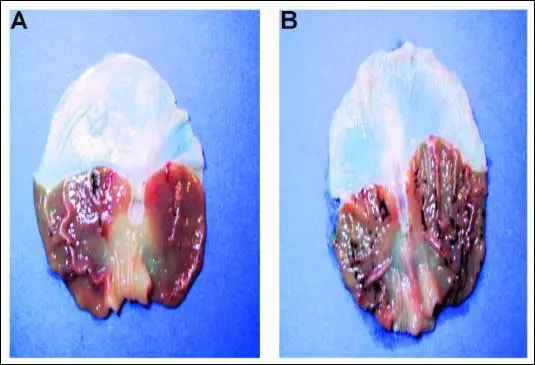
What Calcification Is, and Where the Evidence Stops
The pineal gland sits at the geometric center of the skull. Nearly every tradition that mapped the inner world treated that exact spot as a doorway.
When the doorway begins to cloud, both the old texts and the modern esoteric current speak of calcification. It is a slow hardening that dims the organ’s subtle receptivity, and it muffles the quiet signal the third eye is meant to carry.
In the living esoteric view this hardening is not random. It is understood as the gradual settling of dense material into a gland never meant to serve as a storage site. That material is fluoride from daily water and dental products, heavy metals, and the wider chemical load of modern life.
Because the pineal lies outside the blood-brain barrier, it gathers these substances more readily than most tissues. Over years the accumulation is felt as a progressive closing of inner sight. Melatonin falls, dreams lose their vividness, intuition grows quieter, and the sense of direct contact with something larger begins to thin.
That is the diagnosis the tradition offers, and the remedy is practical. First the intake is reduced, through filtered or spring water, fluoride-free toothpaste, and a general lightening of the toxic burden. Mineral-rich foods and traditional supports such as chaga, chlorella, shilajit, turmeric, and fulvic preparations are brought in to nourish and gently clear.
Darkness at night and morning light on the eyes restore the gland’s natural rhythm. These steps are ordinary care that keeps the doorway as open as present conditions allow.
The deeper work remains the work of attention. Classical methods such as brow-focus meditation, trataka, sustained darkness, balancing breath, and low toning train the awareness that actually inhabits the center.
When the physical load is lightened and attention returns steadily to the brow, the third eye begins to stir. You feel it as pressure, soft color, sharper knowing, and more lucid dreams.
The esoteric understanding is simple. Clear the vessel, then inhabit it, and the rest follows.
What Genuinely Supports the Gland
What does have support is plain and worth doing regardless of what you believe about the third eye. Caring for the gland means protecting your melatonin, and that comes down to a handful of habits. Real darkness at night, morning light in your eyes, steady sleep, and fewer screens after dark all strengthen the very rhythm the gland exists to keep.
Think of those habits as the healthy soil the practice grows in. They cost nothing, they help your sleep and mood on their own terms, and they set a clean foundation for the inner work that follows. None of the deeper practice depends on them, but all of it goes easier when the ground is well kept.
How to Support and Decalcify the Pineal Gland
The idea of decalcifying the pineal gland has become popular, and it helps to approach it with clear eyes. The habits below are the ones I keep.
I hold them as care for the gland and for my general health, rather than as a guaranteed way to dissolve calcium or force the third eye open. Kept steadily over time, they build a clean foundation that the spiritual practice later grows from.
Filter your water
The pineal gland takes up fluoride more than almost any tissue in the body, so many practitioners choose to limit how much they drink. I filter my water or drink spring water for that reason, and I treat it as a sensible way to reduce fluoride and other contaminants rather than as a cure for anything. A decent filter that reduces fluoride, alongside spring or structured water when you can get it, is the simple version of this step.
Municipal tap water is the main source most people think about, and note that anything made with municipal water carries whatever is in that water. In addition, municipal water has heavy metals, parasites, fluoride, chlorine, microplastics, forever chemicals, and who knows what else – so you should not be drinking it anyway, especially if you are on a spiritual journey. In addition, tap water is a “dead water”, and its structure is not the same as spring water.
Eat for a clean system
A diet built on clean, whole food supports your whole body, and the gland is no exception. I lean on mineral-rich foods and keep processed food low, since a well-mineralised system is better able to regulate calcium wherever it goes. Think of this as feeding the ground rather than targeting the gland directly.
Plenty of the foods traditionally associated with this practice are simply nutrient-dense whole foods, and eating that way is worth doing on its own terms. Keep it varied, keep it real, and let it be part of a general move toward cleaner living rather than a single magic fix.
Herbs and supplements
Many traditions and modern practitioners turn to certain plants when they work with this center. I use a short list myself as ordinary nourishment rather than as a proven way to dissolve calcium. Chaga, chlorella, spirulina, turmeric, tamarind, schisandra, milk thistle, and moringa appear often in these circles, and I take them in modest amounts as part of a broader mineral and antioxidant approach.
Shilajit and fulvic-acid preparations are also common, and I include them on the same basis, as traditional mineral supports, not as a guaranteed reverse of calcification.
Iodine shows up in some protocols, but because dosing can affect the thyroid I stay conservative with it. In addition, activated charcoal is sometimes suggested for binding.
I use it only occasionally and short-term because it can also bind nutrients. However, none of these replace the attention practices that follow.
Reduce your exposure
Alongside what you take in, it helps to lower what you are exposed to. Switching to a fluoride-free toothpaste is the change most people make first, since toothpaste is a daily and direct source. From there you can look at the other routine sources of fluoride and heavy metals in your environment and trim the ones that are easy to trim.
None of this needs to become a source of stress, and the goal is a gentle reduction rather than a purge. Your age, your genetics, your mineral levels, and your exposure to fluoride and heavy metals all play a part in the state of the gland. The exposure side is simply the part you can most easily influence day to day.
Sunlight and daily habits
This is the part with the clearest support, and I treat it as the heart of caring for the gland. Getting natural light into your eyes in the morning anchors the rhythm the pineal keeps, and darkness at night lets it produce melatonin cleanly. The two together keep the whole system strong.
Gentle sun gazing in the soft light of early morning or late evening is a traditional practice built on this. You do it carefully, and never with the harsh midday sun.
The daily habits around this are plain and they matter. Steady sleep, real darkness at night, fewer screens after dark, and daily meditation all support the gland and the practice at once. These cost nothing, they help your whole life, and they set the ground for everything in the next section.
How to Open the Third Eye
The tradition opens the third eye through trained attention, not through anything you consume, and its core methods have barely changed in centuries because they work. What follows is a real sequence rather than a scattered list of tips.
First you set the ground with a few prerequisites, then you learn the foundational practice. From there you layer in the classical techniques, and finally you fold it all into a daily rhythm you can actually keep.
Set the ground first
A few things need to be in place before the practice will take, and skipping them is why many people feel nothing and give up. You need consistency more than intensity, since this center answers to daily contact rather than to occasional marathon sessions.
A quiet ten minutes every day beats an hour once a week. You need a settled body and a reasonably quiet mind, which is why the breathwork below comes before the meditation rather than after it.
You also need patience with the timeline. The third eye opens gradually, the first signs are subtle, and the practitioners who get somewhere are the ones who keep showing up without demanding proof each morning. Protect your sleep and your morning light around the practice, keep your feet in ordinary life, and treat the whole thing as something you cultivate rather than something you force.
Begin with brow focus meditation
The oldest method is also the simplest, and it is where everyone should begin. You rest your attention on the point between and just above the eyebrows, and you hold it there while the rest of the mind settles around it. Sit with a straight spine, close your eyes, and turn your inner gaze gently upward toward the brow, keeping the physical eyes soft and unstrained.
Picture a soft indigo light at that point, and let it pulse quietly with your breath. It brightens a little on each inhale. Your attention will wander, and each time it does, you simply bring it back to the brow without frustration, because the returning is the exercise.
The first sign most people feel is a faint pressure or warmth gathering at that spot. For me it took a few weeks of daily sitting before that pressure became reliable rather than occasional.
Add trataka, the steady gaze
Trataka is the classical yogic practice of fixing the gaze on a single point until the eyes water, then closing them to hold the glowing after-image at the brow. You sit an arm’s length from a candle in a darkened room.
Then you gaze at the flame without blinking for a minute or two, letting the eyes fill. Then you close them and watch the bright after-image float to the center of your forehead, holding it there for as long as it lasts.
The practice trains one-pointed attention, which is the real muscle beneath all third-eye work, and the after-image gives your inner sight something concrete to rest on. Keep the early sessions short while your eyes adjust, and stop at once if there is any real strain, since this is a practice of patience rather than endurance.
Work with darkness and morning light
Time in genuine darkness is one of the oldest ways practitioners worked this center, and it lines up neatly with the biology. The pineal answers to darkness by producing melatonin.
So even a few slow minutes in a fully dark room with your eyes closed is a gentle way to turn awareness inward and quiet the outer senses. Longer darkness retreats are a serious traditional method, but you can taste the effect in small doses at home.
The other half of the cycle matters just as much. Getting natural light into your eyes in the morning anchors the whole rhythm the gland keeps.
A strong contrast between bright days and dark nights is what keeps the system working cleanly. Treat darkness and morning light as two halves of one practice rather than as separate tips.
Layer in breath and sound
Breathwork and toning both stir the brow center, and both are safe to explore on your own. Alternate nostril breathing, where you gently close one nostril and then the other through slow, even rounds, is the classical way to balance the two channels that meet at the brow. A few minutes of it settles the mind noticeably before you meditate.
Chanting a low, steady Om is the sound version of the same idea. The aim is to feel the vibration in the front of the skull and gather that buzzing sensation at the brow.
A few subtler levers appear in the tantric material for those who want to go further. Resting the tongue lightly on the roof of the mouth, spinal breathing that draws attention up the spine, and gentle engagement of the pelvic floor all appear in the texts.
Each is a way to lift energy toward the head. Treat these as experiments rather than requirements, and let the plainer practices of brow focus and trataka carry the bulk of the work.
Build your daily practice
You do not need all of this at once, and trying to do everything is how people burn out and quit. A workable daily practice is a few rounds of alternate nostril breathing to settle, then ten minutes of brow focus meditation, with trataka added two or three evenings a week.
Protect your sleep and your morning light around it, and give the whole thing a couple of months of steady practice before you weigh the results. The brow center opens on its own schedule, and consistency is the one thing that reliably moves it.
Common Mistakes That Stall Your Progress
Most people who feel stuck are making one of a few predictable mistakes, and naming them saves you months of frustration. The first is forcing, since straining toward a sensation at the brow creates tension that blocks the very opening you want. You cultivate this center by relaxing into it, not by clenching your way there, so ease is the actual skill.
The second mistake is chasing novelty over consistency. People jump between techniques, trying a new method every few days because the last one did not deliver fireworks by the weekend.
They never give any single practice the weeks it needs to take root. Pick the simple core, brow focus and breath, and stay with it long enough for the ground to soften.
The third mistake is skipping the foundations while reaching for the advanced work. Poor sleep, no morning light, and a scattered mind undercut the practice before it starts, since the brow center opens most easily in a rested body and a settled mind. Handle the basics first, and the deeper practices begin to work far more readily.
The last mistake is measuring too often. Checking each morning for proof that something has shifted keeps you in the posture of someone still waiting, and that impatience is its own kind of noise. Do the practice, let it go, and let the changes gather quietly while you get on with your life.
What an Opening Third Eye Feels Like
People describe the third eye stirring in a handful of recognizable ways, and knowing them helps you read your own progress. The signs tend to arrive in a rough order, starting in the body and moving outward into perception and daily life. You can use them as a loose map of where you are.
The pressure is the most common first sign, a gentle sense of touch or warmth at the brow that arrives even when nothing is touching you. It often shows up within the first weeks of steady practice, sometimes as a subtle tingling and sometimes as a fuller sense of fullness at the forehead. Many people feel it during meditation before they feel it anywhere else.
Color usually comes next, since many people see grey, white, indigo, or violet shapes moving behind closed eyes before anything resolves into a clearer image. These are faint at first and easy to miss, and they tend to grow more defined and more stable as the practice deepens. Do not strain to see them, since the seeing sharpens on its own as the brow center clears.
The signs that matter most
The deeper changes tend to appear in daily life rather than in meditation. They arrive as a run of accurate hunches and dreams that stay vivid after waking. You feel a stronger pull toward stillness, and a sense of reading a room more quickly than you used to.
This quiet growth in intuition is the sign that matters most, since it shows the third eye working in the ordinary world rather than only on the cushion. I hold the grandest claims loosely, the literal seeing of other worlds and the rest, since that sits outside what I have tested. The quieter shifts are the ones that prove real and reliable.
One last thing is worth saying, because an opening third eye can make the inner world louder. The tradition has always paired this practice with grounding.
So keep your feet in ordinary life, stay a little skeptical of your own visions, and let it open at its own pace. A steady, grounded practitioner gets far more from this work than an anxious one chasing fireworks.
FAQ
The pineal gland is the physical organ that tradition links to the third eye, or Ajna chakra, though the two are not identical. The gland makes melatonin and responds to light, while the third eye is the esoteric center of inner vision that tradition treats the gland as the bodily seat of.
There is no fixed timeline, since it depends on how consistently you practice. Most people feel a first faint pressure at the brow within a few weeks of daily meditation. The deeper gains in intuition and inner vision build over months of steady work.
Yes, and the two are closely linked. The brow center governs the inner image you hold in the mind’s eye, and manifestation depends on occupying an inner scene convincingly. A clearer third eye tends to make that felt sense of the wish fulfilled far stronger.
Begin with brow focus meditation for ten minutes a day, with a few rounds of alternate nostril breathing beforehand to settle. Keep it consistent, protect your sleep and morning light, and give it a couple of months before judging the results.
The most common early sign is a soft pressure or warmth between the eyebrows. Many also see indigo or violet shapes behind closed eyes, notice sharper intuition, and have more vivid dreams as the practice deepens over time.