You have a card in front of you and you do not know what it means, so you open a beginner guide, read a paragraph of keywords, and close the tab no clearer than you opened it, because the keyword list for the Five of Swords says “conflict, defeat, hollow victory, betrayal” and none of those words explain what any of it has to do with your current situation.
The failure belongs to the instruction method rather than to you, because the keyword approach treats 78 cards as 78 separate facts to memorize, which is both unnecessary and misleading about how the system actually operates. The deck was built with internal logic, and understanding that logic is what separates reading cards mechanically from reading them as a coherent language.
Why the Deck Has a Logic, and Why That Changes Everything
The entire deck reduces to four elements, ten numbers, and twenty-two archetypes, three building blocks you can hold in your head before looking at a single card, and that alone changes what learning this system requires.
The 78 cards divide into two groups that function differently:
- The Major Arcana is 22 cards numbered 0 through 21, dealing with large-scale archetypal forces and the deeper currents that shape significant periods of a life.
- The Minor Arcana is 56 cards organized into four suits of fourteen cards each, dealing with the texture of daily experience.
Once you understand the four elements governing the suits, you already have the domain of any Minor Arcana card before reading it. Once you understand the ten-number arc, you can derive the specific situation within that domain. Fourteen concepts get you most of the 56 Minor Arcana cards through derivation rather than memorization.
Joan Bunning describes this in Learning the Tarot as the difference between learning tarot as a list versus learning it as a system, and the distinction matters because memorized lists dissolve under the pressure of an actual reading in a way that derived understanding does not.
How Tarot Actually Works: The Psychological Mechanism
The core mechanism behind every tarot reading is projection. When you look at an ambiguous image, you project meaning onto it from your current psychological state, your concerns, and your unacknowledged fears and desires, which means the story you choose to tell about any given card reveals something about what is active in your inner life right now.
Bunning makes this explicit in Learning the Tarot: of all the possible stories you could tell about any card image, you choose a particular one, and that choice is informative. The tarot cards are specifically designed to be rich enough in symbol and ambiguous enough in narrative to allow this projection to operate freely.
Psychologists recognize this same principle through the Rorschach inkblot test, which trained clinicians use precisely because ambiguous images elicit projective content that direct questions would never surface. Tarot cards work as a more structured and symbolically organized version of the same basic tool.
Synchronicity and Why Some Readings Feel Eerily Accurate
The second mechanism, accounting for readings that seem to describe a situation with more specificity than simple projection explains, is what Carl Jung called synchronicity: meaningful coincidence, where the outer event (the card that appears) and the inner state (what is actually happening in your life) correspond without causal connection. Anthony Louis cites Jung’s own description of divination systems as a “picture of the moment” in Tarot Plain and Simple, capturing something true about the quality of the time in which a reading takes place.
Whether synchronicity describes a real phenomenon or simply patterns we notice because we are primed to notice them is a question I have genuinely stopped trying to settle. What I am certain of is that readings done with genuine attention tend to produce more than what the keyword lists predict, and the projection mechanism alone accounts for most of that.
What Intuition Actually Means in a Reading Context
Mary Greer’s Tarot for Your Self offers the most practically useful framing of the intuition question. Greer writes that intuition is pattern recognition from accumulated experience, operating faster than conscious analysis, which means the experienced reader who seems to “just know” what a card means in a given context is drawing on years of observing which meanings land in which situations.
For a beginner, this matters because intuition develops through practice rather than arriving as a prerequisite for starting. You practice, you notice what resonates and what does not, and Tarot for Your Self remains the most useful single book for understanding how to accelerate that process deliberately.
A Brief History Worth Knowing
The tarot deck as most people encounter it descends from two distinct historical moments separated by roughly three hundred years, and knowing which moment produced which layer of the system saves a lot of confusion about why the cards carry the meanings they do.
The first is fifteenth-century northern Italy, where a card game called tarocchi was played by wealthy patrons who commissioned elaborate illustrated decks. The Visconti-Sforza deck, created around 1450, is one of the earliest surviving examples, and for three centuries the cards remained a game rather than a divinatory tool.
The second moment is eighteenth-century France, when a printseller named Jean-Baptiste Alliette, who sold under the name Etteilla, created the first tarot deck specifically designed for fortune-telling and published the first professional guide to reading it. Antoine Court de Gébelin’s claim around the same time that tarot preserved the secret knowledge of ancient Egypt was historically false but enormously influential, drawing serious occultists to the cards and eventually producing their integration with Kabbalah, Hermetic philosophy, and astrology through the Hermetic Order of the Golden Dawn in the late nineteenth century.
The 1909 Deck That Changed Everything
The most practically relevant moment for anyone learning tarot today is 1909, when Arthur Edward Waite commissioned the artist Pamela Colman Smith to paint a new deck. Smith’s decision to illustrate all 78 cards with full pictorial scenes, including the numbered Minor Arcana which in older decks showed only geometric arrangements of suit symbols, created the visual language that every subsequent tarot deck has been in dialogue with ever since.
Smith’s contribution is routinely underacknowledged, and I find that genuinely irritating. Waite provided the esoteric framework, but the images that have shaped how millions of people think about these cards came entirely from her, and the Rider-Waite-Smith deck remains the recommended starting point for new readers not because of tradition but because its Minor Arcana imagery gives you something to engage with before you know the official meanings.
The Major Arcana: Archetypes and the Fool’s Journey
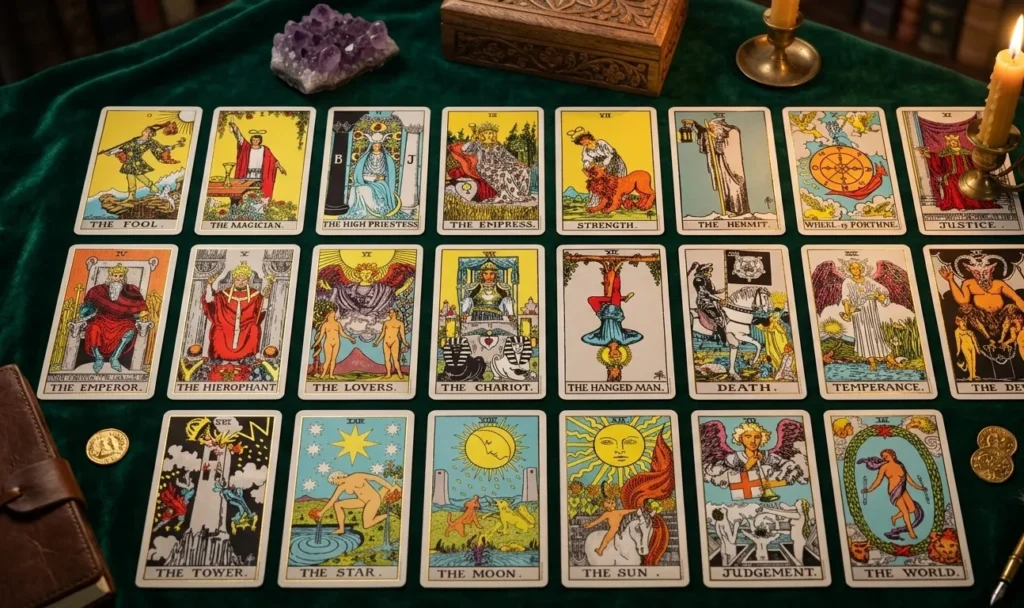
The 22 Major Arcana cards form a complete map of significant human experience, organized as a journey with a protagonist: the Fool, card zero, who stands at the edge of a cliff with a small pack and an expression of total openness.
The Fool represents undirected potential and the moment before anything has been determined. As he moves through the world, he encounters each of the remaining 21 figures in sequence, with each encounter changing him. By The World, card 21, the dancer moves freely within a wreath enclosing all four elemental symbols, and the Fool who began not knowing what he did not know has become whole.
This sequence is called the Fool’s Journey, and it matters because you can locate yourself within it at any given time. If you have recently encountered a Tower moment, the collapse of something built on a false foundation, you know that the Star follows the Tower in the sequence, not as a promise of what comes next, but as a structural fact about how human experience tends to move.
The Three Arcs of the Major Arcana
The 21 numbered Major Arcana cards divide into three arcs of seven cards each, and the arc structure describes the actual sequence by which significant experiences tend to develop rather than serving as a decorative organizational layer.
Arc One: Building the Self (Cards I–VII)
The Fool encounters the fundamental external structures and powers he will need to navigate for the rest of the journey:
- The Magician (I): The capacity to act and direct will
- The High Priestess (II): The inner world and hidden knowledge
- The Empress (III): Generative abundance and the natural world
- The Emperor (IV): Structure, authority, and order
- The Hierophant (V): Tradition and transmitted knowledge
- The Lovers (VI): Meaningful choice and the question of values
- The Chariot (VII): The mastery of opposing forces through directed will
By the end of the first arc, the Fool has encountered every major outer structure he will spend the rest of the journey working with.
Arc Two: Trials and Depth (Cards VIII–XIV)
The Fool turns inward and encounters himself, which is where easy mastery breaks down:
- Strength (VIII): Courage that comes from composure rather than force
- The Hermit (IX): Withdrawal into inner light and necessary solitude
- Wheel of Fortune (X): Cycles of fortune that operate beyond personal control
- Justice (XI): Consequences returning in proportion to what was put forward
- The Hanged Man (XII): The insight that comes from deliberate inversion
- Death (XIII): The transformation that requires a genuine ending
- Temperance (XIV): Integration of disrupted elements into new equilibrium
Most people recognize themselves somewhere in this arc when they look at it honestly, because it describes the experience of discovering that competence alone does not carry you through everything.
Arc Three: Confronting What Cannot Be Reasoned Around (Cards XV–XXI)
The Fool encounters what skill and understanding cannot resolve, and is changed by it:
- The Devil (XV): Chosen bondages and comfortable illusions
- The Tower (XVI): The collapse of what should not have been built
- The Star (XVII): Undefended hope after destruction
- The Moon (XVIII): The navigation of the unconscious and illusion
- The Sun (XIX): The clarity and joy of genuine success
- Judgement (XX): Awakening to a new understanding of self
- The World (XXI): Completion of the whole journey
The Fool who passes through this arc has become someone different rather than simply someone who knows more.
The three arcs follow a consistent logic: the first is about the outer world and the structures you encounter, the second is about encounters with yourself and your own limits, and the third is about what you become through the encounter with what you cannot control or resolve by skill alone.
Finding Your Place in the Sequence
Mary Greer’s Tarot for Your Self introduces what she calls the Year Card: a Major Arcana card calculated from your birth date, representing the archetypal energies in play during a given year of your life. The calculation involves adding the digits of your birth month, day, and the current year down to a single number between 1 and 21.
Reading the Year Card as a framework for what you might be working with during a particular period, rather than as a prediction of specific events, tends to produce genuinely useful reflection. Greer’s exercises around it are some of the most grounded material in any tarot book I have read.
The Minor Arcana: Four Elements and Ten Numbers
The 56 Minor Arcana cards follow a system that can be entirely derived once you know fourteen things: four suit-domains and ten number-patterns. You can walk into your first reading without memorizing 56 separate entries, because the meanings assemble from components you already carry.
The Four Suits and Their Domains
| Suit | Element | Domain | Core Question |
| Wands | Fire | Drive, passion, projects, career | What is being created or contested? |
| Cups | Water | Emotions, relationships, intuition | What is being felt or desired? |
| Swords | Air | Mind, conflict, communication | What is being thought, said, or fought over? |
| Pentacles | Earth | Money, body, work, material reality | What is being built, earned, or grounded? |
Once these four domains are internalized, you have the domain of every Minor Arcana card before looking at its number. The Ace of Wands is about beginnings in the domain of drive and creative energy. The Nine of Cups is about near-completion in the domain of emotion and relationship.
A note on Swords that most beginner guides soft-pedal: this is often the most uncomfortable suit because the mind creates as many problems as it solves, and the imagery in this suit reflects that honestly. A reading heavily weighted toward Swords is already telling you something before you examine a single card’s position.
The Ten-Number Arc
The numbered cards from Ace through Ten follow a consistent arc across all four suits, representing the natural progression of any endeavor, relationship, or experience from initiation through completion. The Five of any suit carries disruption and the Ace of any suit carries beginning, with the pattern holding steady regardless of which suit you are reading.
| Number | Pattern | Core Theme |
| Ace | Beginning | Pure potential, a new force entering |
| Two | Duality | Choice, balance, partnership |
| Three | Growth | Creation from duality, early expansion |
| Four | Stability | Foundation, rest, structure |
| Five | Disruption | Conflict, loss, midpoint crisis |
| Six | Harmony | Restoration, generosity, ease returning |
| Seven | Reflection | Inner challenge, discernment, integrity |
| Eight | Movement | Change, acceleration, breaking free |
| Nine | Intensity | Near-completion, culmination approaching |
| Ten | Completion | End of a cycle, fullness, conclusion |
Any numbered Minor Arcana card combines element-domain with number-pattern to give you its core territory before the image is even examined:
- Five of Cups: Water (emotion) + Five (disruption) = grief, something emotionally valuable that was lost
- Three of Pentacles: Earth (material world) + Three (creative growth) = skilled work coming together, early recognition of craft
- Eight of Wands: Fire (drive) + Eight (movement) = rapid acceleration after a period of stasis
When this derivation becomes automatic, the booklet rarely comes out for numbered cards, because you already have the territory and the image confirms the specifics.
Court Cards: The Part Most Beginners Get Stuck On
Court cards can represent three entirely different things in a reading, and the card itself gives you no signal about which one applies, which is the structural reason most beginners stall here rather than any obscurity in the cards themselves.
Each suit produces four court cards, and each rank represents a level of development within that suit’s element:
| Rank | Quality | Expression |
| Page | Beginning mastery | Curious, receptive, still learning |
| Knight | Active development | Moving, pursuing, sometimes extreme in the element |
| Queen | Internalized mastery | Embodied, integrated, does not need to demonstrate |
| King | Established authority | Leads, directs, has built systems in the world |
The framing that made court cards click for me was rank-as-development-level. The Page is at the beginning of their relationship with an element’s domain, the Knight is fully in motion within it, the Queen has integrated the element so deeply that it simply is how she operates, and the King has made something with it in the external world. Whether you are reading the card as a person in your life or as an aspect of yourself, that developmental hierarchy is the most reliable anchor.
Context usually determines which interpretation applies. A court card in a position about external circumstances tends to indicate a person in your life. A court card in a position about your inner state tends to indicate a quality you are expressing or need to develop. When neither is obvious, hold both possibilities and let the rest of the spread clarify as the reading develops.
Card Reversals: What They Mean and Whether to Use Them
A reversed card appears upside-down when drawn, and whether to read reversals at all is one of the first practical decisions you need to make as a beginner. Reasonable, experienced readers land in genuinely different places on this.
Three Approaches to Reversals
Reading Without Reversals
Many experienced readers assign all cards their upright meaning regardless of orientation and work this way permanently, arguing that the range of upright meanings is already wide enough to cover any situation and that reversals double the interpretive load without proportionally increasing clarity. For beginners, this is the most defensible starting position.
Reading Reversals as Blockage or Internalization
The most common approach for readers who do use reversals treats a reversed card as energy that is blocked, delayed, turned inward, or being resisted rather than freely expressed. The reversed Tower might indicate a crisis narrowly avoided rather than one that has already arrived. The reversed Ace of Cups might point to emotional potential that has found no outlet yet.
Reading Reversals as the Shadow of the Card
A reversed card points to the less constructive expression of the same energy as the upright meaning. A reversed Chariot, whose upright meaning involves directed will and mastery, might indicate control turned into rigidity, or drive that has tipped into recklessness.
For beginners, starting without reversals until the upright meanings feel genuinely familiar tends to produce better results than introducing them immediately. Reversals add a layer of nuance that functions well only once the base meaning is clear enough to distinguish from its shadow.
How to Ask a Question the Cards Can Actually Answer
Open-ended questions consistently produce better readings than closed, yes/no questions. A closed question like “Will I get the job?” gives the cards nowhere to go except confirmation or denial, whereas “What do I most need to understand about this application process?” opens the full range of the system to respond.
Question Formats That Work
Good questions usually take one of three forms:
- Situational awareness: “What do I most need to see about [situation]?” This is the most generally useful format and works well for the one-card pull.
- Action-oriented: “What is the most useful thing I can do in [situation] right now?” This produces actionable readings rather than purely descriptive ones.
- Perspective-shifting: “What am I not seeing about [situation]?” This surfaces the kind of information that a hidden-factors position in a spread is designed to provide.
Questions that assume a fixed outcome, “Is this person being dishonest with me?” for example, tend to produce readings that confirm whatever the querent already suspects, because the projection mechanism amplifies existing belief rather than challenging it. The more genuinely curious the question, the more genuinely useful the reading tends to be.
Reading the Spread as a Whole
A spread is a defined arrangement of cards where each position represents a specific aspect of the question: past influences, present situation, hidden factors, likely outcome, and so on. Reading a spread differs from reading its individual cards because the spread has a composition, and that composition carries meaning before any single card is examined.
Suit Dominance
Before reading any individual card in a spread, look at which suits are present and which are absent. A spread heavily weighted toward Swords tells you something about the mental and conflictual dimension of the situation before you know anything about specific positions. A reading with no Pentacles at all says something about the absence of material grounding in the question. Louis documents this in Tarot Plain and Simple from his daily five-card practice: on days when no Wands appeared, the absence of fire and creative drive in the spread was itself meaningful information.
Card Pairs and Repeated Numbers
Some pairs carry a permanent relationship established by the system’s logic. The Magician and the High Priestess are the conscious/unconscious polarity, so when both appear in a reading about a decision, the spread is already speaking about the tension between action and inner clarity before either card’s position is examined. The Tower and the Star always appear in that sequence in the Fool’s Journey, so their co-appearance in a spread carries meaning beyond what each would mean in isolation.
Two cards of the same number appearing together doubles and emphasizes the theme of that number across the reading, and a court card appearing near a numbered card of the same suit applies the court card’s qualities directly to that numbered card’s situation. Reading a spread as a composition rather than a list is the basic skill that separates someone who reads cards from someone who reads readings, and it starts here.
How to Read a Card: A Step-by-Step Process
Reading a card well follows a sequence, and the sequence matters because most beginners start at step four and skip the three steps that do the actual interpretive work.
Step 1: Read the Image First
Before reaching for any reference, look at what is depicted: who is there, what they are doing, what the scene communicates about mood, what objects appear, and what the image suggests before it means anything official. The Rider-Waite-Smith images were designed to be readable by someone with no training, which is exactly why Smith illustrated all 78 cards rather than leaving the Minor Arcana as geometric symbol arrangements.
Step 2: Apply the Two-Part Derivation
Ask what the suit’s domain is, and what the number’s pattern is. For Major Arcana, locate the card in the Fool’s Journey: which arc does it fall in, and what does the Fool encounter at this stage?
Step 3: Consider the Position
A card in a position labeled “past influences” reads differently from the same card in a position labeled “likely outcome,” because the position provides the question the card is answering. A challenging card in the “advice” position means something different from the same card in the “obstacle” position.
Step 4: Consider Surrounding Cards
Look at the suit composition of the spread and note whether anything appears together that carries a built-in relationship. Two cards of the same suit pulling in opposite numerical directions tell a story beyond what either card says on its own.
Step 5: Check the Reference Last
The booklet or keyword list confirms and sometimes deepens what you have already derived. Used first, it bypasses your own engagement with the image and the logic of the system, which is the only part of reading that actually develops with practice.
Worked example: the Five of Swords. The image shows a figure holding three swords, looking toward two others who walk away with heads down, two additional swords lying on the ground. Something has been won here, but the victor’s expression reads as self-satisfied rather than genuinely triumphant, and the people walking away look diminished. Apply the derivation: Swords (Air, mind, conflict) and Five (disruption, midpoint crisis). The traditional meaning confirms exactly this: pyrrhic victory, conflict pursued at a cost not worth paying, sometimes the choice to walk away from a fight that cannot be won cleanly. The reference deepened what the image and the system already established, which is the right order.
Four Spreads Worth Learning First
The one-card pull, the three-card spread, the five-card spread, and the Celtic Cross cover everything a beginner needs, in roughly that order of complexity and occasion.
The One-Card Pull
Drawing one card daily and sitting with it through the day is the most underused practice in tarot and the most reliable one for developing real fluency. Pull a card in the morning, note what it suggests about the day or the question you have in mind, and return to it in the evening with two sentences: what happened, and how the card related to it.
The relationship between the card and the day is usually not literal. The Five of Pentacles pulled on a day when nothing went wrong financially might speak to a feeling of being excluded or unsupported, which is the card’s emotional territory regardless of material circumstance. These less-literal connections are where pattern recognition develops, because they force you to hold the card’s actual domain rather than its most obvious surface application.
The Three-Card Spread
Three cards in three positions, with the positions defined before the cards are drawn. Common formats include past/present/future, situation/action/outcome, and what I know / what I do not see / what I need to consider.
Three cards create enough narrative to be genuinely informative without the complexity of ten positions competing for attention. The skill of reading three cards as a coherent story rather than three separate statements is the foundation for reading any larger spread, and for most daily questions, three cards is the right scale.
The Five-Card Spread
Five positions covering past influences, present situation, hidden factors, advice, and likely outcome. The hidden factors position is what distinguishes this spread from a simple three-card, asking what is operating in the situation that you have not consciously accounted for, and that position tends to surface the most surprising clarity in a reading. Louis used this spread daily for years during the period he was developing his own understanding of the cards, as documented in Tarot Plain and Simple.
The Celtic Cross
Ten cards in ten assigned positions covering context, crossing influence, foundation, recent past, possible outcome, near future, self-perception, external influences, hopes and fears, and most likely outcome. Waite himself recommended it as most suitable for obtaining an answer to a definite question.
The Celtic Cross works well for thorough analysis of a specific, complex situation. Its weakness for early readers is that ten positions with ten cards can produce a reading where nothing stands out because everything is equally weighted, which makes it harder to develop the skill of identifying what actually matters in a spread.
Building a Practice That Actually Teaches You
Sustained, regular contact with the cards over time is the only thing that produces genuine fluency, and two specific tools make that process deliberate rather than accidental.
The Tarot Journal
A tarot journal is a record of every significant reading: the cards drawn, their positions, your interpretation at the time, and the question you were exploring. You return to each entry when enough time has passed to see what actually happened, and the gap between interpretation and outcome is informative regardless of accuracy.
The gap shows you which assumptions you were making, what you were hoping for, what the cards were actually pointing toward, and what you consistently misread. These patterns, accumulated over months, become a personal layer on top of traditional meanings that Greer argues in Tarot for Your Self is as valid as anything in a published guidebook, because it comes from actual pattern recognition between the cards and your specific life experience.
What you are building is exactly what Greer identifies as genuine intuition: accumulated experience producing faster and less conscious pattern recognition. The tarot journal is the tool that makes that accumulation legible rather than invisible.
When the Same Card Keeps Appearing
A card that appears repeatedly across different readings points to something you have not yet engaged with or integrated. Rather than asking what the card means in the abstract, ask what would change in your current situation if the card’s message were completely accurate, and what action or shift that would require.
Bunning’s framing is useful here: the card is a consistent signal that something in its domain is active and unaddressed rather than a warning or a prophecy. Pulling the same question repeatedly hoping for a different answer is the most common form of confirmation bias in tarot practice, and the cards will typically give you the same answer rephrased until the situation actually changes.
Common Mistakes That Cost Beginners the Most
The mistakes that cost beginners the most tend to be structural rather than interpretive, meaning they come from how you approach the practice rather than which meanings you assign to individual cards.
Memorizing Before Reading
Memorized abstractions dissolve under the pressure of actual readings, because every reading presents something more specific than the keyword allows for. Understanding the elements, the numbers, and the Fool’s Journey gives you a framework for deriving meanings on the spot rather than retrieving them from a list.
Fearing Specific Cards
The Tower, Death, The Devil, and the Ten of Swords produce disproportionate anxiety in new readers, and most of that anxiety evaporates once you understand what these cards actually describe. Death represents necessary transformation, the ending that makes the next beginning possible. The Tower clears away structures built on false foundations, which is disruptive but never arbitrary. The Devil shows where you are maintained in bondage by your own choices, and the chains in the image are loose enough to remove. The Ten of Swords marks a painful conclusion and also, structurally, a floor from which the situation cannot deteriorate further.
Reading for Others Without Their Knowledge
Tarot reflects the querent’s field of awareness and current psychological state, so reading for another person without their participation means projecting your assumptions about their situation onto the cards. The result is a reading that is mostly about you rather than them.
Demanding Accuracy from Every Reading
Readings are engagements with a situation rather than verdicts on it. Some readings hit very close to the truth, others open a line of inquiry rather than providing clear answers, and both serve a genuine purpose. Relaxing the requirement for accuracy paradoxically tends to improve readings, because the pressure to be right interferes with honest engagement with what is actually present in the spread.
Using Tarot as the Sole Decision-Making Tool
The practice surfaces unconscious material, examines assumptions, and opens perspectives you have not considered. A useful reading is one that expands your thinking before a decision, not one that replaces the research, consultation with people who have relevant expertise, or your own judgment that the decision actually requires.
Quick Reference Tables
Suits and Their Elements
| Suit | Element | Domain | Core Question |
| Wands | Fire | Drive, passion, projects, career | What is being created or contested? |
| Cups | Water | Emotions, relationships, intuition | What is being felt or desired? |
| Swords | Air | Mind, conflict, communication | What is being thought, said, or fought over? |
| Pentacles | Earth | Money, body, work, material reality | What is being built, earned, or grounded? |
Number Patterns
| Number | Pattern | Core Theme |
| Ace | Beginning | Pure potential, a new force entering |
| Two | Duality | Choice, balance, partnership |
| Three | Growth | Creation from duality, expansion |
| Four | Stability | Foundation, rest, structure |
| Five | Disruption | Conflict, loss, midpoint crisis |
| Six | Harmony | Restoration, generosity, ease returning |
| Seven | Reflection | Inner challenge, discernment, integrity |
| Eight | Movement | Change, acceleration, breaking free |
| Nine | Intensity | Near-completion, culmination approaching |
| Ten | Completion | End of a cycle, fullness, conclusion |
The Major Arcana at a Glance
| Card | Number | Core Theme | Arc |
| The Fool | 0 | Potential, openness, beginning | Prologue |
| The Magician | I | Will, skill, capacity to act | Building the Self |
| The High Priestess | II | Inner knowing, hidden depths, intuition | Building the Self |
| The Empress | III | Abundance, creative fertility, the natural world | Building the Self |
| The Emperor | IV | Structure, authority, order | Building the Self |
| The Hierophant | V | Tradition, transmitted knowledge, institutions | Building the Self |
| The Lovers | VI | Meaningful choice, values, alignment | Building the Self |
| The Chariot | VII | Directed will, mastery of opposing forces | Building the Self |
| Strength | VIII | Composure, gentle authority, inner courage | Trials and Depth |
| The Hermit | IX | Solitude, inner light, necessary withdrawal | Trials and Depth |
| Wheel of Fortune | X | Cycles, luck, what lies beyond personal control | Trials and Depth |
| Justice | XI | Cause and effect, accountability, consequence | Trials and Depth |
| The Hanged Man | XII | Suspension, deliberate surrender, new perspective | Trials and Depth |
| Death | XIII | Transformation through necessary ending | Trials and Depth |
| Temperance | XIV | Integration, balance, healing after disruption | Trials and Depth |
| The Devil | XV | Chosen bondage, illusion, comfortable prisons | Confronting the Depths |
| The Tower | XVI | False structure collapsing, necessary upheaval | Confronting the Depths |
| The Star | XVII | Hope after destruction, openness, renewal | Confronting the Depths |
| The Moon | XVIII | The unconscious, illusion, navigating what cannot be seen | Confronting the Depths |
| The Sun | XIX | Joy, clarity, vitality, genuine success | Confronting the Depths |
| Judgement | XX | Awakening, reckoning, rising to new self-understanding | Confronting the Depths |
| The World | XXI | Completion, wholeness, full integration | Completion |
Court Card Ranks
| Rank | Quality | Expression |
| Page | Beginning mastery | Curious, receptive, learning, carrying messages |
| Knight | Active development | Moving, pursuing, sometimes extreme in the element |
| Queen | Internalized mastery | Embodied, integrated, does not need to demonstrate |
| King | Established authority | Leads, directs, has built systems in the world |
FAQ
The core mechanism behind every tarot reading is projection: when you look at a symbolically rich, ambiguous image, you project meaning onto it from your current psychological state, concerns, and unacknowledged fears and desires, making visible what is already active in your inner life. Joan Bunning describes this explicitly in Learning the Tarot, noting that of all the possible stories you could tell about any card image, the one you choose is itself informative, which is why the reading reflects the reader’s situation rather than producing generic output.
The Fool’s Journey is the narrative structure running through the 22 Major Arcana cards, in which the Fool, card zero, encounters each of the remaining 21 figures in sequence, with each encounter changing him until The World, card 21, where the journey reaches completion. The structure divides into three arcs: building the self through encounters with outer structures (cards I through VII), turning inward through trials and depth (cards VIII through XIV), and confronting what cannot be resolved by skill or understanding alone (cards XV through XXI).
Court cards can represent another person in the situation, a quality being called for, or an aspect of the querent, and the card itself gives no direct signal about which interpretation applies. The most reliable anchor is rank as development level: the Page is at the beginning of their relationship with the suit’s element, the Knight is fully in motion within it, the Queen has internalized it so completely that it simply is how she operates, and the King has built something with it in the external world.
The Death card almost never refers to physical death and instead represents necessary transformation, specifically the ending that makes the next beginning possible. It appears in the second arc of the Major Arcana between The Hanged Man and Temperance, in a sequence describing how significant change actually happens: inversion of perspective, then genuine ending, then the integration of what remains.
Three approaches exist, all used by experienced readers: ignoring reversals entirely and reading every card upright, reading reversals as energy that is blocked, delayed, or turned inward rather than freely expressed, and reading reversals as the less constructive expression of the same energy the upright card carries. Starting without reversals until the upright meanings feel genuinely familiar tends to produce better results than introducing them immediately, because the shadow interpretation of a card only functions clearly when the base meaning is already solid.
The one-card daily pull is the most reliable practice for building genuine fluency, with the pattern of drawing a card in the morning, noting what it suggests, and returning to it in the evening to record how the day related to it producing more working knowledge over months than any other single practice. The three-card spread covers situation, action, and outcome with enough narrative to be informative, and Anthony Louis’s five-card spread, documented in Tarot Plain and Simple, adds a hidden factors position that consistently surfaces the most surprising clarity in a reading.
Open-ended questions produce better readings than yes/no questions because they give the full range of the system somewhere to go. The most reliable formats are situational awareness questions (“What do I most need to see about this situation?”), action-oriented questions (“What is the most useful thing I can do right now?”), and perspective-shifting questions (“What am I not seeing here?”), with questions that assume a fixed outcome tending to confirm whatever the querent already suspects rather than introducing new information.