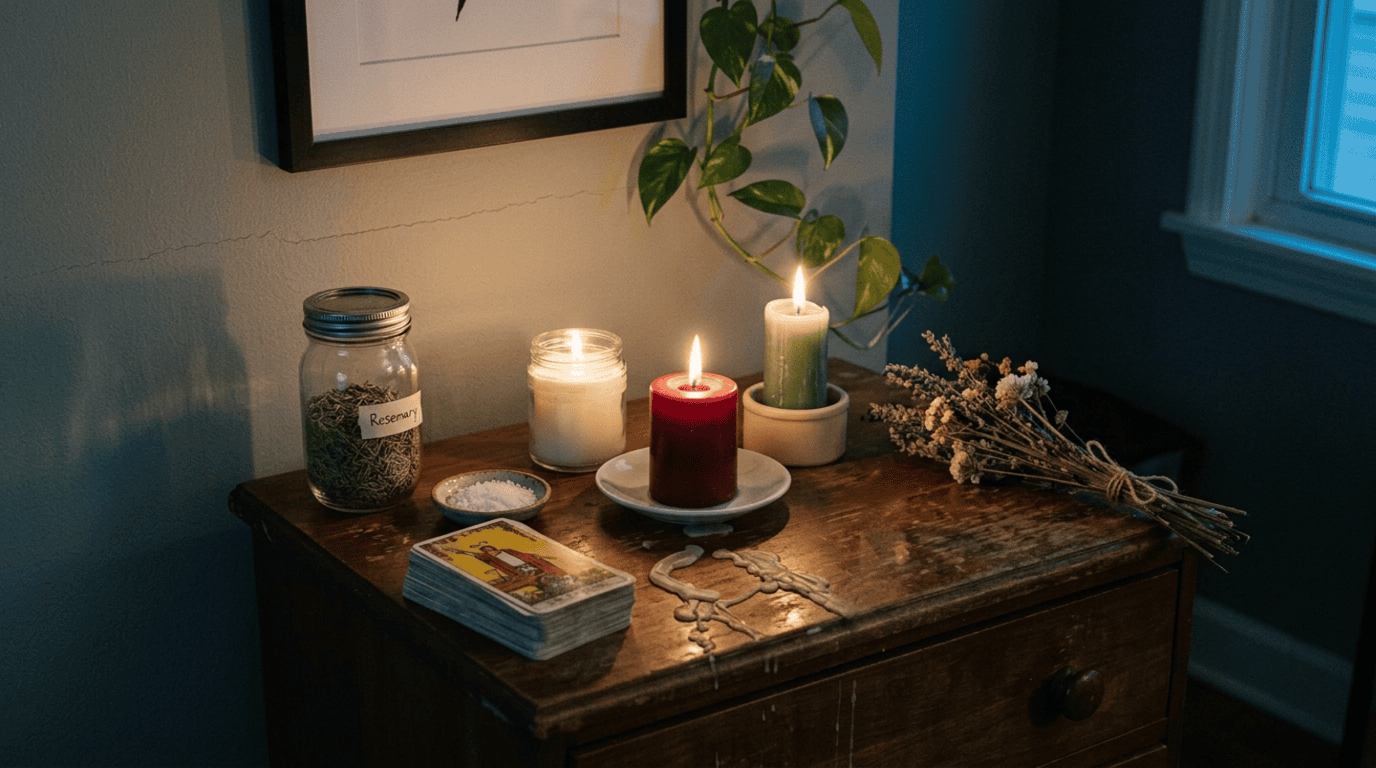
The first candle spell most people cast fails for a reason nobody mentions, since they spend an hour choosing a colour and about thirty seconds on the part that actually carries the spell. Everything that makes candle magic work happens in the ten minutes before the match is struck, because the burn is only the release. Get that order right and a plain white candle from the supermarket will outwork anything sold in a witchcraft shop.
What Is Candle Magic?
Candle magic is spellwork in which you load an intention into a candle through preparation, then release it by burning the candle down. It is the oldest and cheapest form of practical magic still in wide use, and it needs nothing beyond a candle, a match, and a request you can state in one sentence.
Definition: Candle magic is the practice of setting a specific intention into a candle by cleansing, carving, and dressing it, then releasing that intention through the flame. The preparation is the spell, while the burn is the delivery.
The reason candles took this role across so many unconnected traditions is that a single candle holds all four elements at once. Unlit wax is earth, the flame is fire, the melt pool is water, and the smoke and the air feeding the wick are air, so the whole elemental set sits in one object you can hold in your palm.
Tended flame has carried the same meaning far outside spellwork, which is part of why the symbolism feels immediately legible to almost everyone. Six priestesses kept the perpetual fire of the Temple of Vesta alight in ancient Rome, a ritual fire for the goddess Brigid burned at Kildare in Ireland from pre-Christian times until the sixteenth century and was relit by the Brigidine Sisters in 1993, and Orthodox, Catholic, Jewish, Hindu, and Buddhist practice all still turn on a lit wick.
That completeness is also why candle magic layers so well. You start with one candle and one wish, and later you add colour, then oil, then herbs, then timing, then a written petition, until a working that began as a two-minute act carries ten deliberate decisions inside it.
What Do You Need to Start Candle Magic?
You need a candle, something to light it with, a fireproof holder, and a surface that will not burn. Everything past that is optional, so if money is the reason you have been putting this off, the reason is gone.
A starter kit that will carry you through your first year costs very little, and mine has barely changed since I assembled it.
- Chime candles in six colours. These are the small four-inch spell candles, they cost about a euro each, and they burn for roughly an hour.
- A carving tool kept for nothing else, which can be a nail, a hat pin, a bradawl, or a sharpened chopstick.
- Plain olive oil as a base for dressing, since it does everything a shop-bought conjure oil does for a fraction of the price.
- Two or three dried herbs you already cook with, because kitchen herbs carry real correspondences and cost nothing extra.
- A heatproof dish or metal tray to prepare candles on, which keeps oil and wax off your altar cloth.
- A notebook, which matters more than everything above it put together.
Nothing on that list needs to come from an occult shop, and a candle bought in a supermarket works exactly as well as one bought in a botanica, since the difference is the price rather than the power. If you are building a practice from the ground up rather than only trying candle work, my guide on how to start a magical practice covers what sits underneath this, and my guide on setting up an altar covers where to put it all if you want somewhere permanent rather than clearing the kitchen table every time.
Fire, Honestly
Candle magic is the one branch of practice that can burn your house down, so these are part of the craft rather than a disclaimer bolted onto it. Nearly every practitioner I know who has been at this a while has a scorch mark on something.
- Fireproof holder, stable non-flammable surface, and nothing at all above the flame.
- Thirty centimetres clear of curtains, paper, altar cloths, and anything dried.
- Water within reach, and the path to the door kept clear.
- Wick trimmed to about six millimetres before every single lighting.
- Never leave a burning candle alone, and the next room counts as alone.
- Match the candle to the time you actually have, since a working abandoned halfway is worse than a small candle burnt properly.
Loaded candles are the ones that catch people out, because oil and dried herbs on wax will flare without warning and a ceramic dish can split straight down the middle while it does. Prepare on a metal tray, keep the load well off the wick, and stay in the room with it.
Which Type of Candle Should You Use?
Choose your candle by burn time rather than by shape or price, because burn time decides how long the working stays open and whether you can safely supervise it to the end. A one-hour candle suits a single clean request, while a seven-day candle suits something you intend to keep feeding.
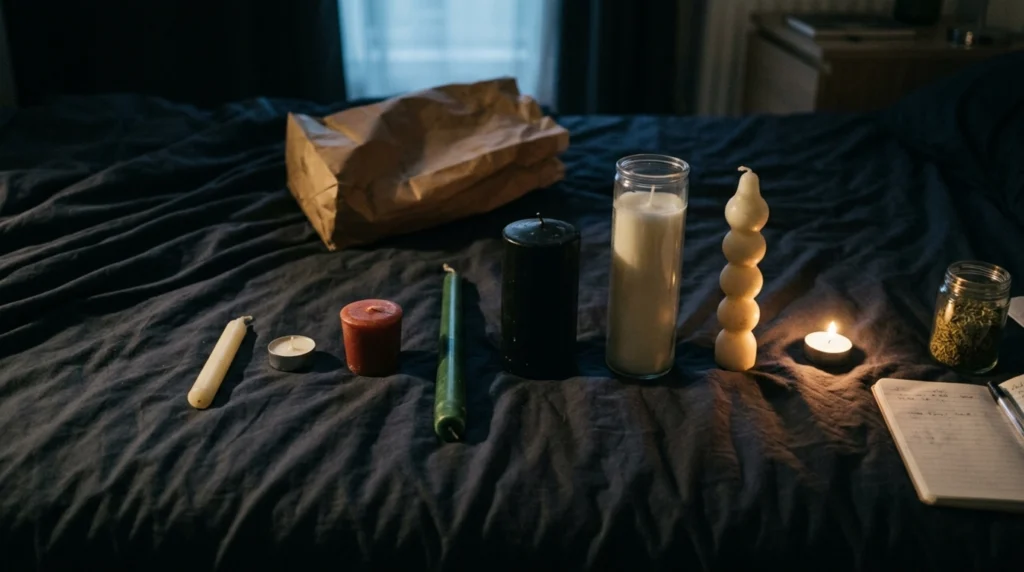
| Candle type | Burn time | Best for |
| Birthday cake candle | 2 to 5 minutes | Fast, small requests finished tonight |
| Chime or spell candle | About 1 hour | The default for almost all spellwork |
| Tea light | Around 4 hours | Grids, altar work, petitions hidden under the wax |
| Votive | Up to 15 hours | Devotional and altar use rather than spells |
| Taper or dinner candle | Roughly 1 hour per inch | Pinning, sectioning, wax divination |
| Pillar | 30 hours and up | Long workings burnt in sessions over weeks |
| Pullout candle in glass | 3 to 7 days | Sustained work, and it lifts out to be carved |
| Seven-knob candle | 7 nights, one knob each | Multi-night workings with a built-in schedule |
| Seven-day or novena candle | 7 days continuous | Ongoing petitions kept alive in glass |
| Figure candle | Varies | Sympathetic work where the shape is the point |
The mistake worth avoiding is scale, because beginners read that bigger means more serious and buy a seven-day glass candle for a modest request. Then they discover they have committed to supervising an open flame for a week in a flat with a cat, and the working gets abandoned halfway, which is a worse outcome than a chime candle burnt properly.
What The Candle Is Made Of
No spell fails on wax composition, so cheap paraffin will carry a working. What changes is what you are breathing, since candle magic has you sitting close to a flame in a room with the windows shut against draughts.
- Beeswax burns slowly and almost without smoke, and it is the traditional choice for devotional work across most of Europe.
- Soy and rapeseed burn cool and slow, hold dye and essential oil well, and leave far less soot on glass.
- Scented paraffin is the one to avoid, because the synthetic fragrance load is what soots the glass, flares against herbs, and lingers in a small room long after the flame is out.
- Unscented paraffin is fine where it is what you have, provided the wick stays trimmed.
One buying note worth having, since many cheap coloured candles are white candles dipped in a coat of colour that stops a millimetre in. That has never changed a working of mine, though colour all the way through costs more.
What Do Candle Colours Mean?
Candle colours carry broad functions that hold across nearly every tradition, with red for passion, green for money, blue for peace and protection, black for banishing, and white for anything at all. The complication almost nobody admits is that the moment you go past that broad layer, the correspondence tables stop agreeing with each other.
The disagreement is neither small nor hidden, since one standard reference gives green to Mercury and then prints the Golden Dawn attribution of Venus directly underneath without comment, while modern witchcraft sources drop planets altogether and folk traditions shift the same colour depending on the lineage a spell comes from.
The table below is the version most consistent across those sources, which is a different claim from saying it is the correct one.
| Colour | Use it for |
| White | Anything, purification, substitution when the right colour is missing |
| Red | Passion, courage, physical energy, urgent ambition |
| Pink | Affection, self-love, reconciliation, gentleness |
| Orange | Attraction, unblocking, communication, motivation |
| Yellow | Focus, memory, study, creativity, confidence |
| Green | Money, employment, growth, fertility, luck |
| Blue | Peace, sleep, honesty, healing, protection from hostility |
| Purple | Divination, spirit work, psychic development, authority |
| Brown | Home, property, animals, stability, grounding |
| Grey | Stalemate, neutrality, drawing something to a halt |
| Silver | Intuition, lunar work, dreams, reflection |
| Gold | Success, recognition, solar work, large undertakings |
| Black | Banishing, absorbing, cutting off, uncrossing, secrets |
The version circulating on social feeds right now is a flattened one, usually seven colours with a single keyword each, which is fine as a starting point and misleading if you take it for the whole picture. Older printed sources carry ten to fifteen colours with far more nuance, and the shorter chart is a symptom of the format rather than a correction of the tradition.
What matters more than which table you pick is that you stop changing tables. A symbol only carries force once your mind reads it without hesitation, so a green candle you have used for money forty times outperforms a technically superior colour you have to look up, and switching systems every time you find a more authoritative book keeps every colour permanently half-charged.
One practical note on white, since it saves real time. Every tradition I have worked with treats white as a universal substitute, so when the colour you want is missing, take a white candle and carve the intention into it rather than driving across town, because that substitution has never cost me anything I could measure.
How Do You Prepare a Candle for a Spell?
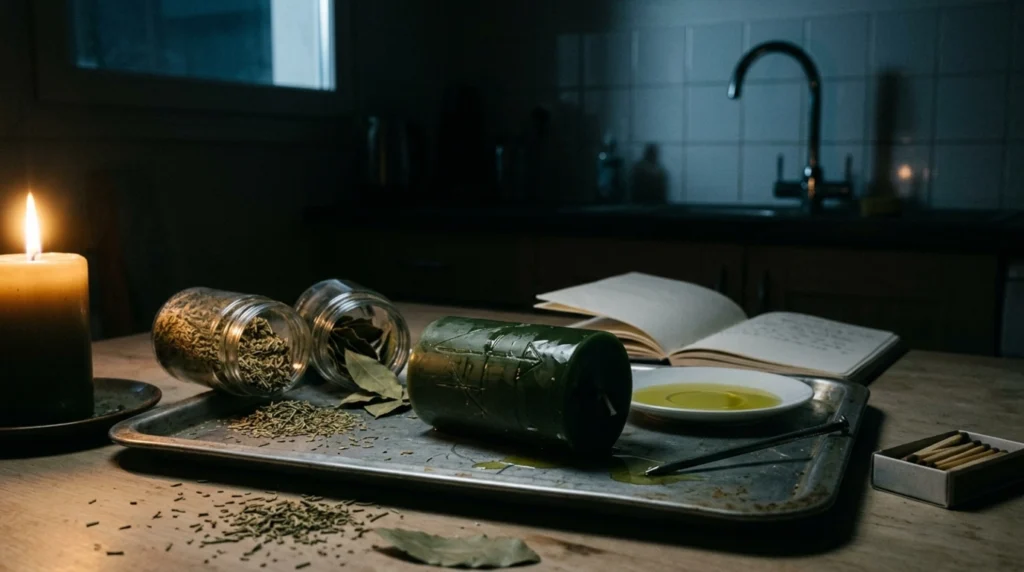
Preparation is the spell, so this is the part to slow down for. The full sequence runs cleanse, charge, carve, dress, and load, and it takes ten to fifteen minutes on a chime candle once you know the order.
Cleansing The Candle
Start by stripping whatever the candle picked up between the factory and your hands, since it has been handled, boxed, shelved, and breathed on by strangers. Wipe it from base to tip with a tissue and a little rubbing alcohol, or pass it three times through incense smoke, or hold it under running water for a few seconds and dry it.
Trim any wax lumps and scrape off seam marks while you are at it, because a candle with a clean surface takes a carving properly and a lumpy one does not.
Charging The Candle
Charging means telling the candle what job it has, and it takes about two minutes. Hold it in both hands, close your eyes, and picture the outcome as though it has already happened, so a money working means seeing the sum in your account rather than seeing yourself wanting it.
Say the instruction out loud while you do it, in plain language, since speaking it forces a precision that thinking it allows you to skip. If you use crystals, this is the point to charge those too, and crystals in magic covers which ones pair with what.
Carving The Candle
Carve the intention into the wax with your dedicated tool, keeping it short because a chime candle gives you roughly six centimetres of usable surface. A name, a single word, a symbol, a rune, a planetary glyph, or a sigil all work, and the only requirement is that it means something specific to you.
Direction carries meaning here, so carve from base to wick for things you want to draw in and from wick to base for things you want gone. Some practitioners insist the whole design be cut in one unbroken motion to keep the focus intact, which is a sound idea and an impractical one on anything detailed, so treat it as a preference rather than a rule.
For a container candle that cannot be carved, draw the same symbols on the glass with a marker, since the glass is part of the object and takes the charge perfectly well.
Dressing With Oil
Definition: Dressing a candle means coating it in oil, and often rolling it in herbs, while holding the intention of the spell in mind. The direction of the strokes marks whether the working draws something in or sends something away.
Dressing means coating the candle in oil, and it is where the transfer happens most strongly, since your hands are on the wax for a full minute with nothing to do but hold the goal in mind. Two or three drops of olive oil is plenty on a chime candle, and any correspondence oil you own works the same way.
Direction is the second place the sources openly contradict each other. One tradition rubs from tip to base to draw something in and base to tip to drive it out, while another works from the ends toward the centre to draw and from the centre outward to banish, and a third uses a clockwise spiral for attraction and a counterclockwise one for release.
So pick one and write it into your notebook, because the version I settled on is toward me for drawing and away from me for sending, holding the candle horizontally with the wick pointing wherever the energy should go, because that convention is spatially obvious enough that I never hesitate mid-ritual.
Adding Herbs And Other Loads
Once the candle is oiled, roll it in crushed herbs, which will stick to the film of oil and stay put. Use a pinch rather than a coating, crush them fine, and keep everything well clear of the wick, since dried plant matter is combustible and will send the flame up unexpectedly.
There are other ways to load a candle beyond rolling it, and each one suits a different candle type.
- Push cloves or small crystal chips into the sides of a pillar, or seal them on top with wax dripped from a taper.
- Unroll a beeswax sheet candle, sprinkle herbs along the inside, and roll it back up so the load burns from within.
- Lift the wax out of a tea light, drop herbs or a folded petition into the tin, and set the wax back on top.
- Carve a small hole in the base with a skewer and press an oil blend or a pinch of herb inside.
- Push a piece of hair or a nail clipping into the top and seal it with wax when the working is for a specific person.
Take the warning about herbs seriously rather than politely, because a loaded candle can crack its dish, and a cracked dish can set an altar cloth alight in seconds. Keep the candle on a heatproof surface, keep nothing above it, and stay in the room.
Writing A Petition
A petition paper is your intention in written form, tucked under the candle or pinned to it, and it sharpens a working more than any herb will. Write a few power words rather than an essay, so a courage spell says “courage and confidence” and a release spell says “release my hold on this.”
Then place it where it belongs in the working, since each placement does something slightly different.
- Underneath the holder so the candle burns above it for the whole working.
- Pinned to the side of the candle so the two burn together.
- Folded and lit from the flame, then dropped into a fireproof dish to burn away.
- Rolled inside a beeswax candle before it is lit.
Fold the paper toward you for drawing work and away from you for banishing, and if the petition names a person, write their full name in the centre and circle it with your sentence written in one continuous line, turning the paper as you go. Torn paper carries this better than cut paper in most folk traditions, and I have kept that habit because tearing feels like a decision in a way that scissors do not.
When Should You Burn a Candle Spell?
Burn drawing spells while the moon waxes and banishing spells while it wanes, and if the need is urgent, burn it tonight regardless of what the sky is doing. Timing sharpens a working rather than permitting it.
The weekday layer sits underneath the moon and is old, stable, and easy to memorise.
| Day | Planet | Burn for | Colour |
| Monday | Moon | Healing, dreams, intuition, ancestors, peace | White |
| Tuesday | Mars | Courage, conflict, defence, strength | Red |
| Wednesday | Mercury | Communication, business, study, travel | Purple |
| Thursday | Jupiter | Money, growth, luck, health, abundance | Blue |
| Friday | Venus | Love, beauty, friendship, harmony | Green |
| Saturday | Saturn | Banishing, binding, cleansing, justice | Black |
| Sunday | Sun | Success, recognition, hope, vitality | Yellow |
There is a redirection rule worth more than the whole table, and I use it constantly. When the moon is wrong for your goal and waiting is not an option, turn the working around rather than fighting it, so a waning moon becomes the time to strip away the obstacles standing in front of what you want instead of the time to call it in directly.
Solar timing works the same way on a smaller scale, with sunrise for beginnings, midday for anything at all, and sunset for release and letting go. Planetary hours exist as a further layer, and my honest position is that I have never been able to tell the difference between a spell cast in the hour of Venus and one cast at nine on a Friday evening, though practitioners I respect swear by them, so treat that as an area where my reading outruns my experience.
How Do You Cast a Candle Spell, Step by Step?
A complete candle spell runs preparation, statement, ignition, attention, and disposal, and a first one takes under an hour with a chime candle. This is the version I would hand to somebody doing it tonight.
- Write the goal in one sentence, present tense and specific, because a vague request produces a vague result. “Steady work I can live on by September” beats “more money” every time.
- Choose the colour from your table, or take white if you lack it, then choose the candle by how long you can stay in the room.
- Set up the surface. Fireproof holder, nothing flammable within thirty centimetres, nothing at all above the flame, and a glass of water within reach.
- Cleanse, charge, carve, dress, and load the candle with the goal held in mind throughout, which is where the spell is made.
- Write the petition and place it under the holder or pin it to the candle.
- Speak the intention aloud once in a full sentence while holding the candle, because saying it makes vagueness impossible to hide.
- Light it with a match rather than a lighter where you can, since the match brings a small element of wood and a striking action into the working.
- Sit with it for at least ten minutes, since that is the part everyone skips and the part that does the most work.
- Let it burn out if the candle is short enough to supervise, and snuff it if it is not.
- Dispose of the remains according to what the working was for, then write the whole thing into your notebook.
That last step is the one beginners skip and later regret bitterly. Record the date, the colour, the oil, the herbs, the moon phase, the exact wording, and anything the flame did, because a spell you cannot reconstruct is a spell you cannot repeat when it works or reverse when it goes sideways.
How Do You Sit With the Flame?
Sitting with a burning candle is the working half of candle magic, and it is the difference between a spell you cast and a spell you are inside. The goal is a soft, unfocused attention on the flame while you hold the outcome as though it has already arrived.
Setting Up The Gaze
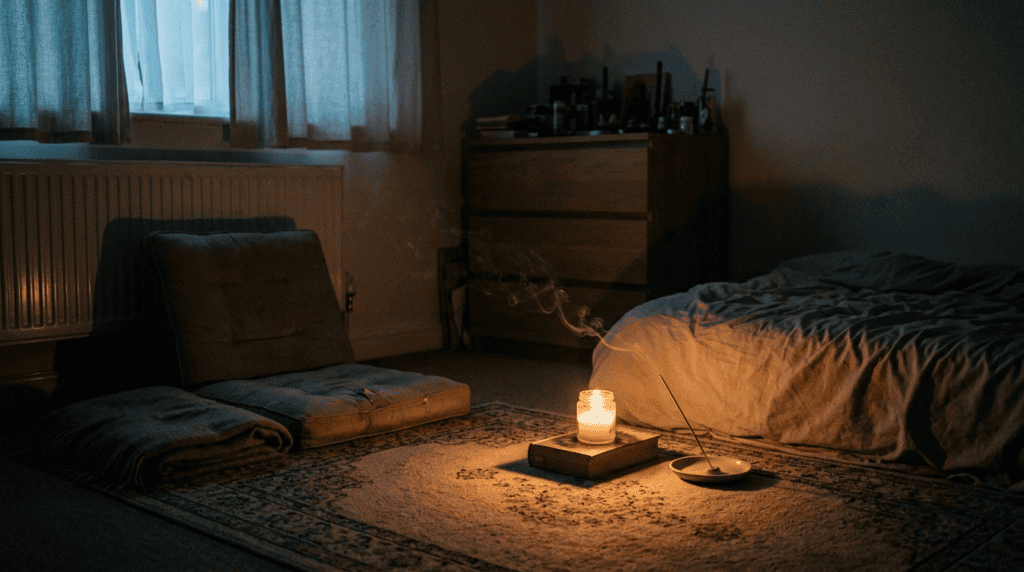
Set the candle about two metres away, roughly at eye level so you can look at the flame without tipping your head, and darken the room enough that the flame is the brightest thing in it. Some practitioners place a small mirror behind the candle to double the light, which I do for longer sessions because it steadies the gaze.
Then look at the flame and let the picture build. If the candle is green and the working is money, see the colour spreading out from the flame until it fills the room and then fills you, and hold that until it starts to fade rather than forcing it past its natural end.
Ten to thirty minutes is the usual range, depending on how strong your visualisation is, and stopping when your attention genuinely wanders beats grinding on out of duty. Say thank you out loud before you stand up, which closes the session.
Single-candle Work Without A Spell
You can use the same practice with no spell attached at all, simply choosing a colour for how you want to feel and sitting with it. Red for depleted energy, blue for a mind that will not stop, yellow for isolation, green for anger you cannot put down, pink for the weeks when you cannot accept anything kind, and white whenever you cannot name it.
I use this more often than I use candle spells, and it is the cheapest reset I know. Fifteen minutes with a blue candle at the end of a bad week does something a spell aimed at the same problem usually does not, because it changes the person rather than the circumstances.
Adding A Mandala
If sitting still is difficult, draw while you gaze. Keep coloured pencils and a sheet of paper in front of the candle, and once the colour has filled you, start drawing shapes outward from a central point without planning any of it.
Date the drawings and keep them, because looking back at a month of them shows changes in your state that you will not have noticed day to day. The ones made on genuinely bad days can be burnt in the candle flame afterwards, which is how I clear them.
How Do You Work a Candle Over Several Days?
Multi-day workings suit anything that needs sustained pressure rather than one clean push, and they run on the same preparation with a burning schedule attached to it. Three formats cover nearly everything you would want to do.
Notched Candles
Cut evenly spaced notches into a taper before you begin, then light it at the same hour each day and let it burn down exactly one notch. Three to seven days is the usual span, and the repetition itself is the mechanism, since a request restated daily at a fixed hour builds a weight that a single burn does not.
Pinned Candles
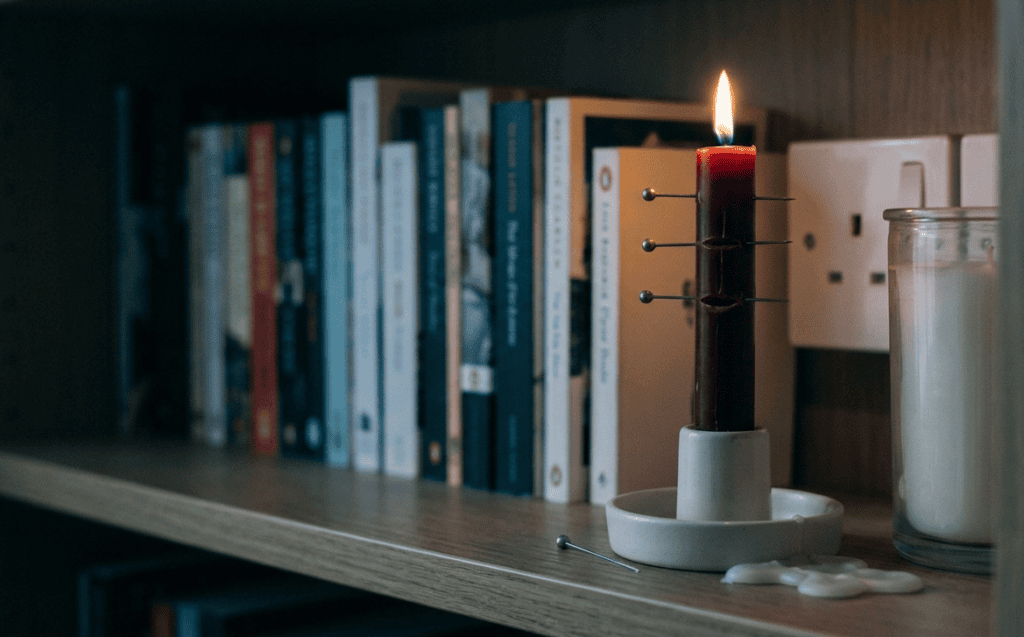
Push a pin into the top third of the candle before lighting, then hold your focus until the wax releases it and the pin drops, which marks the working as finished. Pins also section a candle neatly, so a row of them turns any taper into a seven-day candle without buying one.
Seven-day And Seven-knob Candles
A seven-knob candle burns one knob per night for a week with the schedule built into the wax, while a seven-day glass candle burns continuously and is better suited to an ongoing petition you want kept alive, like sustained protection over a difficult period.
With any continuous glass candle, common practice is to extinguish it after about four hours per session rather than leaving it unattended overnight, and I would rather stretch a seven-day candle to nine days than sleep in a flat with an open flame.
Candle Grids
A candle grid works the way a crystal grid does, with one central candle and others laid out around it in a pattern. Tea lights suit this best because they stand alone and burn evenly, and the pattern can be a spiral, a star, a pentagram, or something you make up.
Charge each candle as you place it, then light the centre first and work outward, telling each one what you need from it as the wick catches. Add crystals, herbs, or tarot cards between the candles if you want more layers, and sit with the whole thing once it is lit rather than walking away.
What Do the Flame, Smoke, and Wax Mean?
Read the flame only after you have ruled out the mundane cause, because a candle is a physical object with physical habits and most beginner omens are craft faults rather than messages. That one rule will save you more misread spells than any correspondence table ever will.
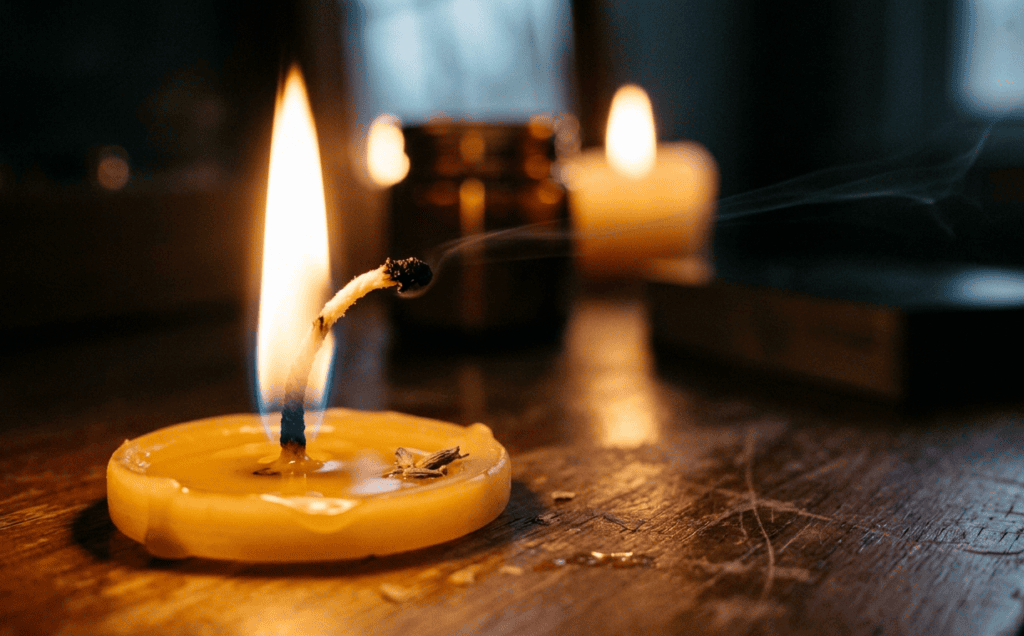
Work through the ordinary explanations first, since they account for the large majority of what people report as signs.
- A dancing, guttering flame is almost always a draught, so close the window and see whether it settles before reading anything into it.
- A tall smoking flame comes from a wick longer than about six millimetres, which sooties as it burns.
- A shrinking, drowning flame means the melt pool has flooded the wick, so pouring the excess wax onto a plate brings it straight back.
- A candle burning down one side is usually a draught or an off-centre wick rather than a lopsided intention.
- Black soot up the inside of a glass is usually an untrimmed wick or too much oil on the surface.
Tunnelling deserves its own warning because it fools people constantly. When a wide candle burns down the centre without melting out to the edge on its first session, it keeps to that narrow channel forever and eventually drowns itself in its own wax, so a beginner who does not know this reads a self-extinguishing candle as a rejected spell. The fix is to let any new wide candle burn about one hour per inch of its diameter on the first lighting, so the melt pool reaches the rim and sets the pattern.
Once the ordinary causes are excluded, the readings below are where the traditions broadly overlap, and they are a starting vocabulary rather than a dictionary.
| Sign | Common reading |
| Strong, steady, bright | The working is running cleanly |
| Very high flame | Strong energy behind it, though the result may be fast rather than lasting |
| Low, weak flame | Resistance, a blockage, or the wrong timing |
| Splits into two flames | Another will or another party is involved in the situation |
| Crackling or popping | Something is trying to communicate, or news is coming |
| Sudden flare | Something unexpected is about to happen |
| White smoke | Success, with difficulty on the way to it |
| Black smoke | Heavy energy being burnt off, or a blockage in the working |
| Burns unusually fast | Success arriving quickly, possibly without staying power |
| Burns unusually slowly | The result will come late, or the working is meeting drag |
| Goes out by itself | Opposition, wrong timing, or an answer already settled |
The self-extinguishing candle is where the disagreement runs deepest, so it is worth knowing before it happens to you. One reading treats it as opposition and tells you to abandon the ritual and repeat it at a better time, another treats it as outright failure and tells you to dispose of everything and rethink the intent, and a third treats it as an answer already given and forbids relighting the candle at all. My own habit is to recast cleanly on another day rather than spend an hour interpreting dead wax.
Wax has its own vocabulary once the candle is out. A clean burn with almost no residue is a good sign across every tradition, while a puddle that sets into a recognisable shape gets read the way tea leaves do, and drips running down the left side are commonly read as negative against drips on the right as positive.
How Do You Use a Candle for Divination?
Candle divination is scrying with fire, and it has four established forms that need almost nothing beyond a candle and a dark room. Each one reads a different part of the burn, so pick by what you find easiest to see.
Pyromancy, Reading The Flame
Sit in a darkened room with no draught, ask your question aloud, light the candle, and then let your gaze go soft on the flame while you write down every image, word, and symbol that surfaces. Judge none of it while you are in the state, and read your notes a day or two later if nothing made sense at the time.
Ceromancy, Reading The Wax
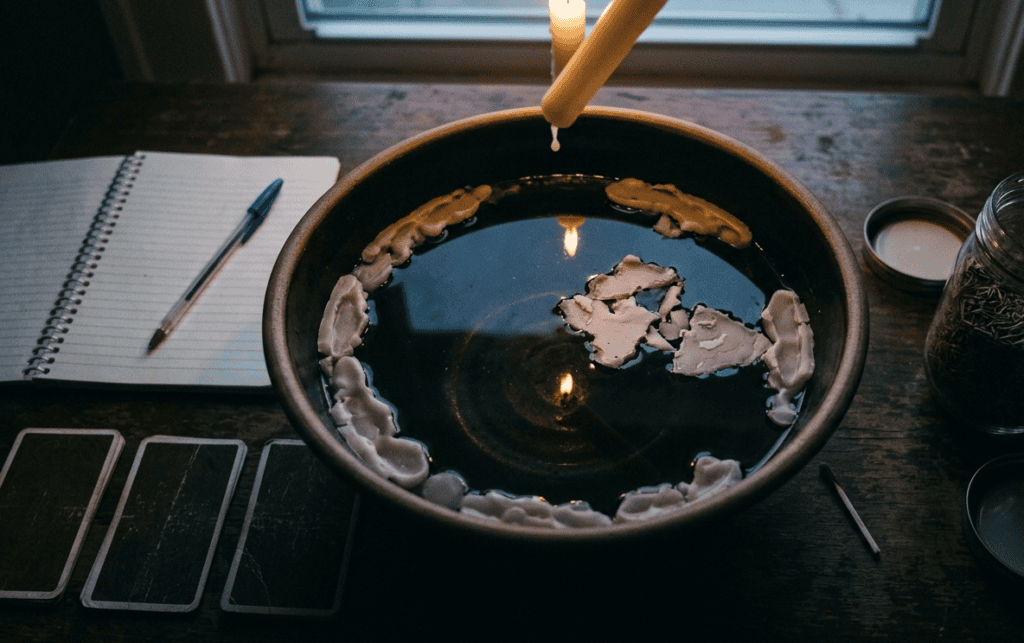
Burn a taper for a few minutes to build a good pool, then ask your question and tilt the candle over a bowl of water or a sheet of paper, dripping generously until real shapes form. The first ring of wax that sets around the edge frames the answer, with an unbroken border reading as a clean yes and a broken one as a no, while the shapes inside carry the detail. Turn the cooled pieces over when you are done, because the underside often holds more than the top.
Pinned Candle Divination
Push three pins into the top of a taper, assign each one a part of the question such as past, present, and future, then ask and light. Read the order they fall in, how far they land from the candle, and how far they land from each other, so pins close in suggest a situation near resolution while scattered pins suggest one still spread out.
Capnomancy, Reading The Smoke
This one needs a candle that smokes willingly and a pale background to see against, and the readings run on direction, with a thin steady column upward as a clean yes, dark puffs as a no, smoke drifting toward you as a quick result, and smoke drifting away as a slow one.
If you already read cards, these pair naturally with a spread rather than replacing one, and the flame tends to answer the question the cards left half-open. My piece on how tarot actually works covers the reading mindset that carries over.
What Do You Do When the Spell Is Finished?
Let the candle burn out where the size allows, and where it does not, snuff it rather than blowing it. The prohibition on blowing is close to universal in modern practice, though it is a convention rather than a law, and the sources are less unanimous than the internet suggests.
The strict position holds that blowing scatters the intention and offends the fire, with some practitioners pinching the flame out between finger and thumb as a small sacrifice of thanks. The looser position, held by people just as experienced, is that blowing has never caused a problem and that cupping a hand behind the flame keeps the energy contained, while a third reading treats breath as adding the element of air to fire deliberately.
What settled it for me came from outside candle magic. The Serbian slava candle, lit for the family’s patron saint, burns all day and is put out with a teaspoon of wine poured down the wick, which avoids breath without treating breath as the offence and gives something back in exchange for the light. That framing has outlasted every argument I have read about whether exhaling is rude.
Disposing Of The Remains
The rule that holds across every tradition is that drawing work stays and banishing work goes. Bury or keep the remains of anything meant to bring something in, and carry the remains of anything meant to remove something well off your property, which is the same logic I use for spent black salt.
Match the disposal to the element the working leaned on, since it closes the circuit neatly.
- Bury it for money, property, stability, and anything you want rooted.
- Send it down running water for emotional work, grief, and release.
- Burn the petition for passion, creativity, and anything urgent.
- Bin it away from home for banishing, binding, and anything you want gone.
Check what you are burying before you dig, because heavy salt is bad for soil, glass and metal do not belong in a hedgerow, and a tin from a tea light belongs in recycling rather than a flower bed.
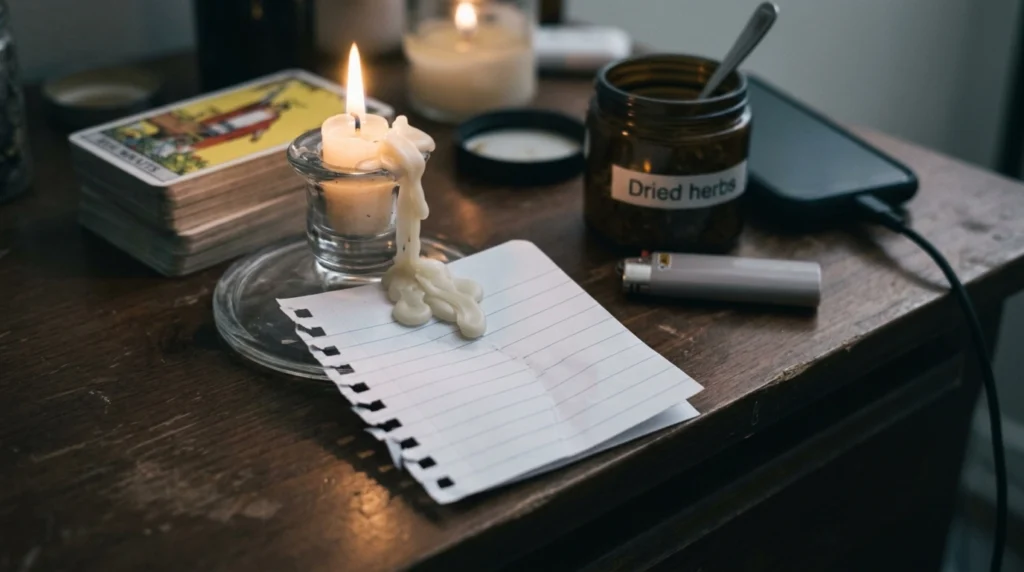
Keeping The Wax
Leftover wax from drawing work is worth saving rather than discarding. Warm a piece in your hands until it softens, shape it into a small disc or charm, and carry it, which is how a finished money spell becomes something living in your wallet.
Wax from a protection working can be buried at the gate, tucked under a doormat, sprinkled along a boundary, or sealed into a pouch, and it pairs naturally with a protection amulet you already carry. Wax can also seal the lid of a spell jar, close a folded petition, or cover the words on a written charm. The only remains I never keep are those from banishing, releasing, or binding.
Letting It Go
The last move in a candle working is taking your attention off it, because a request you keep reopening is a request that never gets to close. Do the spell, write it down, clear the remains, and then treat the problem the way you would treat a job you had handed to somebody competent.
Leave at least a lunar cycle before recasting the same working unless something has genuinely changed, since repeating it inside a week is usually anxiety wearing the clothes of practice, and anxiety is the last state you want built into a spell. Watch instead for the shape of the answer, which almost never arrives looking the way you pictured it.
Reusing Candles
Do not reuse a candle from one spell in a different spell, since the two intentions blur and neither reads cleanly afterwards. A partly burnt candle can be relit for the same working on another day, which is different, and a candle used purely for light can be melted down and recast into something new.
If you consecrated a candle and then no longer need it, you can release it rather than binning it. Hold it in incense smoke, picture the colour of its original purpose draining out until nothing is left but plain wax, and say plainly that the charge is released and the object is only an object again.
What Should You Not Cast a Candle Spell For?
Cast nothing while you are furious, drunk, or in fresh grief, and cast nothing at a named person who never asked for it. Those two rules cover almost every candle working I have watched go wrong, including a couple of my own.
Casting In Anger
A working takes the shape of the state it was cast in, so a spell built in a temper carries the temper into whatever comes back, and waiting three days to cool off costs you nothing.
If you are reaching for a candle to aim at a person, cord cutting is nearly always the working you actually wanted.
Casting At A Specific Person
A candle aimed at making one named person want you tries to move their will rather than your circumstances, and beyond the ethics of that, it carries a failure mode nobody mentions. It works often enough to leave you tied to somebody the spell is holding in place, which is slower and worse than the spell failing outright.
Aim love work at your own openness and the conditions around you instead, then let it find whoever it finds. That version has never left me trying to undo something.
Casting For Someone Else
Working for a person who asked you is simple enough, while working for one who did not is a judgement call every time. My line is that I will light protection or healing without asking, and nothing else.
What Goes Wrong With Candle Spells?
Most candle spells that fail do so physically rather than magically, and the faults repeat in a small predictable set. Recognising them stops you reading a mechanical problem as a spiritual verdict.
| Problem | Cause | Fix |
| Tunnelling | First burn too short on a wide candle | Burn one hour per inch of diameter on the first session |
| Drowned wick | Too much oil on top, or a deep melt pool | Pour off the excess wax onto a plate |
| Soot and mushrooming | Wick longer than six millimetres | Trim before every lighting |
| Cracked glass | Too much oil, too many herbs, or a crystal against the glass | Dress container candles lightly and keep crystals outside |
| Herb flare | Dried plant matter caught the flame | Use a pinch, keep it off the wick, stay in the room |
| Wax everywhere | Blowing hard on a full melt pool | Snuff instead, or blow gently with a hand cupped behind |
| Nothing at all happens | The petition had no shape | Rewrite it with a deadline and a measurable outcome |
The one genuinely magical failure is casting from anger, and it is worth naming plainly. Work no spell while you are furious, drunk, or grieving hard, because the working takes the shape of the state you cast it in, and if you find yourself reaching for a candle to aim at a person, cord cutting is almost always the working you actually want.
Keep the remnants and the notes of anything that might need undoing, since a spell you recorded fully can be reversed step by step, ingredient by ingredient, in the opposite order. A spell you cast in a temper and never wrote down cannot.
FAQ
Yes, and the results in my own practice have been consistent enough that I stopped testing the question years ago. What varies is speed rather than whether anything moves.
Most workings show movement inside one lunar cycle, so roughly two to four weeks. Small, simple requests can land in days, while anything needing other people to change their minds takes longer.
Yes, since a plain white candle prepared with full attention outperforms a perfectly matched colour prepared carelessly. Match the burn time to how long you can stay in the room.
Snuff it rather than blowing it, because most modern practice treats breath as scattering the intention. Experienced practitioners disagree on this, so pick one method and keep to it.
Check for a draught, a flooded wick, or tunnelling first, since those explain it far more often than anything else. Where the cause stays unclear, the usual reading is opposition or bad timing.