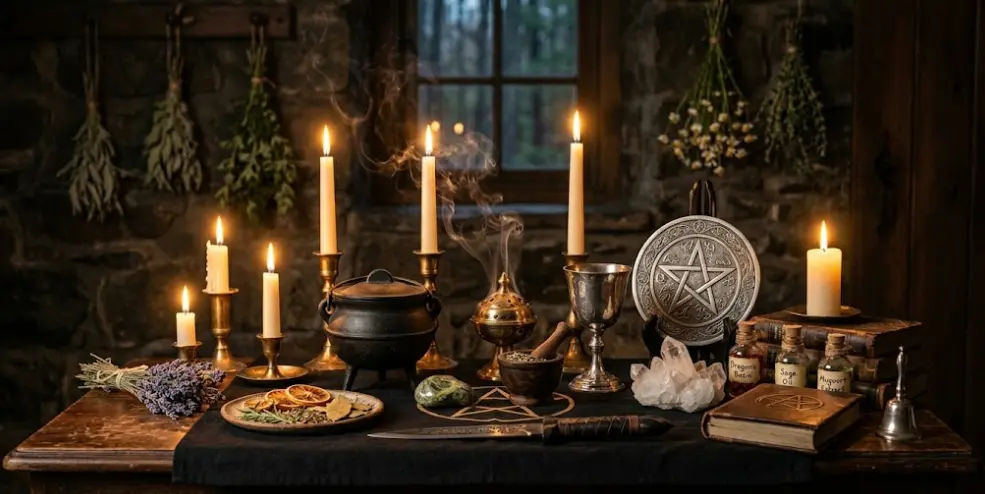
When most people decide to set up their first altar, the first thing they meet is a shopping list. A chalice, an athame, a pentacle, a wand, four element bowls, deity statues, a particular cloth, and a cabinet of crystals, all presented as if the practice cannot begin until the cart is full. That list is where a lot of beginners stall, and it is the wrong place to start.
An altar is older and simpler than any of that. People have kept a shelf, a corner, or a flat stone set aside for what matters to them for as long as there have been homes, long before anyone sold a kit for it. This guide builds your witchcraft altar from that plain idea outward, so you end up with a space that fits your practice instead of someone else’s catalogue.
What Is a Witchcraft Altar?
A witchcraft altar is, when you strip away the mystique, a surface you have set apart from ordinary use as a place to focus, work, and keep the objects your practice needs. That is the whole of it at the start, and everything else is decoration you add once you know what you are decorating.
Definition: An altar is a dedicated working surface and point of focus for ritual, spellwork, devotion, or meditation. It is not sacred in itself and it does not house a spirit. Its power comes from the attention and intent you bring to it, not from the objects sitting on it.
Two functions sit under all the variety you will see online. The altar is a workbench, a clear and reserved space where you actually do the practice, and it is a focus, a fixed point your attention returns to that tells your mind the ordinary day is paused. A kitchen counter buried under mail does neither, while a bare shelf kept only for this does both.
This is worth holding onto because it frees you from the catalogue. Once you know the witch altar is a workbench and a focus, you can judge every object and every rule by a single question, which is whether it helps you work or helps you focus. Whether you call it a witchcraft altar, a witch altar, or a pagan altar, that test is the same, and if an object does neither, you do not need it yet.
What Do You Put on a Witchcraft Altar?
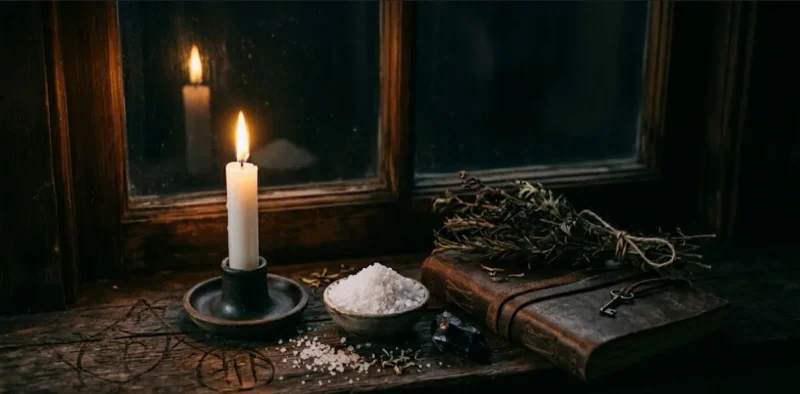
At the start you need a surface you can reserve and one object to anchor your attention, and a plain candle is the traditional anchor, because everything past that is preference rather than requirement. I started with a single white candle on a shelf, and it did its job for months before I added anything.
Here is the honest split between what a working altar needs and what the guides usually sell alongside it.
| Genuinely useful to start | Add later, if your practice asks for it |
| A flat surface you can reserve | A dedicated altar cloth |
| One candle and a safe holder | Deity statues or images |
| A heatproof dish or bowl | A chalice or cup |
| A lighter or matches | A wand, athame, or pentacle |
| Something natural that means something to you | A censer for loose incense |
| A small dish of salt or water | Crystals chosen for specific work |
None of that first column is specialised, because a side plate is a heatproof dish, a tumbler is a cup, a pebble from a walk is the natural object, and a saucer of salt costs nothing. The practice was never meant to be gated behind a purchase, and the older books are blunt about this, holding that the tools carry no power except what the practitioner lends them.
If you want something concrete to copy, here is the first altar I would build today with things already in a kitchen. A small shelf cleared and wiped down, a white candle in a jar at the back, a saucer of salt and a glass of water in front of it, a stone from a place that means something to me, and a sprig of fresh herb laid beside the candle. That is six items, none of them bought for the purpose, and it is a complete working altar the moment you light the candle.
Where Should You Put Your Altar?
Put your altar wherever you can be quiet, undisturbed, and able to leave it set up if possible, because the best spot is the one you will actually use. A neglected altar in the perfect corner does less than a humble one you pass and tend every day.
The direction it faces is the first place beginners get tangled, so here is the plain version. Different traditions favour different orientations, some setting the altar to face north for its link with earth and stability, others to the east where the sun and moon rise. Both are real conventions with reasoning behind them, and neither is a law.
Fact block: If you work with the four elements, a common arrangement places earth in the north, air in the east, fire in the south, and water in the west, with the altar oriented so those line up. If you do not work with the elements, face the altar whichever way lets you work comfortably in the space you have.
For most people the room decides this anyway. You set the altar where the table fits and where the candle is not under a curtain, and that practical truth matters more than the compass. If your only good spot faces the wrong way for the textbook, the textbook loses.
What Should the Altar Be Made Of?
Almost anything flat and stable can be an altar, from a shelf or a bedside table to a wooden box, a tree stump, or a flat stone outdoors. The material carries some traditional lore, but the practical needs come first: stable enough to hold a flame safely, large enough for what you actually use, and yours to reserve.
One old idea about materials is worth knowing even if you hold it lightly. Some traditions prefer an altar with no steel in it, reserving conductive metal like iron and steel for the few tools meant to direct energy, the blade and the wand, and keeping everything else in non-conductive materials like wood, stone, brass, or clay. You do not have to accept the reasoning to take the simple version, which is that a plain wooden surface is a safe, neutral, traditional choice.
Size is the more useful question, because a small surface forces you to keep only what you use, which is no bad discipline for a beginner, while a large one tempts you to fill it with clutter that gets in the way of the work. That is why I would start smaller than you think you need.
How Do You Arrange a Witchcraft Altar?
There is no single correct arrangement, only templates that suit different paths, so the honest answer is to pick the one that matches how you actually practise. Below are four that cover almost everyone, from the familiar Wiccan layout to a plain working surface with no theology at all.
The Wiccan layout
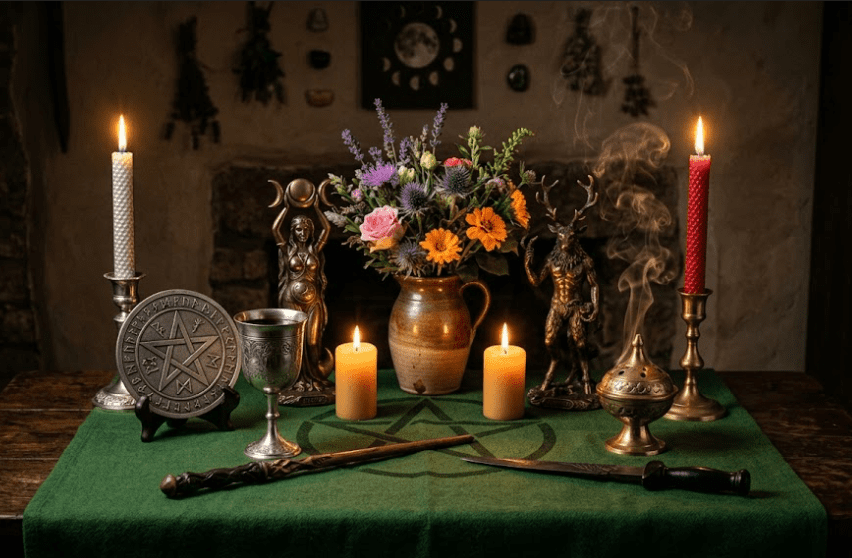
The most widely published arrangement comes from Wicca, and it is worth knowing because so much of the online advice quietly assumes it. It divides the altar by the divine pair and the four elements, like this.
| Position | Holds |
| Left side | Goddess symbol, a cup or chalice, a pentacle, a bell, a crystal |
| Right side | God symbol, a candle, the censer, the wand, the blade |
| Centre | A working space, flowers, or the focus of the current rite |
| Four quarters | Items for earth, air, fire, and water if you use them |
In place of statues, a green, silver, or white candle often stands for the Goddess on the left, and a red, gold, or yellow candle for the God on the right. Some practitioners also mark the four quarters with coloured candles, yellow in the east, red in the south, blue in the west, and green in the north. This is a coherent and beautiful system if the god and goddess and the elements are part of your belief and an empty costume if they are not, so borrow the tidiness rather than a theology you do not hold.
An elemental layout without the theology
You can keep the four elements without the deities, which suits a nature-based practice rather than a religious one. Each element has a traditional place, a simple object, and a meaning it brings to the altar.
| Direction | Element | Place on the altar | What it stands for |
| North | Earth | a stone, a dish of salt or soil, a pentacle | stability, grounding, the body, material life |
| East | Air | incense or a feather | thought, communication, divination |
| South | Fire | a candle or small lamp | will, passion, change, energy |
| West | Water | a bowl or cup of water | emotion, intuition, healing, love |
The four together make a balanced, satisfying focus, and you can group them at their directions or simply arrange them where they look right. If you work with the four classical tools, they usually map onto the same elements: the blade or athame and the wand carry fire and air, the chalice carries water, and the pentacle carries earth. Some traditions swap the blade and wand between fire and air, so treat that pairing as a convention rather than a fixed truth.
If you want to go further with the earth point, my guide to crystals and their properties covers choosing a stone with intent.
A folk or household altar
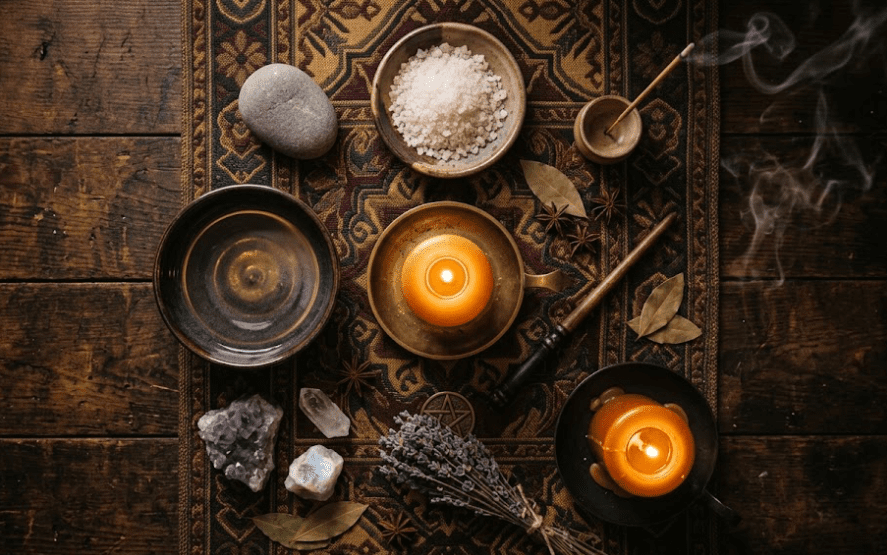
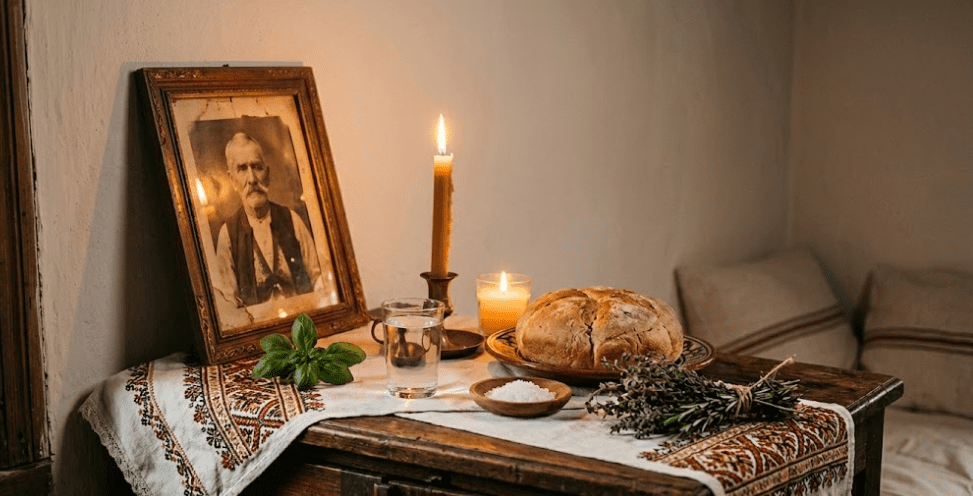
The model I come from is older than any of this and sits closer to the home than the temple. In Balkan folk practice the sacred corner of a house held simple, potent things: a candle, bread, a little salt, a glass of water, a sprig of basil, and photographs of the dead. A slava candle burned for the family’s patron saint, and the bread and salt stood for life and welcome.
You can build a folk altar on exactly those bones. A clean cloth, a candle, a piece of bread or a bowl of grain, salt, water, and an image or token of an ancestor make a working household shrine with no imported correspondences at all. It is the layout I trust most, because every object on it does something in the tradition rather than standing in for an abstraction.
A plain working altar
If none of the above fits, strip the idea to its function and build a workbench. Keep a candle for focus, a heatproof dish for burning, a small bowl for water or salt, and clear space in the centre for whatever the current spell or meditation needs. This is the most honest altar for a skeptic-leaning practitioner, and there is nothing lesser about it.
Whichever template you choose, three practical rules keep the surface usable. Put the things you reach for first nearer the front so you are not stretching across a flame, keep candles toward the back for the same reason, and if you work with a deity or an ancestor, give them a fixed place so the rest of the altar arranges around it. I learned the candle rule the hard way, reaching over a tealight for the matches and singeing a sleeve, and the layout has put flames at the back ever since.
Do the Directions and Correspondences Actually Matter?
The directions and correspondences are tools for focus, not switches that make magic work or fail, so they matter as much as they help you and no more. A practitioner who finds that facing east and laying out the four elements sharpens their attention is getting something real from it, and that is reason enough to do it.
What I would not do is treat them as machinery. The idea that a spell collapses because the water bowl sat in the south rather than the west gives the furniture a power the older sources never claimed for it. The structure is a scaffold for your mind, and the mind is doing the work.
So use the correspondences if they help you concentrate and skip them if they only make you anxious about getting it wrong. A focused practitioner at a plain table will always outwork an anxious one fussing over a compass. Hold the system as a convenience, not a commandment.
How Do You Cleanse and Consecrate a New Altar?
Before you use a new altar, clean it physically and then clear it energetically, because you are setting the space apart from its ordinary life. The two steps are not the same, since wiping the dust off is only hygiene, while clearing the space is the part that tells your practice this surface is now reserved.
A simple method works across almost every tradition and needs nothing you cannot find at home.
- Clean the surface physically. Wipe it down, ideally with water that has a little salt dissolved in it.
- Clear the space. Move through it with salted water sprinkled from your fingers, then with the smoke of incense or a dried herb, covering the corners. My full guide to cleansing a space of heavy energy walks through this in detail.
- Set the intention. State plainly, aloud or in your mind, what this altar is for and that it is now set apart for that purpose.
- Place your objects with attention. Set each item down deliberately rather than dumping them, since the placing is itself the first small act of practice.
Your tools deserve the same care before their first use. The traditional approach is to keep a new tool wrapped in clean cloth until you are ready, then cleanse it by smoke, salted water, or a night under the moon, and finally handle it and state its purpose so it becomes yours through use. A new object carries the handling of everyone who made and sold it, and clearing that is the point.
How Do You Use a Witchcraft Altar Day to Day?
Once it is set up, you use the altar by returning to it, and the rhythm matters more than the elaborateness of any single visit. A short, steady habit builds the relationship faster than a grand ritual you perform twice a year.
A simple daily visit might go like this: stand before the altar, light the candle and any incense, and settle for a moment, then state your intention or simply sit in quiet attention for a few minutes. When you finish, snuff the candle with your fingers or a snuffer rather than blowing it out, which many traditions consider an affront to the flame, and let any incense burn down on its own.
Offerings are the other half of how an altar lives. You might leave flowers, fruit, grain, a little water, or a splash of wine, and the older practice is to return what you leave to the earth afterward rather than letting it sit and spoil. None of this needs a permanent setup, and if you cannot keep one, set the altar up each time and let the act of placing the objects be the first part of the practice.
How Do You Set Up a Hidden Altar in the Broom Closet?
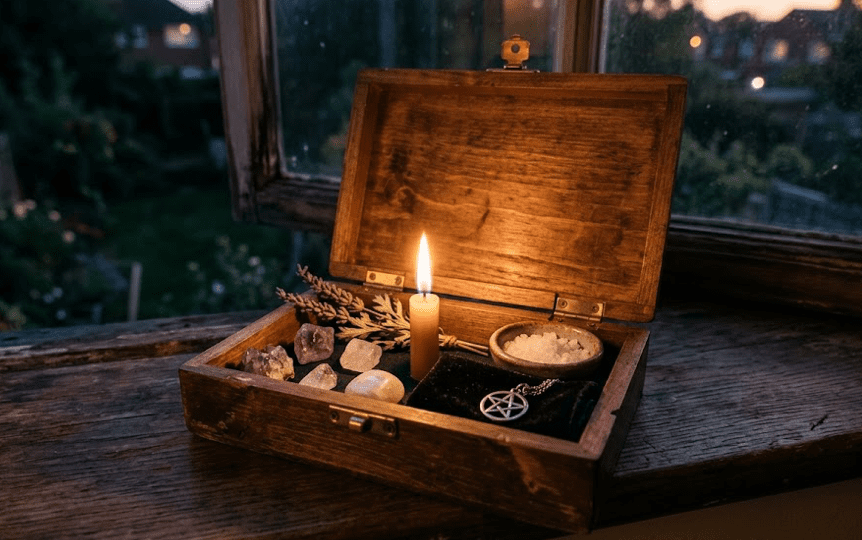
If you share your home or cannot practise openly, a hidden altar gives you the focus without the exposure, and it can be as discreet as you need. Plenty of practitioners keep their work private, and the altar adapts easily. The trick is that nothing on it has to look like what it is.
A hidden altar usually takes one of three forms, the first being a disguised altar that reads as ordinary decor, a few stones, a candle, a plant, and a framed photo on a shelf that no visitor would question. A portable altar lives in a box or tin you open only when you work and tuck away afterward, which suits a shared room. A pocket or travel altar shrinks the whole idea to a small pouch of meaningful objects you can set out anywhere for a few minutes.
Fact block: A working altar can be assembled and dismantled in minutes. Clear a surface, set out a candle and a couple of objects, do the work, and put everything away. Nothing about the practice requires a permanent display, and the older manuals describe exactly this for people without a private room.
The one real need is somewhere to keep your things between sessions, ideally a box or drawer that closes. Beyond that, a hidden altar works no less well than a grand one, because the focus was always in you rather than in the display.
What Are the Most Common Altar Mistakes?
The most common altar mistakes come from treating the furniture as the practice, and they are easy to avoid once you name them. None of them are moral failings, just the places beginners lose time and momentum.
- Buying the catalogue first. Filling a cart before you know your path leaves you tending objects that mean nothing to you.
- Copying a layout you do not believe in. A Wiccan altar setup is wasted on someone who does not work with the god and goddess, and the borrowed symbols only dull your focus.
- Letting it become storage. The moment keys, mail, and loose change land on it, the surface stops being a focus and becomes a shelf.
- Leaving offerings to rot. Old flowers and spoiling food turn a living altar stale, so refresh and return them rather than letting them sit.
- Fussing over correspondences. Anxiety about facing the wrong way or placing the water bowl wrong does more harm than any misplaced object.
- Ignoring fire safety. This is the only mistake on the list that can hurt you, so it gets its own attention below.
The thread through all of these is the same. An altar is a tool for focus, and anything that clutters, confuses, or frightens you is working against the one job it has.
How Do You Look After Your Altar?
An altar needs tending, which mostly means keeping it clean, keeping it current, and clearing it now and then. A dusty, forgotten altar gathers the same stale feeling as any neglected corner, and the upkeep is part of the practice rather than a chore beside it.
Keep it physically clean, trim dead flowers, and replace burned-out candles, since a surface you respect with small attentions stays a focus rather than a shelf. Many practitioners also dress the altar to the season, changing the cloth and candle colours through the year, which keeps the space tied to the turning calendar. If it starts to feel heavy or flat, clear it the way you cleansed it at the start, and you can lean on the same home-cleansing methods for a deeper reset when a season changes or a hard time passes through the house.
One thing matters more than any of the lore, which is fire safety, and it is the part of altar setup people skip until something scorches. Keep flames away from cloth and curtains, never leave a burning candle unattended, stand candles on a heatproof tray, and keep the altar clear enough that nothing flammable leans into a flame. If you have pets or small children, set the altar high or use a flameless candle, since a curious cat and an open flame end the same way every time.
FAQ
No, an altar is a helpful focus rather than a requirement, and plenty of practitioners work without a fixed one. It mainly gives you a reserved space and a point of attention, both of which make a practice easier to sustain.
An altar is a working surface where you actually do ritual and spellwork, while a shrine is a place of devotion and offering dedicated to a deity, spirit, or ancestor. Many home setups are quietly both at once, and you do not need to choose a label.
It can face whichever way lets you work comfortably. Some traditions favour north for earth and stability and others east where the sun and moon rise, but neither is a rule, so use the only sensible spot your room allows.
It can cost almost nothing, since a reserved shelf, a candle, a heatproof dish, and a saucer of salt are enough to begin, and most of that is already in your home.
No, the divine pair belongs to Wicca and some related paths and is optional everywhere else. You can build an altar around the elements, your ancestors, a single deity, or nothing but a working focus.