Most chakra guides stop at the colours – you get seven circles, seven shades, a crystal for each, and you come away able to name the centres without being any closer to reading your own.
What changed everything for me was a distinction almost nobody mentions. A chakra in trouble does not simply switch off. It fails in one of two opposite directions, and those two directions need opposite responses. A withdrawn centre needs waking up, while an overworked one needs grounding and release. Treat every problem as a blockage, which is what most advice tells you to do, and you will push hardest on exactly the centres that already push too hard.
I worked with this system for years before that landed, and it turned the chakras from a list of names into something I could use. What follows is all seven, base to crown, with the full traditional detail for each, and with the deficient and excessive signs set out plainly so you can find your own pattern. By the end you should be able to look at your own life and see which rungs hold you and which give way.
Key Takeaways
- A chakra is one of seven energy centres along the spine, each governing a distinct band of life from survival at the base to meaning at the crown.
- A struggling chakra fails in one of two opposite directions. Deficient means withdrawn from its theme, excessive means overworking it.
- Deficient centres need activation. Excessive centres need grounding and release, and treating every problem as a blockage makes an overactive centre worse.
- The rainbow colours are a modern Western overlay. The centres themselves are ancient, described in the Vedas and detailed in the Sat-Cakra-Nirupana of 1577.
- Work from the base upward, since the higher centres rarely open cleanly while the ground beneath them is unsteady.
What Is a Chakra?
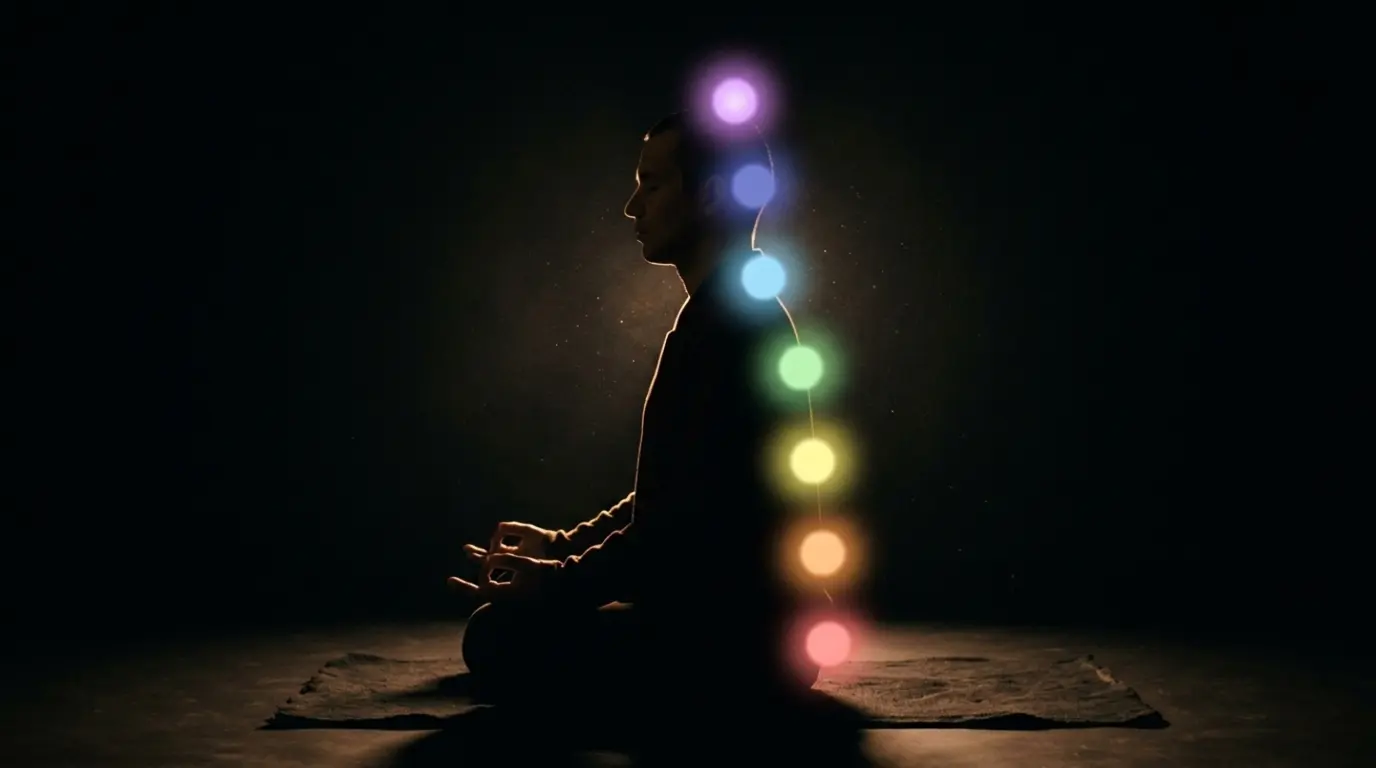
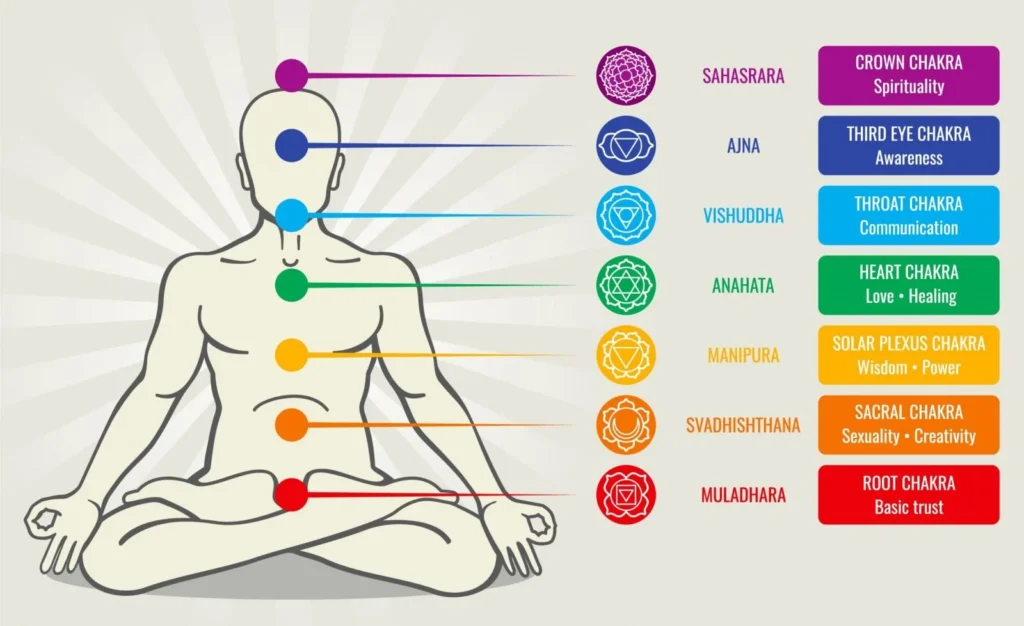
A chakra is a center of concentrated energy in the subtle body, the non-physical layer of a person that tradition says carries the life force. The word comes from Sanskrit and means wheel or disk, and the image behind it is a spinning vortex where energy gathers, turns, and radiates. Tradition counts many such centers throughout the body, yet seven main ones stand out, arranged in a column along the spine from its base to the crown of the head.
They form where the currents of the subtle body converge. The old texts describe a web of fine channels called nadis that carry prana through the whole body, and three of these matter most.
The central channel, sushumna, runs straight up the spine, while two others, ida and pingala, spiral around it and cross at each center. Where those channels meet, energy pools and spins, and that meeting point is a chakra, which is why the seven always sit on the spinal axis rather than scattered at random.
Definition: A chakra is one of seven main energy centers in the subtle body, arranged along the spine from base to crown. Each governs a distinct band of physical, emotional, and spiritual life, from survival at the base to higher awareness at the crown.
Each center is best understood as a theme rather than a spot. A single chakra ties together a place in the body, an element, a psychological drive, and a life stage when it first develops.
It also carries a whole family of behaviors that reveal whether it is thriving. When someone says a chakra is open or closed, this entire bundle is what they mean, and the skill worth building is reading that bundle in yourself and in others.
Where the Chakras Actually Come From
The chakras are far older than the tidy rainbow version most people meet first. The earliest traces appear in the Vedas, the sacred texts of India composed well over three thousand years ago, and the idea deepened through the Upanishads and the later yogic and tantric schools.
The detailed model that Western teachers lean on was set down in a 1577 tantric text called the Sat-Cakra-Nirupana. It described each center with its petals, its presiding energies, and its seed sounds in remarkable precision.
The familiar scheme of seven rainbow colors, one clean shade per center, is a modern Western overlay rather than an ancient teaching. That mapping took hold across the twentieth century, carried first by the Theosophists and later by writers like Anodea Judith. Her psychological reading of the system informs much of this guide.
I still use the colors, since they are a genuine aid to memory and a real focus for meditation, so this is not me dismissing them. I only think it is honest to call the rainbow a recent lens laid over a far older structure. In my experience the people who take the system furthest are the ones who know the difference rather than swallowing the whole thing at once.
A map, not a medical chart
I treat the chakras as a map, not a medical chart. A good map earns its keep by helping you find your way, and this one has guided people through their inner terrain for centuries.
That is a very different claim from saying a particular blocked center causes a particular disease, which is the quiet overreach that turns a profound system into a wellness gimmick. Everything below is offered in that spirit, as a lens for self-understanding rather than a diagnosis.
How to Read a Chakra: Deficient, Excessive, or Balanced
Before walking the seven, it helps to learn the single idea that turns them from a list into a working tool. A center in trouble does not simply switch off.
It fails in one of two opposite directions, and telling those directions apart is what lets you respond in a way that helps. This framework comes from Anodea Judith, and once you see it you cannot unsee it.
A deficient chakra
A deficient chakra has contracted and withdrawn from its own theme. The energy there runs low, the center is underdeveloped, and the person tends to avoid whatever that chakra governs because engaging with it feels unsafe or simply foreign. Someone deficient in the heart center pulls away from closeness, someone deficient in the throat swallows their words, and in each case the pattern is retreat.
An excessive chakra
An excessive chakra fails in the mirror image, overcompensating by pushing far too hard in its own direction. The energy there is stuck in the open position, so the person overuses that theme in a way that never satisfies the need beneath it. An excessive heart gives itself away and calls the loss love, an excessive throat talks over everyone and cannot listen, and in each case the pattern is too much rather than too little.
A balanced chakra
A balanced chakra simply does its work without swallowing the rest of the system. Almost nobody runs seven balanced centers, and that is normal, since most people carry a couple of deficient centers, one or two excessive ones, and a few that hold steady.
That personal pattern is part of what shapes a character. As you read the seven below, keep asking which way each of yours leans, because that leaning is the exact thing you will learn to work with.
All Seven at a Glance
Before the detail, here is the whole system in one view. Read down both columns and mark what you recognise, since the signs you would rather skip past are usually the ones worth your attention.
| Chakra | Deficient (withdrawn from its theme) | Excessive (overworking its theme) |
|---|---|---|
| Root | Anxious, unsettled, disconnected from the body, never quite safe anywhere | Rigid, hoarding, resistant to change, addicted to security |
| Sacral | Numb, stiff, wary of pleasure, little desire or passion | Flooded by emotion, restless, chasing drama or sensation |
| Solar plexus | Weak will, easily led, no follow-through, low self-worth | Controlling, domineering, aggressive, bluster over insecurity |
| Heart | Isolated, cold, critical, guarded against closeness | Gives itself away, possessive, no boundaries, self-sacrificing |
| Throat | Small voice, holds back, cannot put feelings into words | Talks over everyone, interrupts, leaves no room to listen |
| Third eye | Cannot visualise, poor dream recall, dismisses intuition | Lost in fantasy, intrusive images, fixated on signs and visions |
| Crown | Cynical, flat, rigidly certain nothing means anything | Lives up in ideas, spiritually obsessed, neglects ordinary life |
Most people find two or three lines jump out immediately. Those are your starting points, and the centres that read as balanced can be left alone.
The Seven Chakras, One by One
The seven run in sequence from the base of the spine to the crown, and they build upon one another like the floors of a house. The lower three handle the foundations of a grounded life, survival and feeling and will. The middle centers handle relating and expressing, love and voice.
The upper two handle insight and meaning. Reading them from the bottom up is the wise order, since the higher centers rarely open cleanly while the ground beneath them is unsteady.
Root chakra (Muladhara)
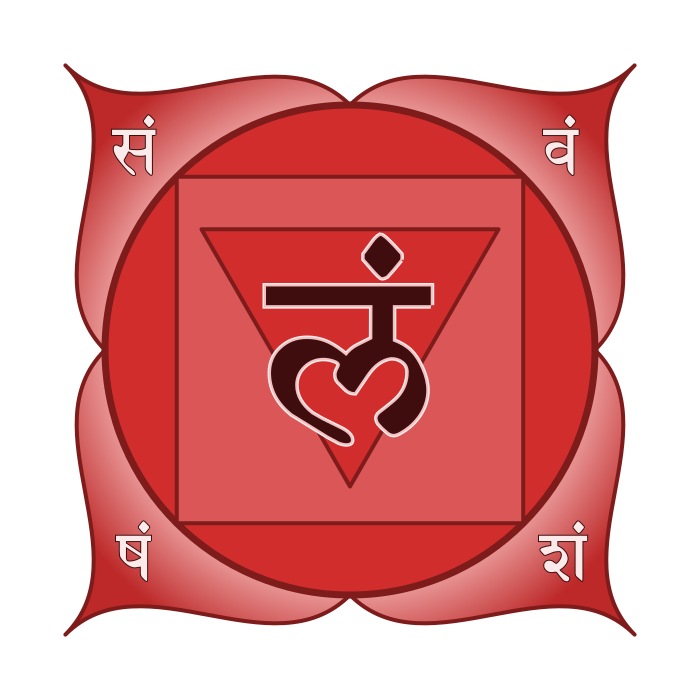
| Correspondence | Detail |
| Sanskrit name | Muladhara |
| Meaning | Root support |
| Location | Base of spine, perineum |
| Element | Earth |
| Seed sound | Lam |
| Color | Red |
| Lotus petals | Four |
| Body | Legs, feet, bones, large intestine, adrenals |
| Right | To be here, to have |
| Verb | I have |
The root chakra sits at the base of the spine and governs survival, safety, and your most basic sense of belonging in the world. Its name, Muladhara, means root support, and its whole concern is the foundation, the deep and often unspoken question of whether you have the right to be here at all. When this center is solid you feel grounded and secure, at home in your body, quietly confident that your basic needs will be met and that the floor will hold beneath you.
A deficient root shows up as anxiety and restlessness, a disconnection from the body, and trouble focusing. It brings chronic financial worry and a nervous sense that you can never quite settle anywhere. An excessive root leans the opposite way, into heaviness and sluggishness, hoarding, and rigidity.
Its fear of change grows so strong it becomes an addiction to security. The tradition ties this center to the element earth and the seed sound Lam, and the work of healing it is literal before it is spiritual. Time in nature, steady routine, physical movement, and honest attention to your body and your basic security all feed the root.
Sacral chakra (Svadhisthana)

| Correspondence | Detail |
| Sanskrit name | Svadhisthana |
| Meaning | Sweetness |
| Location | Lower abdomen, below the navel |
| Element | Water |
| Seed sound | Vam |
| Color | Orange |
| Lotus petals | Six |
| Body | Womb, genitals, kidneys, bladder, circulation |
| Right | To feel, to want |
| Verb | I feel |
The sacral chakra sits in the lower abdomen, a few finger widths below the navel, and governs emotion, pleasure, sexuality, and creativity. Its name, Svadhisthana, means sweetness, a fitting word for the center of desire and delight, and its right is the right to feel your feelings and to want what you want without shame. A balanced sacral center lets emotion move through you freely and lets pleasure be simple, so you can enjoy your body, your senses, and your creative flow without guilt or grasping.
A deficient sacral center appears as rigidity in body and attitude, a fear of pleasure, and a flatness where feeling should be. It also brings poor social ease and a lack of desire or passion. An excessive one runs the other way, into emotional overwhelm and restlessness, chasing pleasure or drama to feel something.
It leans on others or on habits to soothe a deeper ache. Its element is water and its seed sound is Vam, and the medicine is anything that restores flow. Movement, dance, creative play, and letting yourself actually feel an emotion through to its end all wake this center back up.
Solar plexus chakra (Manipura)
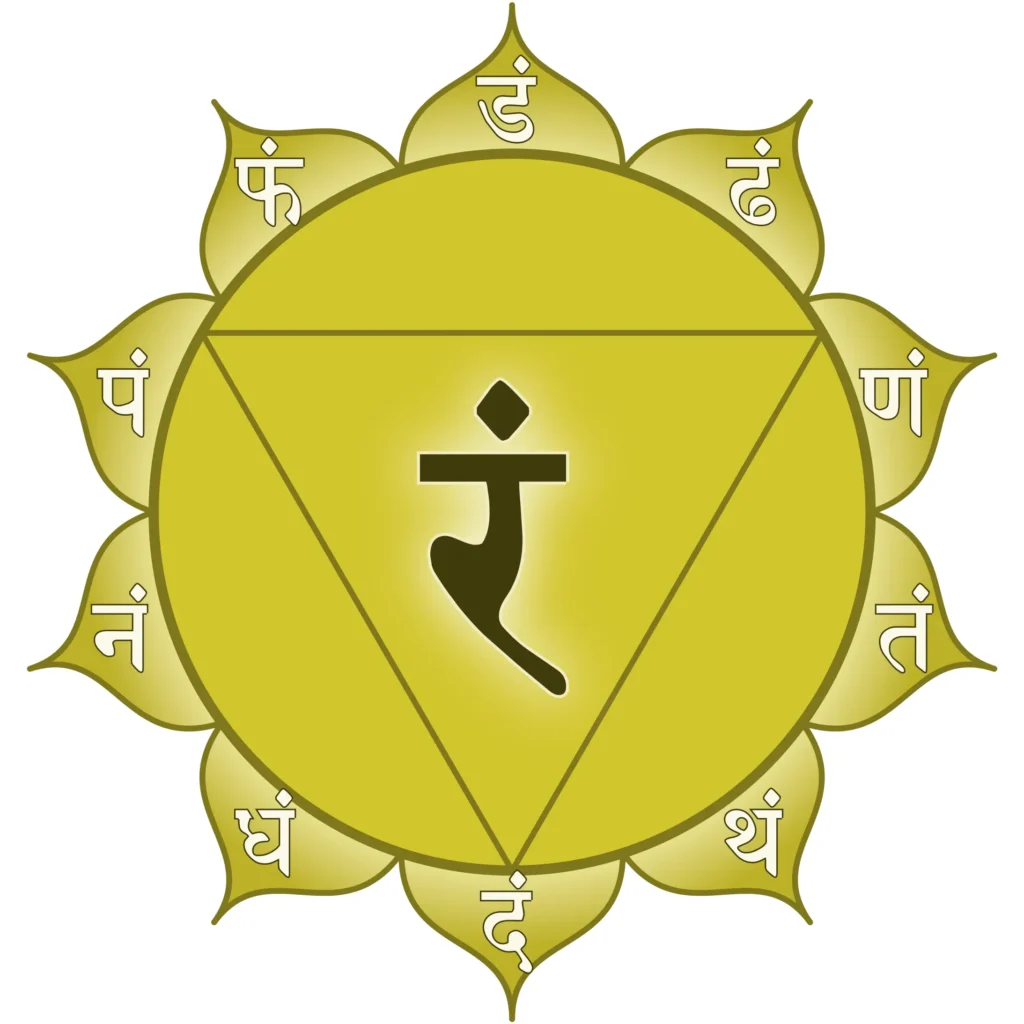
| Correspondence | Detail |
| Sanskrit name | Manipura |
| Meaning | Lustrous gem |
| Location | Above the navel, solar plexus |
| Element | Fire |
| Seed sound | Ram |
| Color | Yellow |
| Lotus petals | Ten |
| Body | Digestive system, pancreas, adrenals |
| Right | To act |
| Verb | I can |
The solar plexus chakra sits just above the navel and governs will, personal power, confidence, and the capacity to act. Its name, Manipura, means lustrous gem, and its theme is agency, the right to shape your own life through your choices.
When it is balanced you feel capable and self-assured, able to make a decision and follow it through. You can meet a challenge without either crumbling or having to dominate everyone in the room.
A deficient solar plexus shows up as low energy and weak will, a person easily manipulated and lacking follow-through. It brings low self-esteem and a sense of being powerless to change things. An excessive one swings into the need to control and dominate, into aggression and stubbornness.
Its overbearing drive usually hides insecurity underneath the bluster. Its element is fire and its seed sound is Ram, and the honest cure is competence rather than affirmation. Setting a real goal and meeting it, taking on a manageable challenge and finishing it, builds this center in a way no mantra alone can match.
Heart chakra (Anahata)
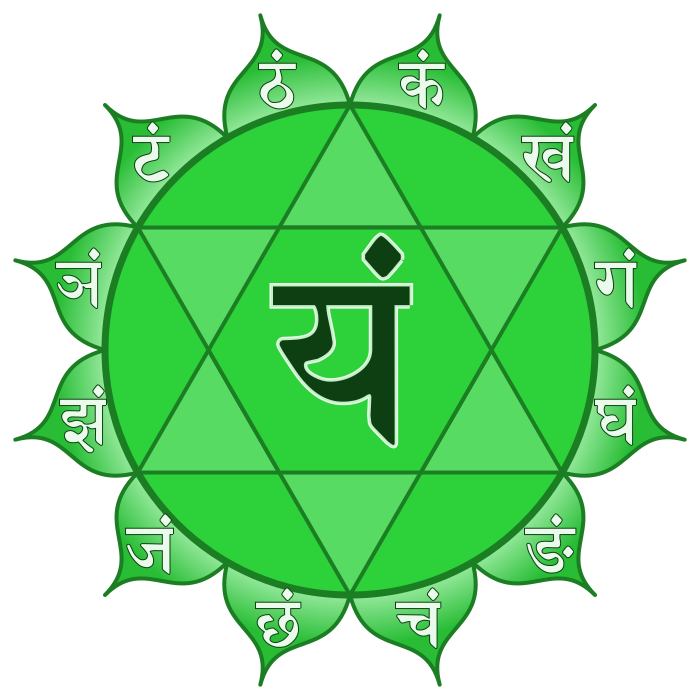
| Correspondence | Detail |
| Sanskrit name | Anahata |
| Meaning | Unstruck |
| Location | Center of the chest |
| Element | Air |
| Seed sound | Yam |
| Color | Green |
| Lotus petals | Twelve |
| Body | Heart, lungs, arms, hands, thymus |
| Right | To love and be loved |
| Verb | I love |
The heart chakra sits at the center of the chest and governs love, compassion, and connection. Its name, Anahata, means unstruck, a beautiful image drawn from the idea of a sound that plays without anything striking it, and it sits at the exact middle of the seven. That position matters, because the heart is the bridge where the grounded energy of the lower body meets the airy awareness of the upper centers, and its right is the right to love and to be loved in return.
A deficient heart center withdraws into isolation and loneliness, turning cold, critical, and judgmental, afraid of intimacy and quick to keep others at a distance. An excessive one loses its edges entirely, giving too much, depending on others for its worth, and mistaking self-sacrifice and possessiveness for love.
Its element is air and its seed sound is Yam, and the work runs both ways at once. A deficient heart has to risk letting others in, while an excessive heart has to learn that love includes holding on to yourself.
Throat chakra (Vishuddha)
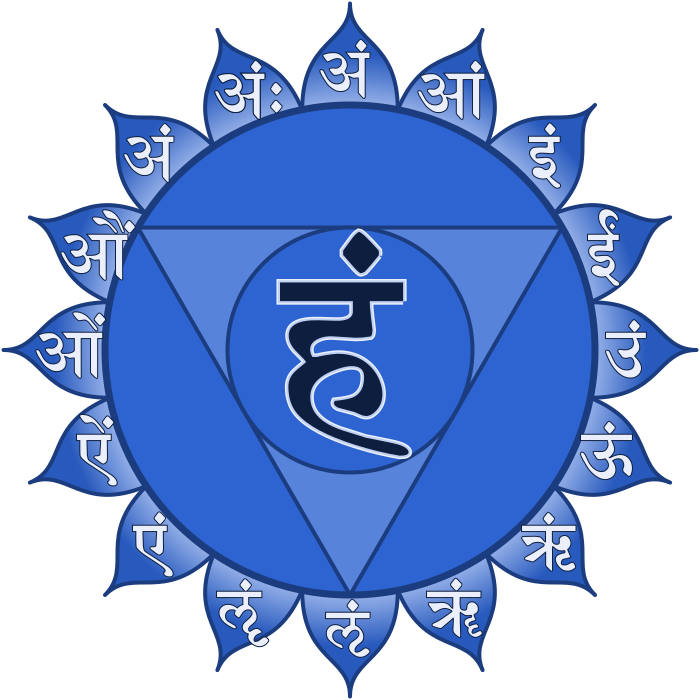
| Correspondence | Detail |
| Sanskrit name | Vishuddha |
| Meaning | Purification |
| Location | Throat |
| Element | Sound, ether |
| Seed sound | Ham |
| Color | Bright blue |
| Lotus petals | Sixteen |
| Body | Throat, neck, mouth, thyroid |
| Right | To speak and be heard |
| Verb | I speak |
The throat chakra sits at the throat and governs communication, truth, and self-expression. Its name, Vishuddha, means purification, and its right is the right to speak your truth and to be heard.
That is why it sits as the gateway between the feeling heart below and the knowing mind above. A balanced throat center lets you say what is true for you clearly and cleanly, and just as importantly lets you listen, so that expression becomes a two-way current rather than a broadcast.
A deficient throat center shows up as a fear of speaking, a small or weak voice, and difficulty putting feelings into words. It brings shyness and a habit of holding back what you really mean. An excessive one overwhelms the channel in the other direction, talking too much, interrupting, and dominating every conversation.
It leaves no silence in which to actually hear another person. Its element is sound and its seed sound is Ham, and honest expression in any form works it. Speaking up when it matters, singing, writing, and above all learning to listen all clear and strengthen this center.
Third eye chakra (Ajna)
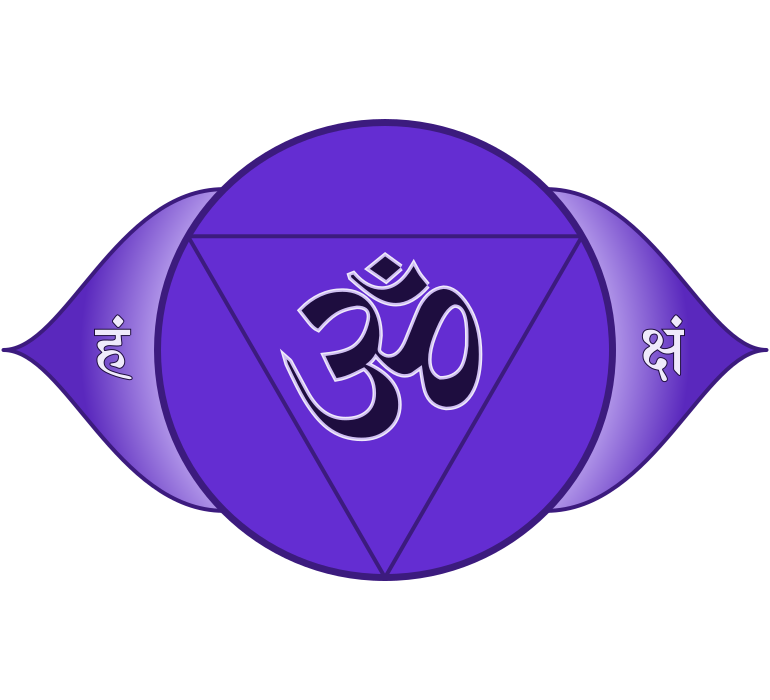
| Correspondence | Detail |
| Sanskrit name | Ajna |
| Meaning | To perceive, to command |
| Location | Brow, center of the head |
| Element | Light |
| Seed sound | Om |
| Color | Indigo |
| Lotus petals | Two |
| Body | Eyes, brain, pineal gland |
| Right | To see |
| Verb | I see |
The third eye chakra sits at the brow, between and slightly above the eyes, and governs intuition, insight, imagination, and inner vision. Its name, Ajna, means to perceive and to command, and it is the center most people mean when they talk about opening the third eye.
This is the center I went deepest on in my guide to the pineal gland and the third eye, and its right is the right to see, both outwardly and inwardly. When it is balanced you think clearly, picture things vividly, and trust the quiet knowing that arrives faster than reason.
A deficient third eye appears as poor imagination, difficulty visualizing, and weak memory. It brings trouble picturing the future, poor dream recall, and a habit of dismissing intuition as nonsense. An excessive one tips into the opposite trouble, lost in fantasy and daydream, or plagued by intrusive images.
It can fixate on visions and portents at the expense of ordinary living. Its element is light and its seed sound is Om, and the practices that serve it are the classic inner ones. Meditation, visualization, working with dreams, and steady quiet attention to the point between the brows all develop this center.
Crown chakra (Sahasrara)

| Correspondence | Detail |
| Sanskrit name | Sahasrara |
| Meaning | Thousandfold |
| Location | Top of the head |
| Element | Thought, consciousness |
| Seed sound | Silence, or Om |
| Color | Violet to white |
| Lotus petals | A thousand |
| Body | Brain, nervous system, pituitary |
| Right | To know |
| Verb | I know |
The crown chakra sits at the very top of the head and governs awareness, meaning, and connection to something larger than the separate self. Its name, Sahasrara, means thousandfold, pictured as a lotus of a thousand petals, and it represents the summit of the whole system where individual consciousness opens onto the universal. Its right is the right to know, and when it opens you feel woven into something greater, carrying a quiet sense of purpose that does not depend on your circumstances.
A deficient crown center shows up as spiritual cynicism, apathy, and rigid belief, with a flat conviction that nothing means anything beyond the material. An excessive one overactivates the head at the expense of the body, appearing as overintellectualization, spiritual obsession, or living so far up in ideas that ordinary life goes neglected.
Its element is thought or pure consciousness, and unlike the others it opens less through direct effort than through everything below it coming into order. That is why the humble work of tending the six centers beneath it matters as much as meditation itself.
How the Chakras Work Together
The seven are not seven separate machines but one connected system, and they lean on each other constantly. Tradition describes two great currents moving through the central column. A liberating current rises from the root toward the crown seeking freedom and spirit, while a manifesting current descends from the crown toward the root seeking form and grounding.
A healthy system lets both flow, so that spirit and matter meet in the middle at the heart rather than pulling a person apart. A block in one center almost always presses on its neighbors, which is why chasing a single chakra in isolation so rarely solves anything.
This is also why I keep steering beginners back down to the humble lower centers. The temptation is always to reach straight for the third eye and crown, since those carry the glamour of intuition and transcendence, the parts that sound impressive, and it is the single most common mistake I see. A shaky root and a closed heart, though, will quietly undermine anything you try to build on top of them.
A great deal of what looks like spiritual crisis is really an ungrounded upper system with no foundation to stand on. The steadier path tends the base first and lets the higher centers open as the ground beneath them firms up. The whole arrangement is one layer of the subtle body, which I cover more widely in my guide to the aura.
Kundalini: The Energy That Rises Through the Chakras
No account of the chakras is complete without the force the whole system was built to carry. Kundalini is the name tradition gives to a dormant spiritual energy said to lie coiled at the base of the spine, in the root chakra, waiting. The word means coiled one, and the classic image is a serpent asleep with its tail in its mouth, holding the potential of your full awakening in a compressed and resting form.
When kundalini stirs and begins to rise, it travels up the central channel, the sushumna, passing through each chakra in turn from root to crown. As it reaches a center it activates and opens it, and the quality of that opening depends on how prepared the center already is. This is the deepest reason the tradition insists on working from the bottom up, since a strong energy rising into a knotted or unbalanced center can be turbulent rather than blissful.
The awakening of kundalini is described as the summit of yogic practice, the union of the rising energy with the crown, and it is not something to force. Accounts of a sudden, unprepared rising describe it as overwhelming, since a great deal of energy moving through an unready system can destabilize both body and mind.
I treat kundalini as something to prepare for rather than chase, a natural unfolding that a balanced, patient practice invites in its own time. Tending your chakras center by center is exactly that preparation, and it is the only approach to this energy I would recommend to anyone.
The Lower Triangle, the Upper Triangle, and the Bridge
There is an elegant structure hidden in the seven that helps the whole system make sense. The lower three chakras, root, sacral, and solar plexus, form a lower triangle concerned with the material world, with survival, sensation, and personal power. These are the centers of the embodied self, the part of you that lives in a body and acts on the world, sometimes called the personal chakras because they govern your life as an individual creature.
The upper three, throat, third eye, and crown, form an upper triangle concerned with the world of spirit, with expression, vision, and transcendence. These centers reach beyond the personal toward the universal, toward truth, insight, and connection with something larger than yourself. Where the lower triangle draws energy down into form, the upper triangle lifts it toward consciousness and meaning, and a life lived in only one triangle tends toward its own kind of imbalance.
The heart sits alone in the middle, and that is the whole point of it. As the fourth of seven, it is the exact meeting place of the two triangles, the hinge where matter and spirit reconcile.
A grounded person whose heart is open lets the strength of the lower centers rise into love, and the awareness of the upper centers descend into warmth. This is why so many traditions place love at the center of the spiritual life.
How Do You Start Working With Your Chakras?
Start by finding your two or three most imbalanced centers rather than trying to fix all seven at once. Read back through the deficient and excessive signs above and mark the ones you recognize in yourself with real honesty, since the ones you would rather skip are usually the ones that matter. Those become your focus, and you leave the balanced centers alone.
First, tell deficient from excessive
Everything you do next depends on which direction the center leans, so name that first. A deficient center is withdrawn and underactive, and it needs you to draw energy toward its theme, to activate and engage it.
An excessive center is overactive and stuck open, and it needs the opposite, some grounding and release so the trapped energy can move on. Cranking an already overactive center harder, which is what happens when you treat every problem as a blockage, usually makes it worse.
Practices that activate a deficient center
When a center is deficient you want to gently wake it up and feed its theme. The classic tools are direct: sit in meditation with your attention resting on the center’s location in the body, chant its seed sound aloud so you feel the vibration there, and visualize its color glowing and growing brighter at that spot. Lam for the root, Vam for the sacral, Ram for the solar plexus, Yam for the heart, Ham for the throat, Om for the third eye, and silence for the crown.
Then take it off the cushion and into your life, since a chakra opens through what you do as much as what you meditate on. A deficient root wants physical movement, time in nature, and steady routine. A deficient heart wants small risks toward closeness and honest connection.
A deficient throat wants you to speak up, sing, or write, and a deficient third eye wants dreamwork and visualization. Choose one real change that engages the theme and do it repeatedly.
Practices that calm an excessive center
When a center is excessive you do the reverse, drawing energy out of it and grounding the excess. Grounding is the core move, so bring your attention and your breath down into the lower body and the feet, and spend time physically settling through walking, stretching, or rest. Where activation feeds a center, here you soothe and discharge it, letting the stuck energy drain downward and out.
The life changes reverse too. An excessive root loosens its grip through releasing control and accepting change, an excessive heart heals by rebuilding boundaries and holding on to itself, and an excessive throat improves by listening more than it speaks.
The pattern is always the same. A deficient center needs you to lean in, an excessive one needs you to let go.
Keep it patient and grounded
The aim is never to force a chakra open by will, which only creates strain, but to restore its natural balance a little at a time. Work with one or two centers for a few weeks before you judge anything, and keep the lower centers grounded while you do, since a stable base makes everything above it safer to open. Steady, grounded attention has done far more for me than any dramatic single session ever did, and if you take one thing from all of this, let it be that the system rewards consistency over intensity every time.
FAQ
From base to crown they are the root (Muladhara), sacral (Svadhisthana), solar plexus (Manipura), heart (Anahata), throat (Vishuddha), third eye (Ajna), and crown (Sahasrara). The lower three govern grounding, the heart bridges the middle, and the upper three govern expression, insight, and meaning.
Read the behaviors and feelings tied to each center rather than looking for colors. A struggling chakra reveals itself either through deficiency, where you avoid its theme, or through excess, where you push too hard. Matching your pattern to one of those directions tells you more than any quick test.
Yes, and this is the piece that most often gets left out. A chakra can be excessive rather than deficient, overworking its theme in a way that never satisfies the need underneath, and it calls for grounding and release rather than more activation.
No, the seven rainbow colors are a modern Western addition. The chakras themselves are genuinely ancient, described in the Vedas and detailed in later tantric texts like the Sat-Cakra-Nirupana. The one-color-per-center scheme spread only in the twentieth century, so treat the colors as a useful aid rather than an ancient truth.
The chakras are energy centers arranged along the spine, while the aura is the energy field said to surround the whole body. They belong to the same subtle body and work together, with the chakras feeding, coloring, and shaping the aura around them.
Start with whichever center you most clearly recognize as imbalanced, and when in doubt begin low rather than high. The lower centers form the foundation the rest depends on, so grounding the base first makes the upper centers far easier to open later.