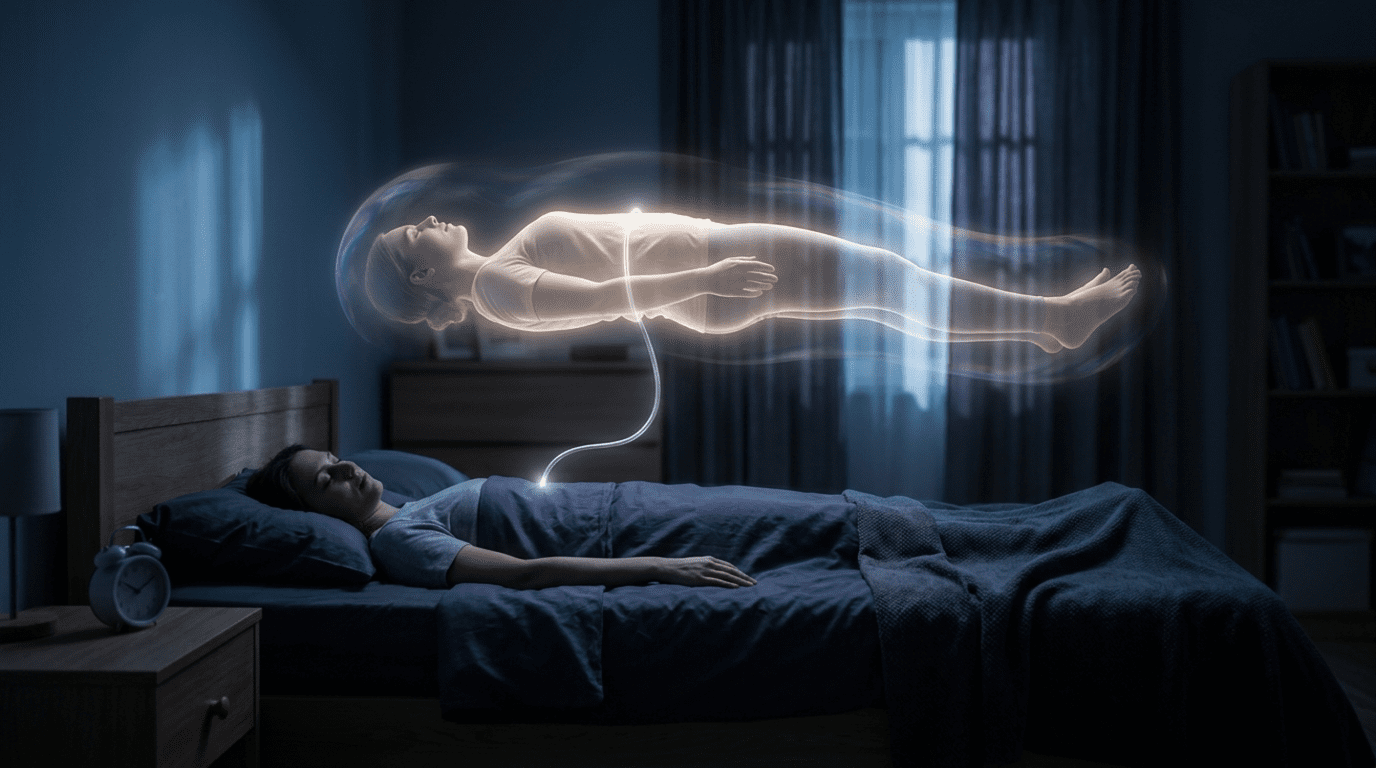
Every night, while your body sleeps, some part of you slips loose and travels, and by morning you have forgotten you ever left. Astral projection is the old craft of staying awake through that crossing, so that you go where you choose, see clearly, and carry the memory home.
It is real, and it is learnable, and the work asks for patience more than talent. Before any of that, however, comes the step that matters most, which is guarding your energy. Your body stays safe out there, but an unguarded mind can return carrying something it never invited.
If you have ever felt a strange buzzing rise as you drifted off and then snapped awake in fright, you were nearer the door than you knew.
What Astral Projection Is
Astral projection means moving your waking awareness out of your body into a lighter one, so that you can see and travel while your body rests, and it keeps you awake the whole way through. The event you are reaching for is the moment that awareness stands outside the flesh, and you come back from it with the memory intact.
Definition: Astral projection is the deliberate practice of moving your awareness out of the physical body into a finer one, so that you perceive and travel beyond the ordinary senses while the body rests.
The truer picture is far gentler than the ghostly double that most people imagine shooting across the room. Ophiel, who wrote one of the clearest manuals on this, corrected that old image long ago. In his telling you only shift your attention into a finer body you already wear, so the whole practice suddenly feels possible, because you are working with something you already own.
The same crossing happens by itself, with no training at all, during a shock or close to death, and we then call it a near-death experience. What you are learning here, by contrast, is the calm and deliberate version that you bring on yourself, by choice and in your own bed.
Why Bother Leaving Your Body
People have chased this for thousands of years, from the Egyptian teaching of the ba and the ka down to the Theosophists and occultists of the nineteenth century who made it widely known by its modern name. The reason has hardly changed, which is the wish to know, firsthand, that you are more than a body. A single clear trip outside the flesh tends to soften the fear of death more than any book or sermon, since you come away having felt the truth of it rather than merely believing it.
Beyond that, the inner worlds are where guides and teachers can be met, and where the roots of your waking troubles often show themselves plainly. So you might go for proof, or for guidance, or simply to see what is there, and any one of those is reason enough to begin.
Astral Projection, Out-of-Body Experiences, and Lucid Dreaming
These three words get tangled together constantly, so it helps to settle the difference before you go on. An out-of-body experience is the event itself, the moment your awareness stands outside your body, whereas astral projection is the deliberate practice that brings that event on.
A lucid dream, meanwhile, sits a step away from both of them. Inside a lucid dream you know that you are dreaming and can bend the scene to your will, yet you remain inside a world your own mind is spinning. In a true projection, by contrast, the world pushes back, carries on without you, and feels more solid than waking life.
Definition: A lucid dream is a dream in which you know you are dreaming and can shape it, whereas an out-of-body experience places your awareness in a world that resists you and runs on without you.
All three rest on one engine, which is a mind that stays awake while the body falls asleep. That single state, awake in mind yet asleep in body, is what every method works toward. The lucid dream earns special attention here, since it gives you one of the most dependable doorways into a full projection.
You Already Do This Every Night
You leave your body every night while you sleep, and you forget the trip by morning, which is the quiet good news underneath this whole practice. Most of your awareness stays settled in your body, while a finer part of you drifts off through the inner worlds and slips back before you wake.
That sudden falling feeling that jerks you awake, in fact, is simply that finer part dropping home a little too fast.
Because of that, the work turns out to be gentle, since you are really only learning to stay awake at a threshold you already cross each and every night. My own dream journal is what made this real for me. Reading it back showed how often I had hovered right at the edge of a projection, only to wave the whole thing off as an ordinary vivid dream.
Your Bodies, the Planes, and the Cord
You wear more than one body, and each finer body belongs to a finer world. A projection is really a short climb up that ladder, where the scenery around you tells you how high you have gone. The map matters far less than the climbing, yet a rough sense of it keeps you from feeling lost.
Definition: The astral body is the vehicle of feeling and imagination that your awareness moves into during projection, lighter than the physical body and able to pass where flesh cannot.
The ladder begins with your physical body. The etheric body, a thin layer of life force that keeps the flesh alive, sits woven into it like warmth held in a stone. Above the etheric spreads the astral, the wide world of feeling and image where most beginners travel.
It shades gradually from a lower part that mirrors your bedroom up to a higher part where solid shapes melt into color. Traditions disagree about how many bodies there are and what to name them, so I hold the count loosely and trust the practice instead.
The Silver Cord, and Whether It Can Snap
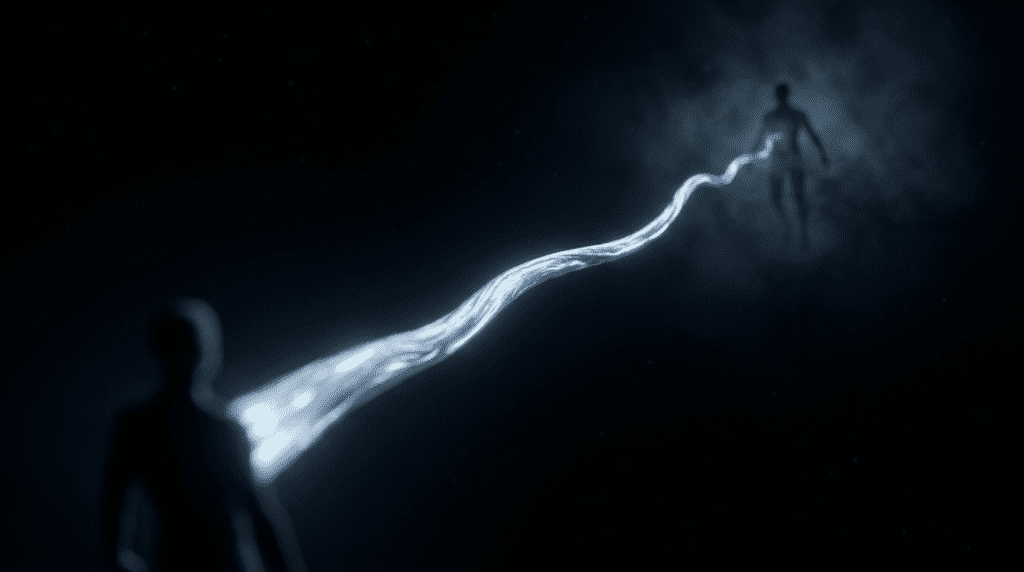
The silver cord is the felt line that links your traveling self back to your sleeping body, and its whole purpose is to draw you home rather than to hold you out there. Muldoon, who wrote the 1929 classic with Hereward Carrington, pictured it as an elastic cable that stretches and thins the further you drift.
Definition: The silver cord is the living link between your projected awareness and your physical body, usually felt rather than seen, that draws you safely back to the flesh.
People love the story that cutting the cord will kill you, yet nothing in real practice supports it, and a good deal of practice quietly contradicts it. You are always free to return, and the work carries no threat to your life, because the cord draws you back the instant your attention wavers or your body stirs.
In my own sense of it, the cord feels more like a current of attention than a rope under strain. You usually have to go looking for it before you notice it at all.
Where You Actually End Up
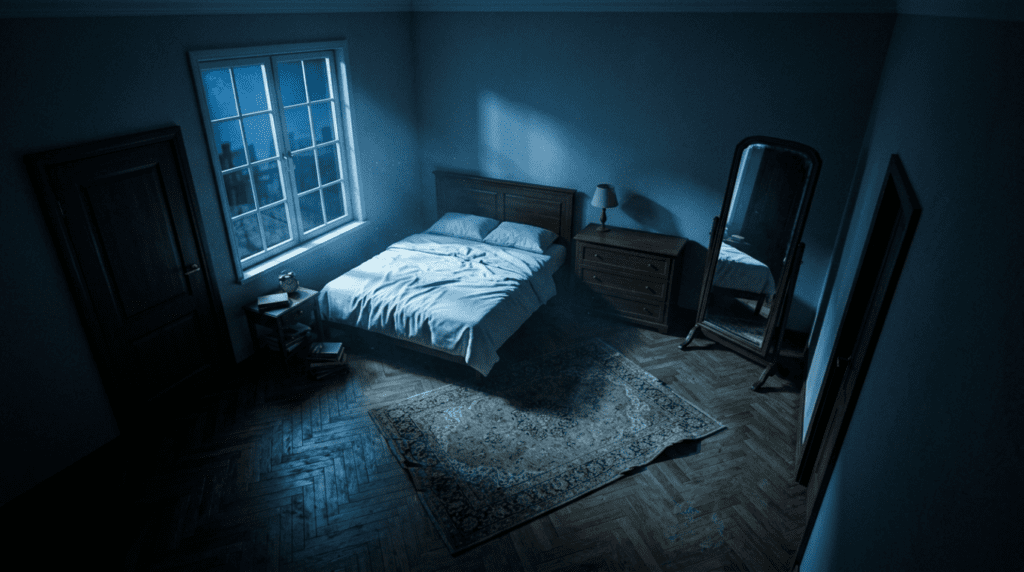
Your first projection almost always sets you down in a near-copy of your own bedroom rather than some far country. Reading the tiny differences is how you confirm that you truly left. Robert Bruce called this nearest layer the real-time zone, the buffer that lies between the waking world and the deeper astral.
Definition: The real-time zone is the layer closest to waking life, a near-perfect copy of your surroundings in real time, where most first projections happen before any travel deeper into the astral.
This layer holds the same furniture and the same people as your waking room. Even so, it carries small slips, such as a mirror that should not be there or a door set in the wrong wall. Those slips are exactly what prove that you crossed over.
The deeper astral planes lie further out, and they look less and less like your bedroom the higher you rise. Many travelers spend years close to home and only rarely go that deep. One more thing lives in this layer as well, the false awakening.
Here you feel certain you have woken and begun your morning until something looks subtly wrong, because you never truly returned and were projecting the whole time. Catching that wrongness is the same skill that confirms a real exit.
Protect Your Energy First
Protecting your energy comes before every attempt, without exception, because an open and unguarded field shines out like a porch light in the dark and draws whatever happens to be passing. The wrong sort of thing can then latch on and ride home with you.
Definition: An energetic attachment is a being or thread of foreign force that fastens onto your aura during travel and then drains you, unsettles you, or colors your thoughts once you are back.
Tyson writes plainly about astral vampires, spirits that feed on your energy wherever they find an opening, with no more malice than a mosquito. Bruce then fills in the other half of the picture, since fear and resentment drag you down toward the lower astral, where the rougher things keep house. Fear in particular is the bait, because whatever feeds on the living is drawn to fear, anger, and grief.
The danger gets twisted in both directions, however, so here is the plain version. Your body always stays occupied while you travel, which is why possession during a projection is close to impossible, and the real risk lies elsewhere. That quieter risk is a passenger which clings to your aura, follows you home, and surfaces later as bad dreams, a heaviness you did not have before, a shorter temper, or thoughts that feel like someone else’s.
A Simple Way to Seal Yourself
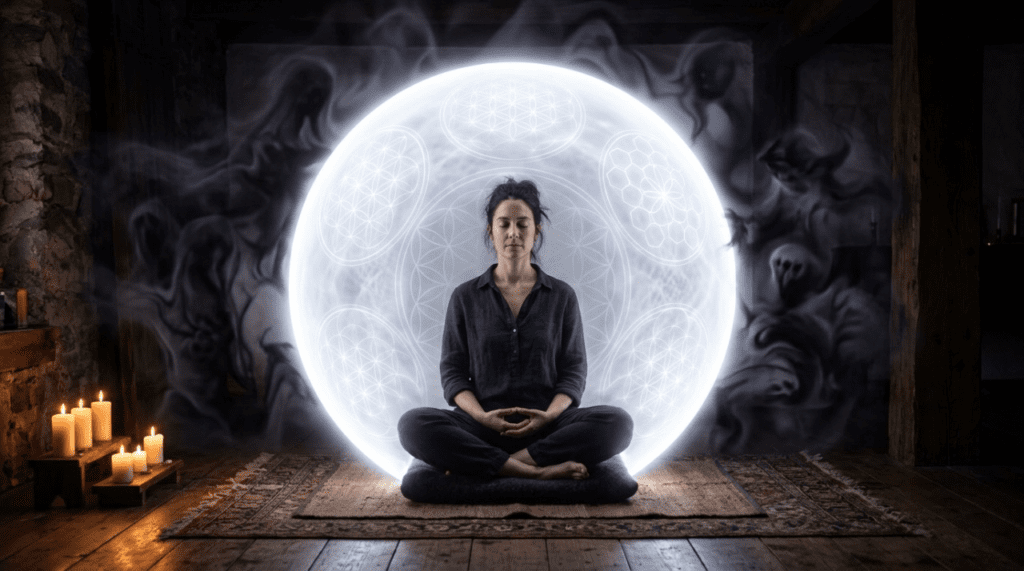
The seal is four short moves you run before you lie down, and once the habit settles it takes barely two minutes:
- Cleanse. Wash, burn a little cleansing smoke, or sweep the room with salt, so that the day’s grime falls away from you.
- Ground. Breathe low into your belly and feel a line drop from your spine down into the earth, so that you settle in anchored and steady.
- Shield. Picture a ball of clear light closing all the way around you, with no gap anywhere, and hold it bright and solid in your mind.
- Call. Reach for whatever protection you already trust, and ask, in your own words, for safe passage and a clean return.
That fourth step is yours to fill, since protection works through conviction rather than through any single method. For one person it is a prayer, for another a guardian or guide called by name, and for another a symbol of their faith or simply that ball of light held brighter.
Tyson favors drawn signs and old names of power, while other traditions lean on a cross or a spoken word. Any of them serves, so long as you mean it, because the inner worlds answer to a clear and steady intent far more than to the shape it wears.
If Something Follows You Home
You can usually tell by how you feel over the next few days. A clean trip leaves you light and clear, while a passenger leaves you heavy, drained, snappish, or haunted by the same dark presence night after night. On their own these signs are easy to wave off, yet together they form a pattern you learn to read quickly.
I notice the difference most on the nights I cut corners. A trip I sealed properly leaves me clear the next morning, whereas the few times I rushed the seal while tired, I woke foggy and irritable in a way I have come to recognize at once. That pattern held often enough that I stopped skipping the routine, even on the nights I least felt like bothering with it.
Should you suspect a passenger, stop projecting and clear yourself before anything else. That means cleansing your body and your home, cutting the thread that ties you to whatever latched on, and calling your own energy back to you by name and by will. Salt baths, grounding, and honest rest then close the field again, so that you go back to the practice only once you feel whole.
Set Up Your Space and Your Timing
A projection really begins before you close your eyes, in a quiet, dim room, with loose clothing and a posture you do not normally sleep in. Robert Monroe, whose book Journeys Out of the Body shaped much of how this gets taught, was exact about the setup, and his points still hold today.
Begin by taking off any jewelry or anything pressing against your skin. Then darken the room until no light reaches you through closed eyes, though leaving it just short of pitch black.
Loosen your clothes and keep yourself a touch warmer than feels comfortable, since a cold body tightens up without ever telling you. Leave a few hours, too, between a heavy meal or any alcohol and your attempt, because both drag you straight down into ordinary sleep.
Lie on your back rather than in your usual sleeping pose, because your body has learned to drop straight into sleep in the position it always sleeps in, and here you want the opposite. Timing then matters as much as posture, so the easiest window falls between three and five in the morning, or right after a short nap, when you are rested rather than worn out. A worn-out body simply falls asleep, while a rested one can hover at the edge for as long as you need.
If silence is hard to find, sound can carry you instead. The binaural tracks from Monroe’s institute, often called Hemi-Sync, nudge you toward that edge-of-sleep state, and any steady, wordless audio that calms you does much the same job. None of it is required, of course, and a plain quiet room works perfectly well.
Build the Basics Before You Try
The exit itself is the small last step. The real work is a handful of basics you build over a few weeks, since skipping them is what leaves people practicing for months with nothing to show. For that reason I lean on them in order, and I practice at the same time each day so that the deeper mind learns the rhythm.
Relax Deeper Than Sleep
Relaxation deeper than ordinary sleep is the floor the whole thing stands on, because a body that merely feels loose can still hold the kind of tension that pins you in place. To reach it, tense each muscle group hard for about five seconds and then let it drop completely, working upward from your feet to your face. The whole sweep takes ten to fifteen minutes, and you treat any leftover tightness as a wall to melt before you move on.
Steady Your Breath
Slow, low breathing is the trunk the other skills grow from, since it calms the body, quiets the mind, and gathers the energy a projection runs on. Once you are relaxed, breathe down into your belly to a slow count, around four counts in and four counts out, and let each breath grow lighter as you settle. After a few minutes the breathing almost forgets itself, and that quiet is exactly the edge you are after.
Wake Up Your Energy Body
Your energy body holds centers that act like gates between the flesh and the traveling self, and rousing them opens the channels a projection flows along. Move your attention slowly up the midline of your body, pausing at the belly, the chest, the throat, the brow, and the crown.
Feel each spot warm and tingle as you go. Bruce calls this energy raising, and doing it for a few minutes before sleep also deepens your dreams and makes a lucid one more likely.
Remember Your Dreams
Strong dream recall comes before anything that leans on dreams, since a projection slips away the moment you reach for it, exactly like a dream. You can only keep what you remember. Keep a notebook by the bed and write within the first few seconds of waking, before you move or open your eyes, even if it is only three or four words.
Within a couple of weeks the dreams come back to you in detail. Pair the journal with a short, calm line you repeat at bedtime, something like “I stay aware as my body falls asleep,” since the deeper mind takes a gentle phrase far more kindly than a warning.
Catch the Edge of Sleep
The whole art turns on a single knack, which is holding your awareness at the exact moment you fall asleep, in the hazy band the old books call the hypnagogic state. Ophiel named this in-between place the Neither State, and you find it by lying still and watching yourself dissolve toward sleep without quite tipping over.
Muldoon taught a neat way in, where you hold one forearm upright and balanced on the elbow, so that as you begin to nod off the arm drops and tugs you back to the edge. You ride that edge again and again until you can find it without the prop, and you take a night off whenever you are exhausted, since forcing it while tired only sends you under.
Choose a Method and Leave Your Body
You pick one method and stay with it for weeks rather than jumping around, since they all work only once the basics are built and your energy is sealed. Each one simply coaxes the same exit in its own way, so the best choice is whichever fits the way your mind already runs. The first few suit beginners, while the later ones reward a little practice.
Wake and Return
Waking partway through the night and returning to bed is the gentlest opener there is, because your body stays heavy with sleep while your mind comes back up easily. To use it, set an alarm for four to six hours after you fall asleep, which usually lands you inside that three-to-five window.
When the alarm wakes you, get up for fifteen to thirty minutes with the lights low, holding projection in mind the whole time. Then lie back on your back, relax, and settle on one quiet, certain wish to leave your body.
Muldoon called the engine behind this the passive will, that odd and unforced certainty you feel in the dead of night. It works best when it stays steady and loose, almost a daydream you happen to believe completely.
The Rope and the Feather
Once you are deep, still, and right at the edge of sleep, picture a thick rope hanging straight down over your chest, close enough to grab. Then, without moving a single muscle, reach up with imagined hands and pull yourself up it, hand over hand, feeling the rough fibers slide through your grip.
A faint dizziness builds as you climb, and you keep climbing into it, since that very motion is what loosens you from the body. The feather works the same way in reverse, where you become a falling feather and sink a little lower with each out-breath, until the drifting deepens into the trance.

The Roll-Out and the Lift-Out
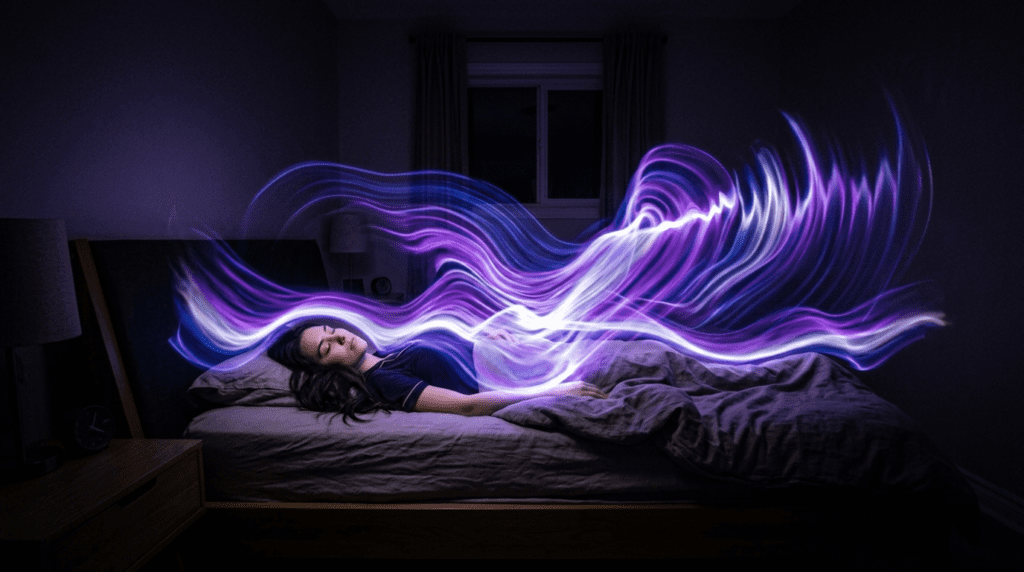
Robert Monroe built his whole method around the vibrations, so that once they arrive you slip out by one of two gentle moves rather than by any effort of muscle.
Definition: The vibrational state is the wave of buzzing, tingling energy that runs through the body just before separation, felt in the head and limbs, and treated as the sign that a projection is starting.
For the lift-out, you think yourself lighter and lighter and hold the single thought of how good it would feel to float upward, and the rise tends to happen on its own. For the roll-out, you try to turn over as though rolling in bed without moving a muscle, twisting from the top until you roll into your second body. Once you find yourself beside the physical one, a thought of floating lifts you clear.
A gentle way to test the water first is a partial exit. Reach one imagined hand toward a nearby wall, feel it pass through, and then draw it back before you go any further.
The Dream-Control Method
You can also reach the astral by building the right dream and steering it as you cross into sleep. This sits at the heart of Muldoon’s dream-control method, where the dream becomes the engine that lifts you out. Its action only has to carry you up and away, since that rising motion mirrors the real movement of leaving the body.
So you pick one scene you enjoy that lifts you, such as an elevator climbing high, rising water that floats you up, or a long ladder. Then you hold that single scene clearly as you drop off.
Using the same scene every night lets the deeper mind learn it. Muldoon found that, should you come fully awake inside the dream, you often arrive standing in the astral right where the dream had reached.
Turn a Lucid Dream Into a Projection
Turning a lucid dream into a projection is the doorway I lean on most, and it suits anyone who already dreams vividly, since a lucid dream drops you straight into the state a projection needs. Oliver Fox pioneered this through what he called the Dream of Knowledge, the moment your judgment wakes inside a dream and recognizes the scene as impossible. Ophiel later sharpened the same idea into a faculty he named the Critical Facility.
Build the habit through the day with reality checks, pausing five or six times to count your fingers or to push off the floor and try to float. In a dream, after all, the count comes out wrong and the floor lets you go.
That same test then fires inside a dream and wakes your judgment. The moment you know you are dreaming, you steady yourself, turn from the dream scene, and hold the firm intent to rise, so that the dream gives way to the wider planes.
The Thirst Method
A strong, unmet need can move your traveling body on its own, and Muldoon leaned on thirst because it bites hardest and grips the deeper mind completely. So you go without water through the day to build real thirst, and before bed you set a glass where you normally drink.
Then you sit and stare into the water, picturing your traveling body rising and crossing to the glass, and you run that route through your mind again and again before lying down still thirsty. The craving keeps the deeper mind moving while you sleep, so that the route you rehearsed becomes the very path it takes to the water.
The In-House Route
A gentle starter is Ophiel’s Little System, where you walk a fixed path through your own home in your traveling body, since keeping the first trips close and familiar settles the nerves. Choose a short route through rooms you know well, learn it by heart in the flesh, and mark six clear landmarks along the way.
After that you lie down, relax fully, and move along that exact route in your imagination, seeing each landmark through your traveling eyes until the inner walk feels as solid as the real one. The control you build here then carries straight into the bolder methods.
Signs You Are Getting Close
Progress tends to show up as a string of smaller signs well before a full exit, so learning to read them keeps you from quitting one step short. They usually arrive in roughly this order, though everyone differs a little.
The first sign is simply remembering your dreams in detail, which tells you your recall is now sharp enough to hold a projection. After that you begin catching yourself half-aware at the edge of sleep, awake in mind while the body sinks, and soon the inner sounds and the first faint vibrations follow.
Along with them come patches of color or light drifting behind your closed eyes, which Ophiel watched for as the gateway to breaking through. Closer still, a hand or a foot slips free on its own, or you wake convinced you got up when in truth you never did. Every one of these is the threshold opening a little wider, so you can greet each as a sign that the work is taking.
What You Feel as You Separate
The signs that you are slipping out arrive as plain body sensations, and every one of them means you are close rather than in danger, so you can read them as green lights. Most often you feel some mix of the following:
- A deep vibration rolling through you, like current down a wire or electricity through your limbs.
- A roar, hum, or buzz in your ears, sometimes loud enough to startle you awake if you let it.
- Pressure at the back of your head, which Muldoon felt right before he floated up to standing above his bed.
- A pounding heart with nothing behind it, racing as your energy body wakes.
- A sharp click at the very moment your traveling body comes free.
The single rule over all of it is to stay loose and follow through, because tension snaps you straight back, and Muldoon called that backward jolt repercussion. My own early tries died right here, since I would feel the vibrations build and then flinch. It took weeks of deciding in advance to ride them out before that reflex finally let go.
Should the feelings come on weak, gently rolling your closed eyes up toward your brow will often turn a flutter into a full surge. Should they instead climb to a head-splitting roar, that means you are forcing it, so you ease off and let the state come to you on its own.
What to Do Once You Are Out
Right at the start you may find yourself unable to move at all, since the body often locks while a quiet force seems to lift you upright, in what Muldoon called astral catalepsy. The thing that helps is to stop fighting it and let it pass, which it always does within moments. Close to your body you will also feel a steady pull tugging you back, strongest within about thirty feet. So you drift clear of that pull to move freely, though there is no need to travel far on a first trip.
Your sight out here no longer runs through your eyes, which is why you can see in a dark room or through closed lids. The world around you may also carry those small slips that quietly confirm you are truly out. Look at your hands to steady the scene, where they often shimmer or seem to melt. Meet whatever crosses your path with plain courtesy, since the early trips are for finding your feet, so a slow look around your own home is plenty for the first few.
Tyson gives a whole chapter to manners out there, and the heart of it is simple, since you are a visitor. So you avoid bullying the locals or showing off, and you stay out of the heavier, darker places below, where the rougher things keep house.
A guide will often come to you if you wait for one rather than wandering off alone. Should anything turn hostile, the same protection you raised before you left still holds out here. So you keep it firm and keep your fear low, since fear is the only real grip these things have on you.
How to Come Back and Remember It
Coming back happens by itself, and you are always free to return. So the hard part is keeping the memory rather than finding the way home, and forcing it only makes it worse. When you choose to return, do it calmly instead of clawing awake. Lie your traveling body down in the same pose as the physical one, and let yourself drift back the way sleep drifts into morning.
The memory is the prize you can easily lose. As you slip back in, the trip downloads the way a dream does, hovering just out of reach, and Bruce calls this the shadow memory. At the moment you left, your awareness split in two, with one of you traveling and one of you asleep, and each kept its own memories. The trip stays hard to hold because those two streams never fully merge when you wake.
Just before you settle back in, fix one clear detail or a single phrase and hold it hard with feeling, which is what burns it into reach. The moment you wake, stay still, reach for that anchor, and write the trigger words first and the full story second, since whatever you fail to write is usually gone within minutes. Calling your own energy back to you as you return then leaves nothing of yourself behind.
When Nothing Happens, and How Long It Takes
Most beginners stall on the same short list, and each snag has a fix. A first exit usually lands within a few weeks to a few months of daily work, since steadiness matters far more than effort. You can nearly always trace a stall back to one of these few causes.
If you keep falling asleep, you are either too tired or too lightly relaxed, so you practice rested, go deeper with the muscle work, and use Muldoon’s upright-arm trick to hold the edge. When fear keeps throwing you back, the cure is the seal from earlier, since a traveler who has cleansed, grounded, shielded, and called has far less to fear. The shapes that loom at the edge of sleep are mostly your own mind painting the dark.
Should weeks pass with nothing at all, you are likely closer than you feel and quitting at the threshold. So you promise yourself in advance to ride out the vibrations, and you keep the journal, which often turns up trips you had and then forgot.
How long it truly takes varies more than anyone honest can pin down, since some people project on a first serious try while others practice for months. So I will not sell you a fixed date. What I can tell you is that the ones who keep a steady, protected, and unhurried practice are the ones who arrive in the end.
Going Further, Once the Basics Click
Once the simpler doorways come easily, two deeper paths open the way to richer travel, and both reward the patience that a first exit does not yet ask of you. They are where the practice turns from getting out toward what you actually do once you are there.
Ophiel’s Body of Light method has you build a vehicle on purpose instead of waiting for one to loosen. You begin with the Cabalistic Cross, touching your forehead, breast, and shoulders while naming the powers, and then you raise a glowing copy of yourself in the inner light and move your awareness into it.
Tyson’s astral doorways, meanwhile, work the other way around, turning a held symbol into a gate. A tattwa shape, a tarot card, or a rune, gazed at until it fills your mind, can grow into a door you step through. Both are journeys for later, once leaving the body has become easy.
FAQ
Your body stays safe and you always come back, so the real risks are an attachment or frightening yourself, and sealing your energy first handles both.
Yes, a being can fasten onto an unguarded field and trail you home, surfacing later as heaviness, mood swings, or recurring dreams, which is why you seal your energy before you go.
They are close cousins rather than twins, since a lucid dream is one you shape from inside, while leaving your body feels solid and more real than waking. The lucid dream still makes the best doorway in.
Most people feel deep vibrations, a floating pull, loud inner noises, and a clear sense of moving while the body lies still, all of it sharper and more real than a dream.
The hours between three and five in the morning, or just after a short nap, work best, since the body is rested enough to hover at the edge of sleep rather than drop under.