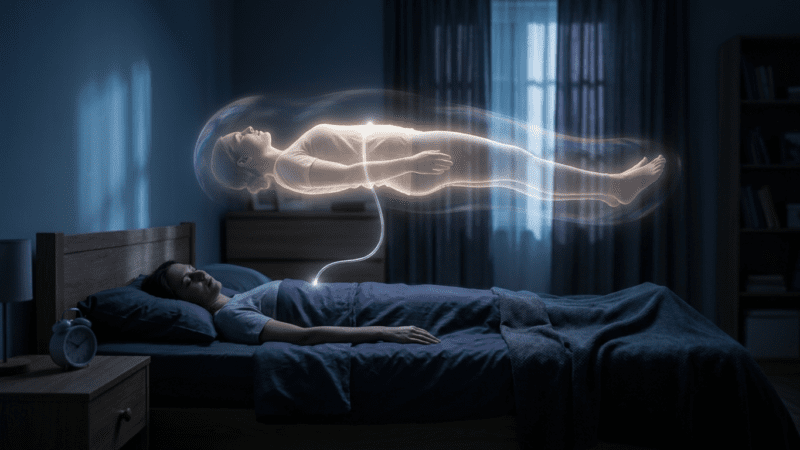
Every night your brain builds a complete world from nothing, and most people move through it without ever noticing they are inside it. Lucid dreaming is what happens when you notice while still asleep: you are in a dream, you know it, and what you can do with that awareness turns out to be one of the more remarkable things the human mind is capable of. And it can be learned.
What Lucid Dreaming Actually Is
Definition: A lucid dream is any dream in which you know you are dreaming while the dream is still happening. That single point of awareness is what makes it lucid, and it changes the entire experience: instead of moving through the dream passively, you are awake inside it, able to notice, choose, and respond.
The sensory experience of a lucid dream is fully convincing. Robert Waggoner, who logged approximately 1,000 lucid dreams over thirty years and wrote about them in “Lucid Dreaming: Gateway to the Inner Self,” describes the realism as total: surfaces have texture, light behaves normally, and knowing you are dreaming does not make anything look or feel less real. Your sleeping mind generates the whole thing from memory and imagination, and it does it well enough to pass every sensory check you might think to run.
What Lucid Dreaming Is Not
People often confuse it with things it is not:
- A vivid dream. Vividness and lucidity are unrelated. A dream can be overwhelmingly detailed without any awareness that it is a dream.
- A vague feeling. Drifting through a dream with a vague sense that something seems off is not genuine lucidity. The test: would you walk toward the frightening thing or away from it?
- Daydreaming. Lucid dreaming happens during actual sleep, specifically during REM, and produces measurable physiological markers.
- Sleep paralysis. A separate phenomenon. It can serve as a doorway into a lucid dream, but the two experiences are not the same.
How Common Is It?
About 55% of people have had at least one spontaneous lucid dream in their lifetime, according to research cited by Daniel Love in “Are You Dreaming?” Around 20% have them regularly without any deliberate practice. The capacity is there in almost everyone. What changes with practice is how often and how reliably it happens.
The Two Types of Lucid Dreams
Every lucid dream enters through one of two doors, and knowing which one you are aiming for shapes everything about how you practice.
DILD: Dream-Initiated Lucid Dream
A DILD is the most common type and the right starting point for beginners. You are already inside a dream when something triggers your awareness that you are dreaming, and you become lucid within that existing dream. The trigger might be a reality check habit carrying over from waking life, noticing something physically impossible, or recognizing a recurring personal dream element. Almost all the techniques in this article are designed to produce DILDs.
WILD: Wake-Initiated Lucid Dream
A WILD happens when you maintain continuous awareness as your body falls asleep, sliding directly from waking into the dream state without any gap in consciousness. The result is often a very vivid and stable lucid dream, but the problem for beginners is that the failure mode is invisible: you simply fall asleep without noticing, which makes it nearly impossible to learn from. WILD becomes reliable after months of consistent DILD practice. Starting with it before building that foundation is the most common reason people give up thinking lucid dreaming does not work for them.
How to Have Your First Lucid Dream
Having a deliberate lucid dream involves four things done in the right order. Skip any of them and the process tends to stall.
Step 1: Build Dream Recall
If you cannot remember your dreams, you have nothing to work with. Start a dream journal and keep it next to your bed. Write in it immediately on waking, before speaking or looking at your phone, because dream memory dissolves within minutes and is mostly gone by the time you reach the kitchen. One recorded dream per night is enough to start.
Before falling asleep, set a genuine intention to remember your dreams, not as a casual thought but as something you actually mean. Lee Adams documents in “A Visionary Guide to Lucid Dreaming” that this simple act of intention produces a consistent and measurable effect on morning recall.
Step 2: Do Reality Checks During the Day
A reality check is a brief habit of genuinely asking “could this be a dream?” with actual attention behind the question. Done automatically without thinking, it trains nothing. Done mindfully, it builds a pattern that eventually fires inside the dream itself, triggering lucidity.

Three checks that work reliably:
- Check your hands. Look carefully, look away, look back. In dreams, hands often appear distorted between glances.
- Pinch your nose and try to breathe. Impossible in waking life. In most dreams, you can still breathe through a pinched nose.
- Check a clock or phone screen twice. Read the time, look away, check again. Digital displays rarely show consistent numbers in dreams.
Ten to twenty genuine checks per day is enough. The moment they become automatic reflex without attention, they stop working.
Step 3: Identify Your Dream Signs
Dream signs are elements that appear specifically in your dreams: locations that keep coming back, people who show up across unrelated dreams, recurring situations that could not happen in waking life. Daniel Love identifies these in “Are You Dreaming?” as one of the most underused tools in the practice, because recognizing a personal dream sign inside a dream is one of the most direct triggers for spontaneous lucidity.
Review your journal once a week. When you find elements that repeat across different dreams, add them to your reality check habit: every time you encounter that element in waking life, ask whether you are dreaming. The more specific the dream sign, the more targeted the recognition becomes.
Step 4: Use Wake Back to Bed With a Technique
This step is where most of the results come from. The 2020 International Lucid Dream Induction Study, which tested five method combinations across 355 participants, found that MILD and SSILD both produced reliable success, and that both worked substantially better when combined with Wake Back to Bed.

Why timing matters: Lucid dreaming happens almost exclusively during REM sleep, which is concentrated in the second half of the night and grows longer with each cycle. The final 90-minute cycle before waking can contain 45 to 60 minutes of continuous REM. Practicing at your normal bedtime puts you in competition with the body’s deep-sleep drive. Practicing during the second half, when REM is dominant, gives you the conditions you need.
Wake Back to Bed (WBTB)
- Set an alarm for five to six hours after falling asleep.
- Get up and move to a different room when it sounds.
- Stay awake for 15 to 60 minutes. Longer gives stronger REM rebound when you return to sleep, but can make falling back asleep harder, so find what works for you.
- Use the time to review your dream journal or simply hold your intention to become lucid.
- Return to bed and apply MILD or SSILD as you fall asleep.
MILD: Mnemonic Induction of Lucid Dreams
Developed by sleep researcher Stephen LaBerge at Stanford University and described in his 1985 book “Lucid Dreaming,” MILD works through prospective memory: the same mechanism that lets you remember to do something later.
- Think of any dream from earlier in the night, even a fragment.
- Find one element that could only exist in a dream, something impossible or out of place.
- Repeat as you fall asleep: “Next time I am dreaming, I will remember that I am dreaming.”
- Visualize yourself back in that dream, noticing the impossible element, and becoming aware you are dreaming.
- Let sleep arrive while holding the intention. Do not stay awake trying to finish it.
SSILD: Senses Initiated Lucid Dream
The 2020 ILDIS found SSILD produces comparable results to MILD and is particularly useful for people who find MILD’s visualization difficult at 5am.
- Lie comfortably after WBTB.
- Do one quick pass through three things: what you see behind closed eyes, what you hear in the room, what you feel in your body.
- Begin slow cycles, spending about 20 seconds on each: visual, then sounds, then body sensations.
- Do four to six slow cycles without forcing anything.
- Stop directing your attention and let sleep arrive.
What to Do the Moment You Realize You Are Dreaming
The recognition that you are in a dream is not where the work ends. It is where the harder skill begins. Robert Waggoner identifies this as the first major lesson in “Lucid Dreaming: Gateway to the Inner Self”: the surge of excitement that comes with recognition tends to flood attention inward at exactly the moment it needs to stay on the dream environment, and that inward flood is what collapses most first lucid dreams within ten to thirty seconds.

The First 30 Seconds: How to Stay In
As soon as you become lucid, ground your attention in the dream environment rather than in the feeling of having become lucid.
- Look at your hands. Bring them into focused visual attention. This was Waggoner’s first deliberate technique, taken from the Castaneda method, and it gives the dreaming mind something concrete to hold.
- Rub your hands together. The tactile sensation engages the dreaming mind in something specific and sensory, pulling attention outward.
- Press your hands into a surface. Push both palms flat against the floor, a wall, or anything solid. Strong tactile input anchors attention in the environment.
- Speak to the dream. Say “I am dreaming and I am staying here.” Verbalizing intention in the lucid state tends to reinforce it.
- Slow down. Take a few seconds to look around before doing anything. Let the initial wave of excitement settle.
Most first lucid dreams end before any of this is possible. The second one lasts a little longer, the third longer still, and stabilization starts to feel natural within the first half dozen attempts.
How to Extend a Lucid Dream
When the dream starts to fade, vision graying out or sensations becoming less distinct, these three approaches consistently help:
- Spin your body in place. Stand and spin like a child turning in circles. Stephen LaBerge documented this as one of the most reliable ways to reset a fading lucid dream.
- Press your hands into the floor. Strong physical contact with the dream environment reanchors attention and often stabilizes the scene.
- Stay still and keep your eyes closed when you wake. REM periods in the second half of the night last 45 to 60 minutes, so there is usually time remaining when a lucid dream ends. Moving or opening your eyes typically closes that window.
One more thing worth knowing: whenever you think you have woken up from a lucid dream, do a reality check before assuming you are back in the real world. False awakenings, where the dream produces a convincing copy of your bedroom, are common after lucid dreams. The habit of checking when you wake costs almost nothing.
How the Dream Responds
Once you are stable in a lucid dream, the most useful thing to understand is what Waggoner calls the expectation effect. The dreaming mind responds to your expectations rather than to physical effort, treating your state of mind as an instruction rather than a wish. Walk toward the edge of a building expecting to fly and you fly. Hesitate with anxiety and the flight becomes much harder. This applies to everything you attempt, which is why emotional state in a lucid dream matters more than any specific intention.
Waggoner’s frame for all of this is worth holding: no sailor controls the sea. A lucid dreamer directs attention within the dream, and the dream responds to that attention, but the dream remains its own thing, generative and unpredictable. Trying to force it tends to collapse it. Directing focus clearly and letting the dream respond is what keeps it open.
What You Can Actually Do in a Lucid Dream
What you do inside a lucid dream tends to follow a natural progression, and where you start depends entirely on where you are in developing the skill.

Stage 1: Exploration and Play
The first lucid dreams almost always go toward the obvious: flying, moving through walls, creating objects, exploring the environment. But keep in mind that this is not a lesser stage, it is where you develop stability, learn how the space responds to your intentions, and build enough comfort with the state to eventually do more deliberate things. Many practitioners spend months here before wanting to go further.
Stage 2: Deliberate Practice
Working Through Nightmares
A nightmare you can recognize as a dream stops being frightening in the same way, because nothing in it can physically affect you. Experienced lucid dreamers use this to deliberately face the frightening element rather than run from it, often with the result that it transforms or loses its hold entirely.
Rehearsing Skills
The brain does not clearly distinguish between vividly imagining a performance and actually performing it, which is why lucid dream practice translates into real-world skill improvement. Athletes, musicians, and public speakers have used this, and the result is a training space with no physical risk and no external limitations.
Creative Problem-Solving
The dreaming mind makes connections that waking logic tends to block, which makes lucid dreams useful for creative problems that feel stuck. The environment responds to your questions and ideas in ways that bypass the usual constraints of conscious reasoning.
Stage 3: Inner Inquiry
Working With Dream Figures
Waggoner’s own deeper experiments involved asking dream figures what they represented, and the responses consistently went beyond what his waking mind would have constructed. What those figures actually are is a question that sleep science answers one way, framing them as projections of unconscious material, and the esoteric traditions answer rather differently. Shamanic practice treats them as genuine autonomous presences, while hermetic thought frames them as intelligences within the deeper layers of mind that operate independently of ordinary conscious thought. I hold the mechanism loosely, and what I have found is that engaging dream figures as if they carry something genuinely worth hearing produces better results than treating them as props, and that matches what Waggoner documents across hundreds of encounters.
The Deeper Practice
The Tibetan Buddhist tradition has worked with this state deliberately for centuries under the name dream yoga, as described by Tenzin Wangyal Rinpoche, using lucid awareness in the dream state as a direct path toward understanding the nature of consciousness. Waggoner connects the deeper stages of lucid dreaming to Carl Jung’s concept of the unconscious as an independent productive entity. Whether this dimension of the practice interests you depends on what you are looking for. The first two stages are fully accessible on their own.
What the Esoteric Traditions Say About Dreams
The esoteric traditions treat the dream space as something more than neurological activity, and understanding that distinction changes what you think is possible inside a lucid dream. Sleep science describes what happens in the brain during dreaming. The traditions describe what the dream space is and what it connects to, which is a different question. The convergence I find genuinely interesting is the one Waggoner returns to repeatedly: the dream space responds to intention in ways that behave more like a living environment than a passive projection. Tibetan dream yoga, as described by Tenzin Wangyal Rinpoche, calls this the luminous nature of mind, and hermetic philosophy frames it as the mental plane operating according to its own laws. Whether either framework accurately describes what is happening is something I hold loosely. What matters practically is that the experience they describe is recognizably the same one, which tells you something about the territory even if the maps differ.
Dreams as a Source of Guidance
Almost every tradition that works with dreams deliberately treats them as a source of genuine information rather than just psychological processing. In Serbian and Balkan folk practice, specific dreams are understood as communication from the dead, particularly around zadušnice, when the ancestors are considered closer to the living. Prophetic dreams appear in the folk record as a distinct category to be taken seriously. The lucid dream state extends this possibility considerably, because you can direct questions toward the dream with actual intention rather than just experiencing whatever arises. Waggoner documents his own experiments with this approach, asking the dream environment direct questions and consistently receiving responses that outran what his waking mind would have produced. Whether those responses come from the unconscious, from something else, or from a distinction that does not hold under examination is less important than the practical result: the questions tend to get interesting answers.
Protection Before Dream Work
Deliberate consciousness work is where the esoteric tradition consistently recommends protective practice, and intentional lucid dreaming falls squarely in that category. This does not mean approaching the practice with fear, but treating it the way you would treat any serious inner work that involves deliberately altering your state of awareness. In practice, this can be as simple as cleansing your sleeping space before a session, setting a clear intention that only what serves you can reach you in the dream state, or keeping a protective herb near the bed. Mugwort functions in both roles here, as a dream enhancer and as a protective plant at the threshold, and rosemary serves the same function in many European traditions. If you already have a protection practice, applying a basic version of it before deliberate dream sessions is a natural extension.
Warnings and What to Avoid
Lucid dreaming is safe for most healthy people. A few things are worth understanding before you start.
| Concern | What to know |
| Getting stuck | No mechanism for this exists. Lucid dreams end the way all dreams end: you wake up, the dream collapses, or you drift back into non-lucid sleep. |
| Events in the dream hurting you | Nothing that happens inside a lucid dream affects your physical body. The emotions can be intense. The injury is not real. |
| Sleep disruption | WBTB interrupts the sleep cycle. Practicing every night over a long period will degrade your sleep quality. Two to three sessions per week is sustainable. |
| Mental health conditions | Psychosis, bipolar disorder, schizophrenia, and dissociative conditions carry increased risk from deliberate sleep disruption. Speak to a doctor before starting. |
| Sleep paralysis | Normal dream paralysis occurring while conscious. Frightening but not dangerous. Relaxing into it rather than fighting it frequently produces a direct transition into a lucid dream. |
| Starting with WILD | The failure mode is invisible. Build a DILD foundation first. |
Supplements That May Help With Lucid Dreaming
Read this before anything else in this section: I am not a medical professional, and nothing here is medical advice. I am not responsible for any outcome that results from using any supplement mentioned below. Supplements interact with medications, affect existing health conditions, and produce unpredictable reactions in different people. Consult your doctor before trying any of them. If your doctor advises against it, follow that advice. This information is provided for educational purposes only.
That said, several supplements have a documented connection to lucid dreaming through both research and practitioner experience, covered in detail by Thomas Yuschak in “Advanced Lucid Dreaming: The Power of Supplements.” None of them are shortcuts: they produce results on top of an established practice, not instead of one.
| Supplement | What it does | Risk level |
| Galantamine | Strongest LD effect, keeps acetylcholine active during REM | High: doctor consultation required |
| Alpha-GPC or CDP-Choline | Boosts acetylcholine, often paired with galantamine | Moderate |
| Melatonin (low dose 0.1-0.5mg) | Promotes vivid and memorable dreams | Low-moderate |
| 5-HTP | Improves sleep quality and dream recall | High if taking antidepressants |
| Mugwort | Traditional dream herb, gentlest option | Low, limited research |
Galantamine
Originally developed to treat Alzheimer’s disease, galantamine slows the breakdown of acetylcholine, a brain chemical active during REM sleep that appears to be directly connected to lucid dreaming. Yuschak considers it the most thoroughly documented option in the field, and the practitioner community broadly agrees.
The cautions deserve careful attention. Galantamine can cause nausea, dizziness, and headaches. It interacts with several common medications. It is prescription-only in some countries and available over the counter in others, but availability does not reflect risk profile. Consult your doctor before using it. The standard approach documented in the literature is to take it during WBTB, four to six hours into sleep, when REM is active, rather than at bedtime.
Alpha-GPC or CDP-Choline
Choline is a nutrient the body uses to produce acetylcholine. Taking a choline supplement alongside galantamine is common because the two effects complement each other: galantamine slows acetylcholine breakdown while choline supports its production. On their own, choline supplements produce milder effects, with some people reporting noticeably more vivid dreams and others noticing little difference. Side effects are generally less pronounced than galantamine, though headaches and digestive discomfort are possible.
Melatonin
Melatonin is the hormone your body produces naturally to regulate sleep. At low doses (0.1 to 0.5mg, much lower than the standard doses sold in most pharmacies), it can produce more vivid and memorable dreams in some people. It is the mildest option on this list, though regular use over time can affect the body’s own melatonin production. Not appropriate for people with certain autoimmune conditions or those taking blood thinners.
5-HTP
5-HTP is a compound the body uses to produce serotonin, and some practitioners take it to improve sleep quality and dream recall. The critical warning about 5-HTP is that it must not be combined with antidepressants, particularly SSRIs or MAOIs, because the combination can produce serotonin syndrome, a serious and rapidly developing condition. If you take any antidepressant, do not take 5-HTP without explicit guidance from the prescribing doctor.
Mugwort (Artemisia Vulgaris)
Mugwort (Artemisia vulgaris) earns a more detailed discussion here because its connection to dreams runs deeper than the supplement framing implies. It is sacred to Artemis in classical tradition and appears consistently in European folk practice across protection work, psychic development, and dream enhancement, where it was understood to open the dreamer to clearer and more meaningful dreams rather than simply intensifying them. The practice of keeping dried mugwort under or near a pillow before sleep is documented in German, Anglo-Saxon, and Balkan folk traditions specifically. In practical terms, it typically appears as a tea consumed about an hour before sleep, or as a dried herb kept near the sleeping space. Research on mugwort specifically for lucid dreaming is sparse compared to the pharmaceutical options above, and experience varies significantly between people. Avoid it during pregnancy, if you have ragweed allergies, or if you take blood-thinning medications.

On Combining Supplements
Combining supplements amplifies both effects and risks. The galantamine and choline pairing is the most documented combination, but it is not appropriate for everyone. Do not combine multiple supplements without researching each interaction and speaking with a doctor first.
FAQ
The excitement of becoming lucid floods your attention inward at exactly the moment it needs to stay on the dream environment. Rub your hands together or press them against a surface to redirect attention outward and give the dream a chance to hold.
Strong dream recall is the strongest predictor of early success per the 2020 ILDIS study, which is why two weeks of dream journaling before any technique is the standard starting point. Timelines range from one week to about six weeks.
For healthy people, no documented physical risk exists. The main concern is sleep disruption from WBTB, so two to three sessions per week is more sustainable than nightly practice. Anyone with psychosis, bipolar disorder, or dissociative conditions should consult a doctor first.
Sleep paralysis is a normal biological event where dream paralysis occurs while you are still conscious, and it is not dangerous. Relaxing into it rather than fighting it frequently produces a direct transition into a lucid dream.
Lucid dreaming occurs within established REM sleep, where you become conscious inside an existing dream. Astral projection as Robert Monroe describes it typically involves onset from hypnagogia or sleep paralysis, with a distinctly different phenomenological profile.