
The first time a pendulum answered me I spent the rest of that evening trying to catch myself cheating, tilting my wrist, holding my breath, watching my own fingers for the tremor that would explain the swing. I never caught it, and that bothered me more than catching it would have.
Most people hit the same wall within a week of buying one, and that doubt is what puts the thing in a drawer rather than any failure of the tool. Your hand does move it, and everything worth knowing about how to use a pendulum starts from that fact rather than in spite of it.
Key Takeaways
- The swing comes from unconscious muscle movement in your fingers, so the operator matters far more than the object.
- Grip and posture cause most failures, and a tight grip stops a pendulum before it can start.
- Programme four answers rather than two: yes, no, I do not know, and I will not answer.
- Chain length of four to five inches and a weight around three ounces suit most people.
- It fails on anything you badly want, and it has no place in medical, legal or financial decisions.
What Is a Pendulum and How Does It Work?
Definition: A pendulum is a small weight suspended from a thread or chain, held still over a question and read by the direction of its swing. The movement comes from unconscious muscle activity in the hand rather than from the object itself. Practitioners use it for yes and no answers, for narrowing down where something has been lost, and for checking impressions they cannot put into words.
This apparatus costs nothing if you want it to. For instance, a wedding ring on a length of cotton works, and so does a paperclip, a button, a key, or a plumb bob from a hardware shop. Richard Webster goes further and hands out paperclips on thread when he teaches groups, and those paperclips answer as readily as anything sold in a shop window.
What you are buying when you buy a pendulum is a shape you enjoy holding, because everything that determines whether it answers well sits in your hand, your posture, and the question you asked. That is worth knowing before you spend forty pounds on rose quartz.
Why Does a Pendulum Move on Its Own?
The swing comes from your own fingers, through small oscillating movements you cannot feel, and when those movements land near the weight’s resonant frequency they compound until the motion becomes visible to you. Webster, whose living depends on people trusting the tool, says the same thing in the opening chapter of Pendulum Magic for Beginners, and he has been teaching this for decades.
Chevreul worked it out in the 1830s with an experiment you can run tonight. Start by supporting your forearm progressively closer to your hand and the swing shrinks at every step, and once the fingers holding the chain rest on something solid, it stops altogether.
Most people meet that fact as a debunking and stop reading. That reading is the actual mistake, because the interesting question is not whether your hand moves the weight but which part of you is instructing your hand.
What the Pendulum Is Reaching
You know things you cannot state on demand, and the mind files impressions it never bothered to put into words, patterns noticed in passing, conclusions you have been talking yourself out of for weeks. None of it is available when you sit down and ask yourself a direct question, since the conscious mind is the wrong instrument for the job.
An ideomotor signal is one of the few routes that material has to the surface. Hypnotherapists use the same principle deliberately, asking a client’s unconscious to answer by lifting one finger for yes and another for no, because the body will sometimes report what the person cannot yet say aloud.
A pendulum is the same idea with the signal moved off the hand and onto a string. That makes it an amplifier pointed at you rather than a line to anywhere else. That framing also draws the boundary, because it reaches whatever some part of you already registered and cannot reach what no part of you has ever touched.
How to Choose a Pendulum
Four properties decide whether a pendulum answers cleanly, and none of them is the stone it happens to be cut from.
| Property | What to look for | Why it matters |
| Weight | Around three ounces, roughly 60 to 85 grams | Heavier answers feebly to a weak signal, lighter overreacts and swings past where it should stop |
| Shape | Symmetrical, tapering to a point | Balance improves sensitivity, and the point lets you read direction at a glance |
| Material | Wood, glass, stone or plastic | Metal conducts and interferes, with copper and aluminium the worst offenders |
| Chain | Four to five inches, with a bead or ring at the top | Short enough to respond quickly, and the bead stops your fingers sliding down |
If your readings feel mushy rather than decisive, change the weight before you change anything else. That single variable fixes more vague sessions than any amount of cleansing or intention-setting.
A crystal pendulum is a fine choice if the stone appeals to you, and I cover the wider question of stones elsewhere on the site. Even so, liking the object does real work, because a tool you enjoy handling is a tool you pick up.

Making Your Own
A homemade pendulum performs as well as a bought one and costs nothing, and there is no reason to wait for a shop. Choose a non-conducting weight of roughly the right mass, attach a thread you can replace when it frays, and knot something at the top to hold.
Keep it in a small bag or pouch between sessions, since a tangled chain wastes the first two minutes every time and a pendulum that lives loose in a drawer arrives in a different condition each time you fetch it. Small habits like that are most of what separates a tool you trust from one you argue with.
How to Prepare a New Pendulum
Cleansing a new pendulum takes a minute and marks a beginning rather than performing any technical function. Rinse it under cool water if the material allows, or pass it through incense smoke, or hold it in a closed hand and breathe steadily for sixty seconds. Before any water touches it, though, check the material, because some stones are soft or soluble and will not survive a soak, and selenite dissolves outright.
After that, spend five minutes getting used to the movement before you ask anything serious. Swing it gently back and forth, let it circle, hold the chain at different lengths and notice where it responds most readily, then tie a knot at that length so your grip is identical every session. Your signals calibrate to a particular chain length, and changing it quietly changes the readings.
How to Hold a Pendulum Correctly
A friend once handed me his pendulum, complained that it had died, and watched me get a clean yes out of it in about ten seconds. Nothing was wrong with the weight, since he had been gripping the chain like a man holding a wasp, forearm braced, both feet hooked around the chair legs.
Grip and posture decide more than the object ever will, and Mermet, who did this professionally for water boards and police forces, called insufficient relaxation the great fault and ranked it above every other error a beginner makes.
- Rest your elbow on the table and keep every other part of you off it, including your stomach, your free hand, and your other forearm.
- Hold the chain between thumb and first finger with the least pressure that will keep it there, because a tight grip locks the movement before it can start.
- Turn your palm downward and let the weight hang about a foot in front of you.
- Put both feet flat on the floor and uncross your legs and arms, then test it by getting a swing going and crossing your legs, at which point the motion dies.
- Standing, hold ninety degrees at the elbow so your forearm sits parallel to the ground.
- Keep the arm loose throughout, since a stiff or contracted arm produces the same dead result as a clenched hand.
Two conditions from the field manuals are worth knowing before you blame the tool. Reactions weaken badly when you are tired, and there are days when nothing comes through at all, so insisting on those days only teaches you to distrust something that was working fine a week earlier.
How to Programme a Pendulum for Yes and No
Two signals is the usual arrangement and it throws away half the instrument. Four gives you yes, no, I do not know, and I will not answer, and those last two carry information the first pair cannot, since a refusal tells you the question itself was wrong.
- Sit in the position above and still the weight with your free hand, then take the hand away.
- Ask it to show you yes. Say the words aloud or think them, wait, and note the movement without pushing it.
- Still it again and ask for no, which usually arrives perpendicular or opposite to your yes.
- Ask for I do not know, then still it once more.
- Ask for I will not answer.
- Write all four down in the same session, because people misread a swing three weeks later and conclude the tool has broken when the only thing that failed was memory.
What comes back will be some arrangement of a forward-and-back swing, a side-to-side swing, a clockwise circle and an anticlockwise one. If nothing moves at all, stare at the weight and picture it swinging, since that starts it for almost everyone. Failing that, put it down and return in ten minutes rather than straining at it.
Once set, these four tend to hold for years, although they do drift with long gaps. Check them whenever you have left the pendulum alone for a month or two, and when a session feels wrong, reset all four from scratch rather than guessing which one moved.
Your First Session
Spend the first five minutes on questions you already know the answers to, such as your own name, the town you live in, or whether you have children. At this stage you are not testing the pendulum, you are learning to recognise its movements without hesitating over them.
Keep sessions short and frequent rather than long and occasional, since accuracy in this kind of work falls off as boredom rises. Twenty minutes of interested practice will teach you more than two hours of grinding at it, and the difference shows up within a fortnight.
How to Ask a Pendulum Questions That Work
A question with two halves gets you a swing that answers one of them, and you will never know which. In practice, most poor readings trace back to this long before any question of whether the tool works arises.
| What people ask | Why it fails | What to ask instead |
| Should I go to Lisbon or Rome? | Two options competing for one answer slot | Ask about each city separately, then compare |
| Is he right for me and does he care? | Two questions fused into one | Split them and take them in turn |
| Should I take this job? | Should asks for a judgement rather than a fact | Would I be better off in a year if I took it? |
| Will I be happy? | No definition attached and no timeframe | Am I avoiding something I already know here? |
| Is something wrong with me? | Open ended, and anxiety supplies the answer | Have I been sleeping badly this month? |
For a choice between two options, run each one on its own and then check the comparison in reverse. So ask whether Lisbon would suit you, ask the same about Rome, then ask whether Lisbon suits you better than Rome, and finally whether Rome suits you better than Lisbon. Answers that hold across the reversal mean something, and answers that flip mean the question needs rebuilding. The phrases rather than, instead of, and in preference to do a great deal of work here, because they turn a fuzzy either-or into something with one clean answer.
Four Rules That Prevent Most Errors
- Ask one thing at a time, since a compound question splits the response between its halves.
- Hold the question in mind while you wait, because a wandering attention gets you an answer to whatever drifted through instead.
- Ask once per session and leave it there, as asking again until the answer improves is shopping rather than divination.
- Hand the chain to someone neutral when you badly want one outcome, because a person with no stake in it gets a cleaner reading than you will.
How to Use a Pendulum Chart or Board
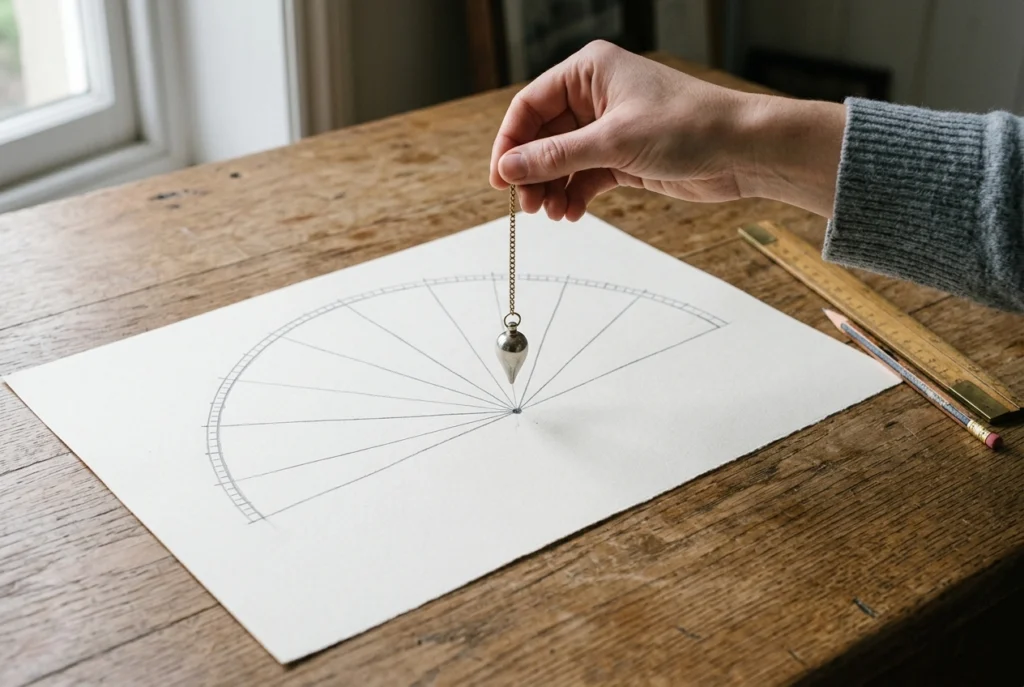
Once your four signals are steady, a chart opens up answers the four responses cannot give. A pendulum board is a printed semicircle with options around the edge, and you hold the pendulum over the centre point and read which option it swings toward. Paper and a pen will make you a serviceable one in two minutes.
Charts earn their place on a scale of one to ten, on the days of a week, on percentages, on letters of the alphabet, and on a small set of named options. They fail on open questions, because a chart carrying too many choices gives the swing enough room to mean whatever you want it to mean.
One practical warning comes from the field manuals. When you are counting swings rather than reading a direction, wait until the oscillations settle into a clean rhythm before you start counting, then count two or three runs and take the average. Otherwise you run into a real problem, because a pendulum changing direction carries momentum into the next movement and draws ambiguous ellipses that you will misread as a number.
How to Find Lost Objects With a Pendulum
This is the application that earns the tool a place in a drawer you open regularly. Your subconscious recorded where the keys went even while you were thinking about something else, and the pendulum is a way of retrieving that record.
Panic is the normal condition around a lost object, and tension is the one thing that reliably stops a pendulum, so take a few slow breaths before you pick the thing up.
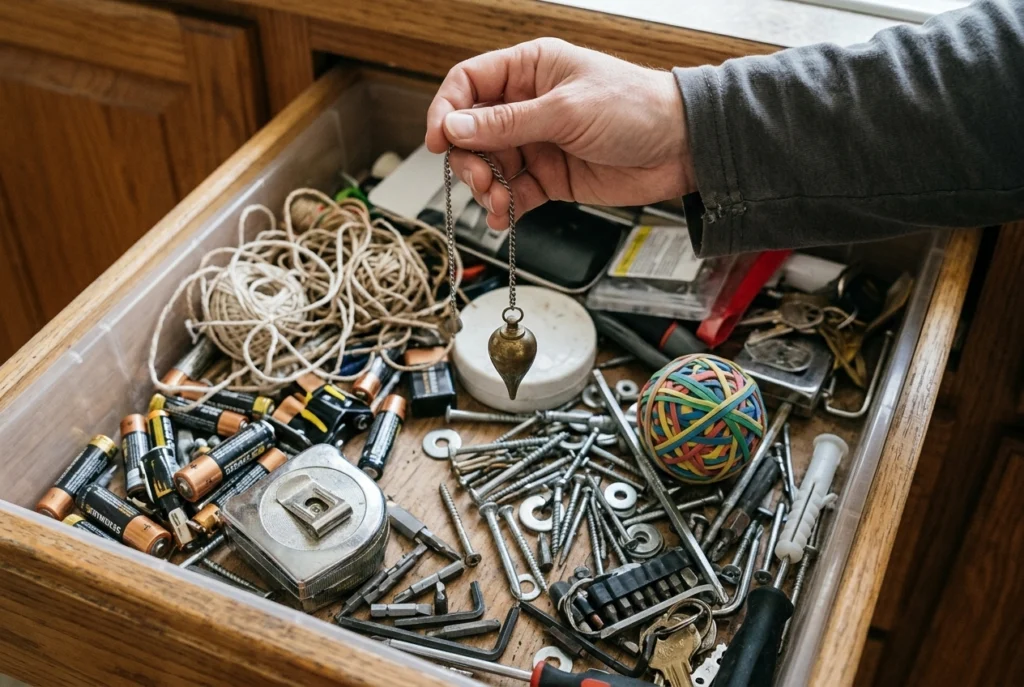
- Confirm the general area. Ask whether the keys are in the house at all, and treat a negative as valuable rather than disappointing, since it saves you searching the wrong building.
- Narrow by room. Ask about each room in turn until something comes back positive.
- Narrow within the room. Ask about the wardrobe, the dressing table, the drawer under the sink, and take it as far as you need.
The Triangulation Method
This works faster than the question chain when it works at all. Stand somewhere in the room, hold the pendulum, and ask it to indicate the direction of what you are looking for, then note the line it swings along. Move to a different corner and ask again, and your object sits near where the two lines cross.
The Walking Method
This one is harder than triangulation and worth learning anyway. Hold the pendulum and move slowly through the space, waiting for it to react as you close in. What you feel is a faint pull rather than anything dramatic, and it takes weeks of practice before you can trust the sensation.
Working From a Map
Map work extends the same logic to places you cannot walk. From there the method is unchanged. Lay out a map, hold the pendulum over it, move slowly across the area asking whether what you seek lies in this section, then narrow down with a larger scale map of whichever section answered. Serious practitioners add a witness, meaning a small sample of the thing sought held in the free hand, and Mermet’s own pendulum was built with a hollow compartment for that purpose.
How to Test Your Pendulum’s Accuracy
Since the signal comes from you, you can measure how good that signal is, and an hour spent doing it is worth more than a month of assuming. The method is to set up questions with answers you can verify but cannot see, then count the results against what guessing would produce.
The Card Test
Take five or six cards from a deck and look at the bottom one, making that card your target. Shuffle them, lay them face down in a row, and hold the pendulum over each in turn asking whether this is the card you are looking for. Better still for a first attempt, use colour instead, with one red card among several black ones.
The Cup Test
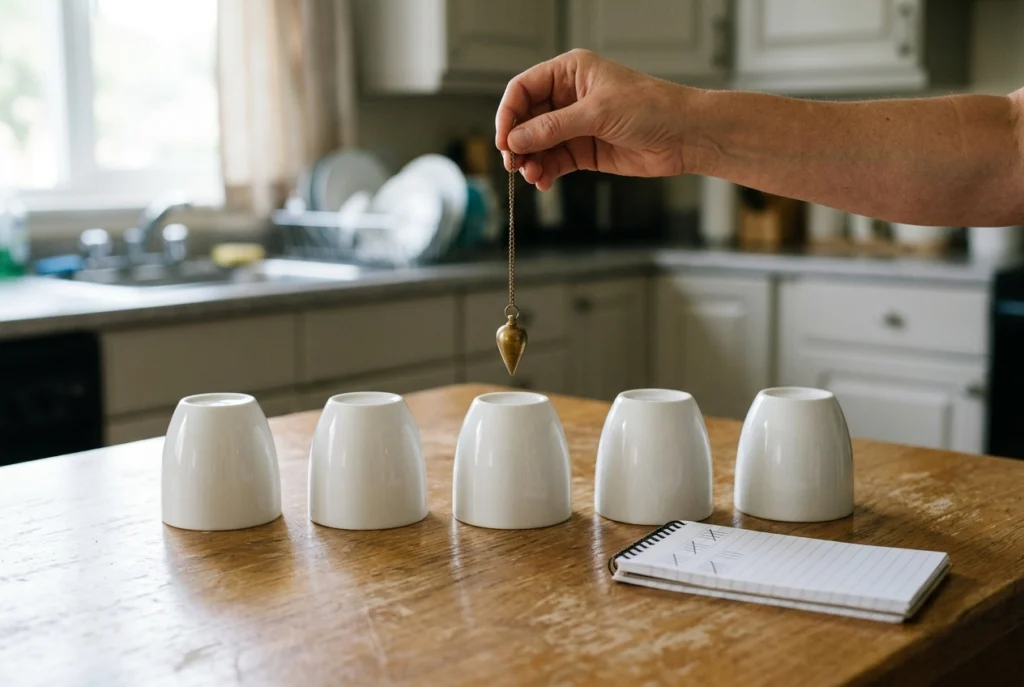
Close your eyes and shuffle five identical cups, place a small object under one, then shuffle again until you have lost track of it, then open your eyes and ask over each cup in turn. Closing your eyes matters more than it sounds, because we register small marks and imperfections without noticing them.
The Envelope Test
Write the names of five objects on slips of paper and seal each in an envelope, then line the real objects up in front of you. Draw one envelope and hold it unopened in your free hand while you ask over each object in turn whether it is the one named inside.
Reading Your Score
Count hits against chance rather than against how the session felt. One in five cups means four correct out of twenty runs is what guessing produces, and ten out of twenty is worth your attention. Keep the tally written down either way, because memory keeps the hits and quietly loses the misses.
Run this for a few weeks and a pattern usually emerges. Accuracy on sealed information hovers around chance, while accuracy on questions about your own life sits well above it, and that split is what you would predict from a tool that reads the operator rather than the world.
Why Is My Pendulum Not Working?
Errors have specific causes and most of them are fixable in under a minute.
| Problem | Usual cause | What fixes it |
| Nothing moves at all | Tight grip, stiff arm, crossed legs, feet off the floor | Loosen everything, elbow only on the table |
| Vague or wild swings | Wrong weight for your sensitivity | Heavier if it overreacts, lighter if it barely stirs |
| Answers contradict each other | Compound question, or you want one outcome | Split the question, or hand it to someone neutral |
| Reliable, then suddenly not | Fatigue or overuse | Stop for a week |
| Signals seem to have changed | Chain length drifted between sessions | Reset all four signals, then knot the chain |
| Answers flatter you | Autosuggestion | Ask a person with no stake in the outcome |
Desire is the failure mode that matters most, because a pendulum runs on unconscious muscle movement and wanting an answer moves muscles as well as knowing one does. The readings you most want to believe are therefore the readings to trust least, which is an uncomfortable rule and the one worth keeping.
Mermet spent a career on this and put it about as plainly as it can be put, saying the art lies in finding what is there and above all in not finding what is not. He described dowsers posting him maps marked with buried treasure they had convinced themselves into, over ground that held nothing at all.
When You Should Not Use a Pendulum
Some uses stay off the table permanently, and the list follows directly from the mechanism rather than from caution for its own sake.
- Never for medical decisions, since it cannot diagnose and cannot tell you whether a treatment suits you, and a doctor can do both.
- Never for legal or financial decisions, where the consequences of a wrong answer land on someone’s life.
- Not for gambling, because accuracy collapses the moment money rides on the outcome, and that is what you would expect from a tool running on desire.
- Not about other people’s private business, as what comes back is your impression of a person rather than the truth about them.
- Not when you are tired, unwell or upset, since the signal is small and a loud mood drowns it.
There is one more limit and it cuts against everything above. Room-scale searching for something you mislaid has a mechanism behind it, and map dowsing for a thing you never handled does not, which is the strongest argument any sceptic could raise here. Granted, the literature carries famous cases and I have read them, but my own results at that range have been poor enough that I would not build a practice on them, and I would rather say so than sell you the whole catalogue.
Frequently Asked Questions
Grip and posture, almost every time. Start by loosening your hold until you are barely pinching the chain, keep the arm relaxed, rest only your elbow on the table, and put both feet flat on the floor with your legs uncrossed. If it still sits dead, stare at the weight and picture it swinging, and leave it for ten minutes if that fails.
Four to five inches works for most people, shorter than beginners tend to guess. To find yours, hold it at a few different lengths, notice where the response comes fastest, and tie a knot there so your grip stays identical from session to session.
Wanting a particular answer is the biggest cause, followed by asking two questions at once and by tiredness. Because your wishes move your fingers as readily as your intuition does, hand the chain to someone with no stake in the outcome when you have one yourself.
It works well on things you mislaid yourself, because some part of you logged where they went. Confirm the general area, narrow room by room, then narrow within the room, or stand in two spots and see where the directional swings cross. Results on objects you never handled are far weaker, and I would not lean on them.
No. A ring on a thread or a plumb bob both work. What matters is a weight around three ounces, a symmetrical shape with a point, and a material that does not conduct, ruling out copper and aluminium.