Both my parents came from the village, and I spent a good part of my childhood there, enough to see what happened when something went wrong that bread and rest could not fix.
A child who would not stop crying, a grown man wasting away with no illness a doctor could name, a run of ruin settling over a house, these did not always send people to the pharmacy first.
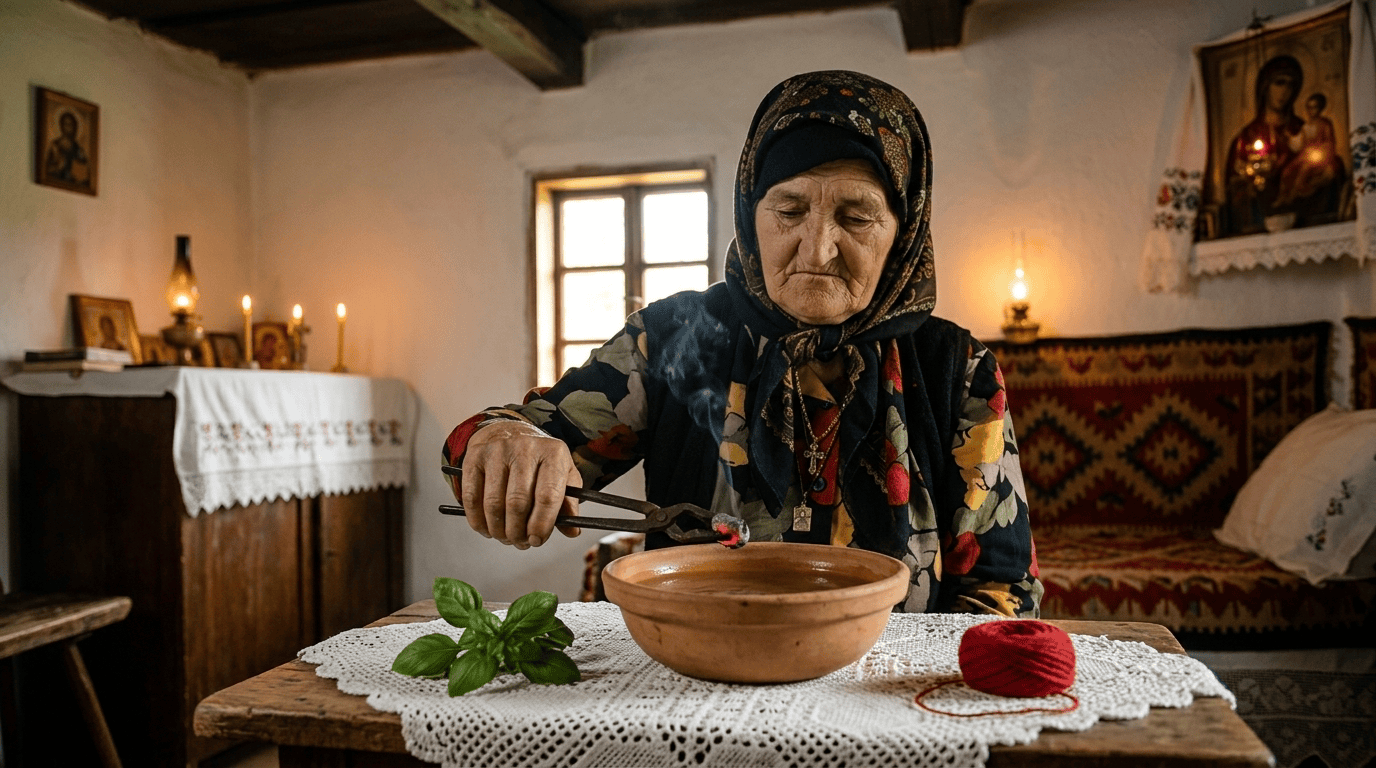
They sent them instead to an old woman who knew the words. She would sit the sufferer down, take up a few coals or a length of thread, and begin to whisper an old charm handed to her by her grandmother.
That whispering is bajanje, and it is one of the oldest living pieces of South Slavic folk tradition still practised today, kept alive above all in Serbia and the lands around it. Most of what exists about it in English sits locked away in academic papers, dense and lifeless, stripped of the warmth the practice has in the mouth of a real village healer.
Bajanje belongs above all to Serbia and the wider South Slavic world around it, from Bosnia to Macedonia to the Serbian villages of Romania, and I want to give you the living thing rather than the footnote. That means covering what bajanje is, who the woman doing it was, how the spoken charm works, and the rituals that carry the words.
This is the tradition of the world my family came from, read back through the Serbian sources, and set down as plainly as I can so that anyone can follow it.
Key Takeaways
- Bajanje is the Serbian and South Slavic folk tradition of healing and protection through spoken charms, practised mainly by women.
- The healer is a bajalica and the charm she speaks is a basma, and both words come from an ancient root meaning “to speak,” because the word itself is the medicine.
- It is the healing, protective side of Slavic folk magic, distinct from the harmful spell-casting the tradition calls vračanje or činjenje.
- The charm is usually whispered and kept secret, and it works by counting illness down to nothing, banishing it to the wilderness, and calling on God and the saints.
- Spoken words are paired with ritual actions such as quenching coals in water, measuring with a cord, and pouring molten lead.
What Bajanje Actually Is
Before we go further I should give you the plainest definition I can, since the word gets used loosely even in the Balkans.
Definition: Bajanje is the Serbian and South Slavic folk practice of healing and protection through spoken charms, where a village healer whispers a traditional verbal formula, called a basma, often alongside simple ritual actions, to cure illness, remove the evil eye (urok), and undo harmful magic.
Everything in the practice turns on the spoken word, because the healer speaks or whispers a set text over the sufferer and that text is believed to carry the power that drives out sickness and misfortune.
The coals, the thread, and the water all matter, yet they support the words rather than replacing them, which is why bajanje is first and last a craft of speech. That emphasis is not an accident, and the language itself records it.
The words bajanje and basma both descend from the ancient Proto-Indo-European root *bhā-, meaning “to speak, to tell, to say.” That is the same root standing behind our words “fable” and “fame,” so the tradition names itself after the act of speaking.
Here the word is not a description of the medicine but the medicine itself. There is a telling afterlife to the word, too. From the verb bajati, “to charm,” Serbian later grew the expression nabajati, meaning to talk nonsense, to exaggerate, or to spin lies.
The same root gives bajka, a fairy tale, and basna, a fable. Somewhere in that drift from sacred speech to tall tale you can see how a whole culture slowly moved from believing in the charm to smiling at it, even as the practice itself carried on in the villages.
The Bajalica: Who the Healer Is
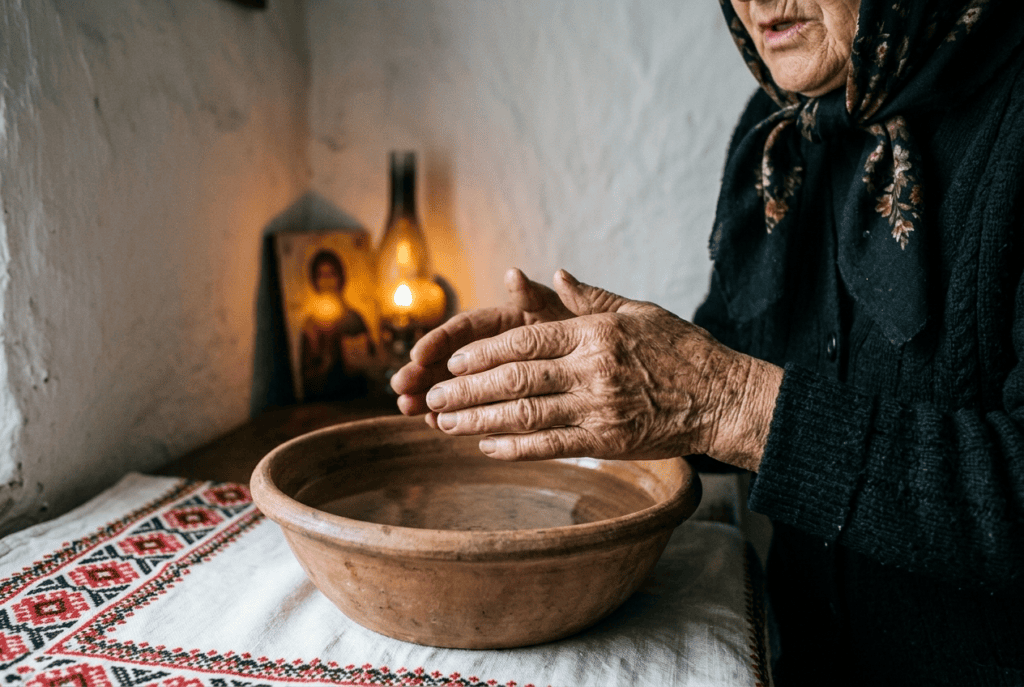
The woman who performs bajanje is called a bajalica, or in some regions a basmara, while a man who does the work is a bajač or basmar. She was the village charmer, the one you went to when something felt wrong in a way that ordinary remedies could not reach.
In most communities she was known to everyone, respected and a little feared at once. She rarely asked for much in return beyond a small gift or a favour, since the gift was understood to be given rather than sold.
It helps to place her among the other figures of Serbian and South Slavic folk magic, because the names get tangled and people often treat them as one and the same. The Serbian tradition has many words for those who work with unseen forces, and they do not all describe the same work, so the table below sets the three main figures side by side.
| Figure | What they do | Their role |
|---|---|---|
| Bajalica (basmara) | Heals, removes the evil eye, undoes spells others have cast | The village healer, known and trusted |
| Vračara (činilica) | Casts harmful magic, the čini and madjije meant to bring someone low | The one people feared and avoided |
| Veštica (witch) | Uses ritual tools, enters trance, is said to leave her body and fly | A being of folklore, of night and story |
The bajalica and the vračara are near-opposites in purpose even though outsiders lump them together, and that difference is the one I keep coming back to, because it defines the whole tradition.
The veštica belongs to a different order again. Where the bajalica is a healer working with words and simple objects, the witch of folklore works with the staff, the broom, and the knife, and she is said to answer to the forest goddess the tradition calls the Šumska Majka, the Forest Mother. Put simply, the bajalica is the one who lived next door, and the veštica belonged to the world of night and story.
How the Gift Is Passed Down
Nobody simply decides to become a bajalica, because the tradition holds that the gift has to come to you rather than being taken up at will. It arrives in three main ways, and the same three turn up across the sources again and again:
- By inheritance, passed down a family line from a grandmother or a mother-in-law to a younger woman judged ready. The knowledge often skips the most direct line on purpose, since it is thought to weaken if handed straight from mother to daughter.
- Through dreams, where a person receives the charms and the calling in their sleep, taught by a voice or a figure who comes in the night.
- From the fairies, the most striking of the three. Charmers across southern Serbia and Kosovo claimed the vile had given them their power, and in that belief one fairy teaches the charms, another the healing herbs, and another the silent language of plants and animals.
Healing Magic, Not Harmful Magic
There is a distinction the tradition itself insists on, and it shapes everything that follows. Bajanje sits on the healing and protective side of Slavic folk magic, since its purpose is to mend, to guard, and to lift what has been laid on a person. That defensive character is exactly what separates it from the darker work the tradition keeps at arm’s length.
The Serbian language draws the line through its own words, because bajanje and vračanje in the healing sense mean charming that cures and protects. Činjenje, madjije, and čini name the casting of harm on another. A bajalica undoes those harmful workings rather than performing them.
In the folk world she stands closer to a doctor than to a curse-worker. Villagers came to her precisely to have malicious magic removed. That same protective spirit runs through my guide to the evil eye and my guide to psychic attack.
This is where I set my own boundary too, since I write about the healing tradition, the removing and the guarding. I have no interest in teaching anyone to lay harm on another person. The harmful side existed and honesty means naming it, yet the living value of bajanje is in what it heals, and that is the part worth carrying forward.
The Basma: How the Words Heal
The basma is the spoken charm itself, the actual words the bajalica says over the sufferer, and it is the beating heart of the whole practice. These texts were carried in memory and passed by mouth across centuries, never fixed on paper, which is why collectors like Radenković spent lifetimes writing thousands of them down before they could be lost.
A few features run through nearly all of them, and each one shows you a little more of how the charm is thought to work.
Whispered and Kept Secret
A basma is almost always spoken low, under the breath, in a murmur too quiet for a bystander to catch. That quiet is not for atmosphere, since the secrecy is itself part of the power, and a charm spoken openly for all to hear was thought to lose its force.
The bajalica guards her words closely and passes them only to the one who will carry the craft after her, because a basma freely told is a basma drained. Within that fixed secrecy there is still room to move, since the healer follows the traditional shape of the charm while adapting its verses to the person before her and the trouble they carry.
Scholars who studied the Serbian charms found them built the way oral poetry is built, out of remembered patterns and phrases the healer recombines as she speaks. No two performances come out quite the same.
Counting the Sickness Down to Nothing
One of the most common devices in a basma is the countdown, where the healer names a number and steps down through it, nine, eight, seven, on toward none. As the count falls the illness is meant to shrink with it, dwindling from something to nothing until it has no hold left.
Some charms take this further and send the sickness off to perform an impossible, endless task. It must count grains of sand forever or drink a sea dry, wearing itself out in work it can never finish.
Banishing the Sickness to the Wilderness
Alongside the counting runs the theme of banishment, where the charm drives the illness out of the body and orders it somewhere no person lives. The healer sends it off to the high mountains, into deep water, or out to the empty places at the edge of the world, anywhere far from human warmth.
One old charm calls on the wolf, telling the sickness that the wolf with his terrible yawn will swallow it whole, so it had better retreat and run. Another, recorded in the Bosnian tradition and spoken while drawing a knife or sickle down the aching limb, orders the illness out in almost the same breath:
Izađi, pogana poganice, u visoke visine, u duboke dubine, gdje sjekira ne sječe, gdje vo ne riče, gdje ovca ne bleji, gdje koka ne kakuće!
Come out, foul sickness, into the high heights, into the deep depths, where the axe does not cut, where the ox does not bellow, where the sheep does not bleat, where the hen does not cluck!
The logic stays steady throughout, since illness is treated as an intruder that can be named, commanded, and shown the door.
To see how these devices come together, here is a real charm against the evil eye, recorded from a Bosnian folk healer and typical of the whole South Slavic tradition. The same charm, with small local changes, turns up across Serbian, Bosnian, and other South Slavic communities alike. I have kept the original on top and put my English underneath, since the sound of it matters as much as the sense.
Uroka devet braće; od devet osam, od osam sedam, od sedam šest, od šest pet, od pet četiri, od četiri tri, od tri dva, od dva jedan, od jedan ne bio ni jedan! Bješte uroci po svijetu k’o pčele po cvijetu, hajte u visoke visine, u duboke potoke, u niske nizine, gdje vo ne buče, gdje koza ne dreči, gdje pijetao ne pjeva, sad tamo neka je!
Nine brothers of the evil eye; of nine eight, of eight seven, of seven six, of six five, of five four, of four three, of three two, of two one, of one let there be none! Flee, you evil eyes, across the world like bees across the flower, off to the high heights, the deep streams, the low hollows, where no ox lows, where no goat bleats, where no cockerel crows, let it be there now!
You can hear the whole method working at once. The counting drains the affliction from nine down to nothing, and then the banishment drives it out to a wilderness so empty that no cockerel crows there, somewhere it can never trouble a person again.
The Christian Surface and the Older Core
Most basme that survived into recent centuries wear a Christian dress, calling on God, on Christ, on the Mother of God, or on a particular saint to come and help. Underneath that surface lies something far older, a pre-Christian Slavic core that the church layer never fully covered over.
This double faith, pagan roots showing through a Christian face, runs through the whole of South Slavic folk practice, and I cover it more widely in my guide to Vlach magic. In a single basma you can often hear both voices at once, a saint invoked in one line and a far older power in the next.
The Ritual Actions Behind the Words
The words rarely travel alone, since a bajalica pairs her basma with physical acts, each carrying its own meaning, and together the speech and the action make the full cure. The table below gathers the ones that appear most often across the Serbian and wider Balkan tradition, and I go through each in turn underneath.
| Ritual action | Serbian name | What it does |
|---|---|---|
| Quenching the coals | gašenje ugljevlja | Diagnoses and cures the evil eye; the charmed water becomes medicine |
| Pouring the lead | salivanje strave | Treats fright-sickness; the shape it freezes into reveals the cause |
| Measuring with a cord | merenje | Confirms an evil spell if the body’s measure changes |
| Pulling through | provlačenje | Acts out a rebirth, leaving the illness behind |
| Ritual washing | kupanje | Carries the illness away in running water |
Quenching the Coals
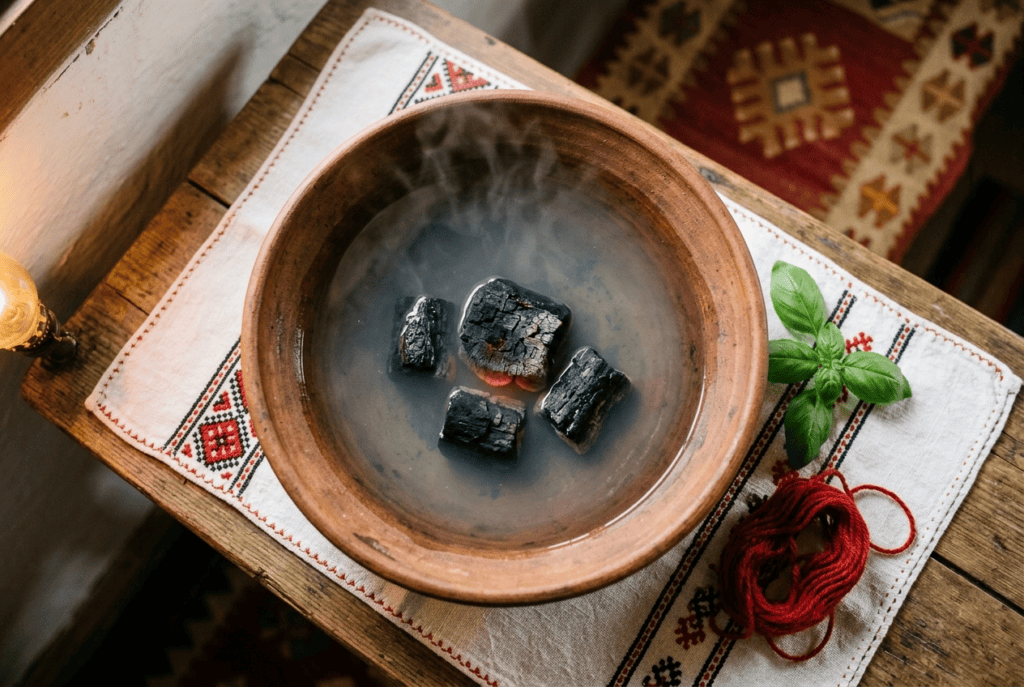
The best known of them all is the coal quenching, in Serbian the gašenje ugljevlja. The healer takes live coals from the fire, often nine of them, and drops them one by one into a vessel of water while she counts down and whispers her charm.
She reads the evil eye in how they behave, since coals that sink to the bottom point to a genuine urok laid on the sufferer. Into the water she may also drop a sprig of basil, a small pebble, and a thread from the sick person’s clothes, each with its own protective sense.
Once the basma is spoken, she blows over the sufferer’s head and spits lightly to the side to drive the harm off, and the charmed water becomes the medicine. The patient drinks it in three small sips and is washed with it across the forehead and face, and in some places is sent home with three of the coals to put in their washing water.
The other coals go back into the fire to come alive again, so that the sufferer too returns to full health.
Pouring Out the Fear
Another widespread cure is the pouring of lead, tied closely to the fright-sickness the tradition calls strava. The healer melts lead and pours it into cold water held over the frightened person. The sudden shape it freezes into is read to reveal the cause of the fear, often the face of the animal or person behind it.
This practice, salivanje strave, is found right across the region, in Serbia and Bosnia and among the Vlachs of eastern Serbia, and it deserves a full guide of its own, which I will write.

Measuring With a Cord
A quieter diagnostic act is the measuring, or merenje, where the healer takes a length of cord and measures the sufferer’s body, the arm span or the height, before the charming begins.
She measures again once it is done, and a change between the two readings is taken as proof that an evil spell was the cause. The cord that carried the illness is then destroyed, burned or thrown into running water, and whatever it drew off is carried away for good.
Pulling the Sufferer Through
One of the oldest actions is the pulling-through, the provlačenje, where the sick person is drawn bodily through a gap.
That gap might be the chain hanging over the hearth, a ring of woven flowers, or a young tree split down its middle for the purpose. Passing through the barrier acts out a rebirth. The person goes in carrying the illness and comes out having left it behind.
Washing It Away
Water closes many cures, in the ritual washing called kupanje. The sufferer is bathed at the stream or well where the charming was done, or in the very water that quenched the coals or caught the lead.
Running water carries the illness off downstream, and in the older belief it also helps the person cross back safely from the between-place the sickness had pulled them toward.
What Bajanje Is Used to Heal
The tradition covers a wide range of troubles, and most of them share one quality, since they are the afflictions that ordinary medicine struggles to name. The complaints a bajalica is called on for fall into a few clear groups:
- The evil eye (urok), the harm that flows from an envious or admiring glance, which is the single most common reason to seek a charmer and which I treat fully in my evil eye guide.
- Fright-sickness (strava), the draining of vitality that settles in after a shock or a scare.
- Wasting illnesses with no clear source, along with skin complaints and other troubles that resist an ordinary diagnosis.
- Protection of children and livestock, the most vulnerable members of a rural household.
- Undoing cast spells, the malicious workings someone is believed to have laid on a person or a home.
- Matters of the heart and home, from securing a marriage to guarding a house, and in some regions reading the future or carrying word to the dead.
The thread running through all of it is a sense that the trouble came from outside the natural order, from a glance, a curse, a fright, or a spirit. It therefore calls for a cure that works on that same level.
When and Where the Charming Happens
Bajanje is bound tightly to time and place, because the tradition holds that the barrier between worlds grows thin at certain moments and in certain spots.
The healer usually works at the edges of the day, at dawn before the sun clears the horizon or at dusk as it sinks. These in-between hours are when the charm is thought to carry furthest, and many charmers keep particular days of the week for particular cures.
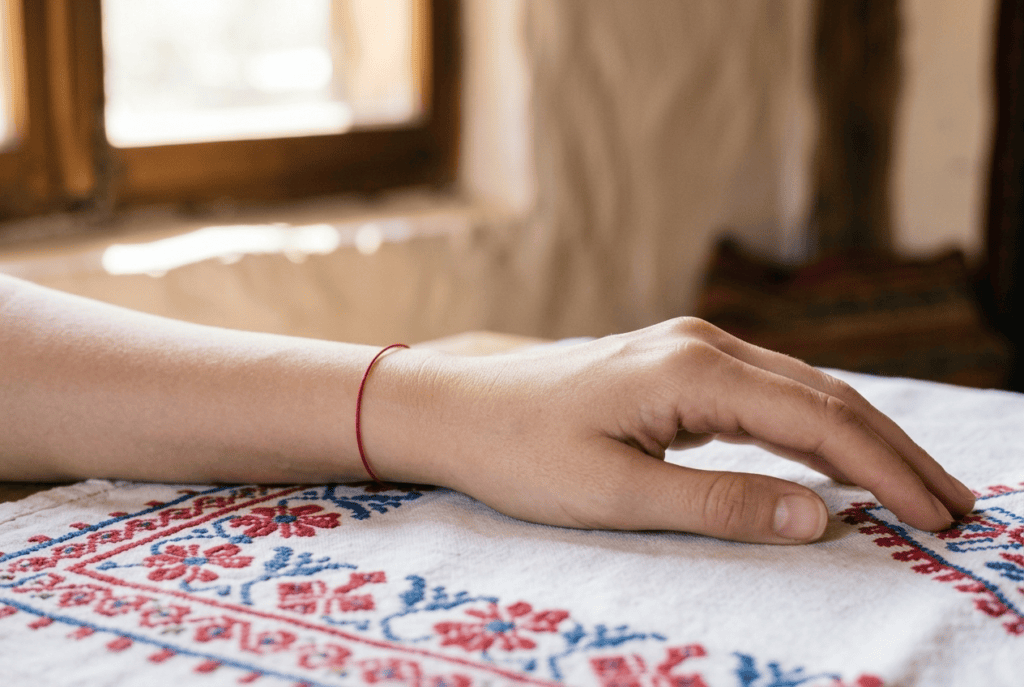
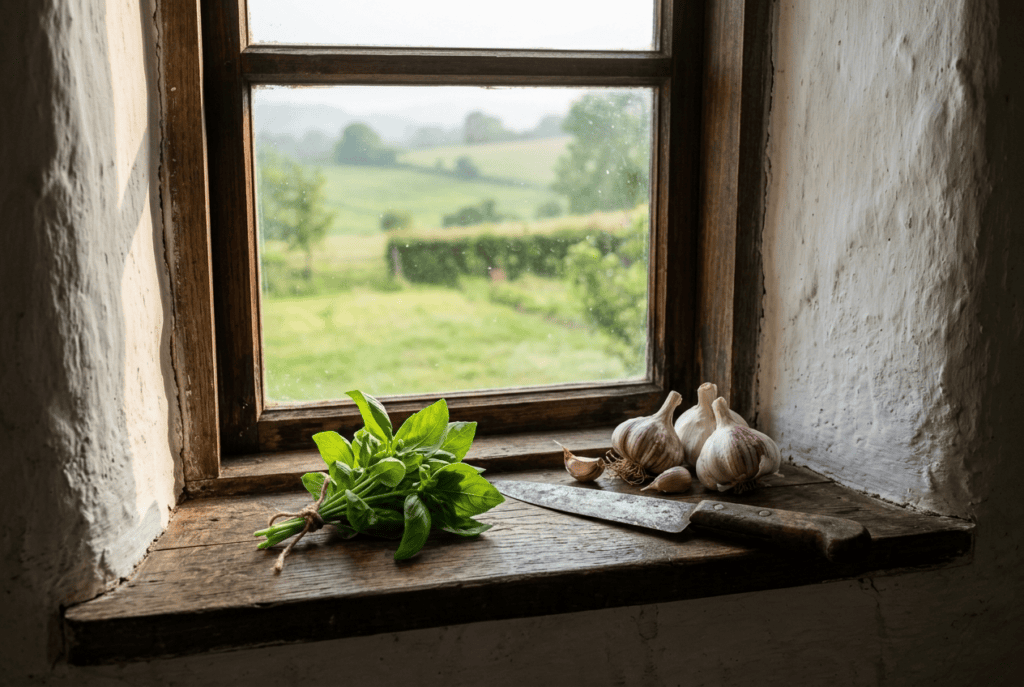
Certain materials and moments recur because the tradition trusts them. A red woollen thread tied around a child’s wrist guards against the evil eye, and basil appears in charm after charm as the protective herb of choice. Many charms are spoken before a full moon, when their force is thought to swell, and incense, later folded into Orthodox practice, was burned to cleanse a home.
Place follows the same logic of the threshold. The charming is done at running water, at a well, at a crossroads, or on the doorstep, each of them a point where one state passes into another.
A rule that recurs everywhere is that the healer and the sufferer leave without looking back once the work is done. They walk away from the discarded coals or the buried remnants without a backward glance, and nothing then draws the banished illness home again.
It is the same instinct that runs through my guide to cleansing a home of negative energy, the sense that once something harmful is sent off, you do not call it back by turning around.
Bajanje as a Living Tradition
It would be easy to file all of this under history, and that would be a mistake, because bajanje did not die with the old century. In the rural parts of Serbia, especially the east and south, and among the Vlach communities of the Braničevo region, the charmers are still working and people still seek them out.
A survey in one Vlach area found that close to half of those asked believed in the power of the local folk magic. The figure rose above eighty per cent among the oldest generation, which tells you how alive it remains where it is rooted. I think it deserves better than to be treated as a curiosity from a poorer past.
Bajanje is a genuine spiritual technology worked out over centuries, a way of naming trouble and moving it out of a person that countless people found real help in. The academic collectors did it both a service and a quiet harm.
They wrote the charms down before they vanished, which mattered, yet they also cut the words loose from the living women who spoke them. What I have tried to do here is give a little of that life back. To set the practice down with the respect owed to the world my family came from rather than the distance of a footnote.
Frequently Asked Questions
Bajanje is the Serbian and South Slavic folk tradition of healing and protection through spoken charms, still remembered across Serbia, Bosnia, and Macedonia.
A village healer whispers a set verbal formula, called a basma, over a sufferer, usually alongside simple ritual actions, to cure illness, remove the evil eye, and undo harmful magic. The word comes from an ancient Slavic root meaning “to speak,” because the spoken word is understood to carry the healing power.
A bajalica is a folk healer who works with spoken charms and simple objects to cure and protect, and she was a known, respected member of her village.
The veštica, or witch, of Serbian folklore is a different figure entirely, associated with ritual tools, trance, night flight, and the forest goddess called the Šumska Majka. In short, the bajalica heals within the community, while the witch belongs to the world of night and story.
No, since bajanje is the healing and protective side of Serbian and South Slavic folk magic, used to cure illness, remove the evil eye, and undo spells others have cast.
The harmful casting of magic on another person has its own separate names in the tradition, činjenje and madjije, and it is considered the opposite of what a bajalica does. Her whole craft is about removing harm rather than causing it.
A basma is almost always whispered, spoken low and kept secret, since the tradition holds that a charm said openly loses its power.
The healer follows the fixed traditional shape of the charm while adapting its verses to the person and their trouble. Common features include counting the illness down toward nothing, commanding it away to the wilderness, and calling on God or a saint for help.
Removing the evil eye, the urok, is one of the most common uses of bajanje. The classic method is quenching live coals in water while charming over them, then having the sufferer drink and wash with that water.
How the coals behave also serves as a diagnosis, since coals that sink are taken as a sign that a genuine evil eye was laid on the person.
A basma is a short, rhythmic charm, often built on a countdown and a banishment. A typical charm against the evil eye counts the affliction down from nine to nothing, then drives it away “across the world like bees across the flower” to the high mountains and deep streams where no cock crows.
Many end with a Christian close, calling on God, Christ, or the Mother of God, laid over an older pagan core.
Yes, since bajanje remains alive in rural Serbia, especially the east and south, and among Vlach communities, where charmers still work and people still seek them out. Surveys in some regions show that a large share of the population, and a clear majority of the oldest generation, still believe in the power of these folk practices.