In Eastern Serbia, there is a healing tradition that has nothing to do with the witchcraft content you find online. It belongs to the Vlachs, a small community that kept its own language, its own spirits of forest and water and fire, and its own professional female healers for centuries. Every ritual is spoken in Vlach. Every herb is chosen for a reason, and every location matters because a specific spirit lives there.
I grew up in Serbia watching this from the outside. I knew it was real, and I knew it was not mine to practice. What I am sharing here is your way into a system that is still alive but fading, and that works nothing like the generic Balkan magic you have already read about.
Who the Vlachs Are and Why Their Magic Is Structurally Different
The Vlachs of Eastern Serbia are a Romanized pre-Slavic population living between the Morava, Danube, and Timok rivers. They speak a Vlach-Romanian dialect with no written alphabet, formally belong to the Orthodox Church, and have maintained a parallel pre-Christian religious system alongside it, running independently rather than blended into it. Official census numbers put the population at around 40,000, though many Vlachs have historically registered as Serbs to avoid social friction, so the real number is likely much higher. The highest concentrations are in the municipalities of Bor, Negotin, Zaječar, Majdanpek, and Kučevo.
Definition: Vlach magic is a professional ritual system rooted in pre-Slavic cosmology, conducted exclusively in the Vlach language, transmitted through female family lines, and organized around two core beliefs: that fate is written at birth by three spirit beings, and that the manner of a person’s death determines what the living must manage for generations afterward.
The difference between Vlach and Serbian folk magic is not surface-level. Serbian folk magic has a Slavic base integrated with Orthodox Christianity and no closed professional specialist class. Vlach magic runs on a completely different cosmological framework, requires the Vlach language for every ritual formula, and has a professional female practitioner lineage that Serbian tradition simply does not have in the same form. A Serbian-language charm is Serbian folk magic. A Vlach-language formula is Vlach magic, regardless of what saint it invokes.
The Supernatural Hierarchy and Why Location Is a Technical Decision
In Vlach practice, where you perform a ritual is not about atmosphere or preference. Each supernatural force governs a specific physical domain, and addressing the right force in the right location is part of how the ritual works. Getting this wrong does not produce a weak result. It produces no result, because the force you need is simply not present where you are.
The Three Great Forces
Muma Paduri
Muma Paduri (Forest Mother) governs land and forest and sits at the top of the Vlach hierarchy. She is invoked at the start of all major rituals, her domain is forest clearings and woodland, and she specifically protects women and children born outside of marriage. Her husband is Padurioul and her daughter is Fata Paduri, which makes the forest itself a kind of family territory with a clear internal structure. A girl is introduced to Muma Paduri from her first day as an active step in a lifelong protective relationship, not a passive blessing. A vračara treating fertility problems or menstrual irregularity may instruct a woman to gaze alternately at the sun and at her own soiled laundry three times. This is not folk strangeness, and it is a precise signal to Muma Paduri that the petitioner acknowledges the full female cycle and is requesting intervention in conception, pregnancy safety, or recovery after birth.

Tartor
Tartor governs all water and is addressed at streams, at small rivers flowing east to west, and at mill thresholds. He is attended by a hundred spirit helpers and is most active in July, when the region’s heat makes bodies of water both tempting and dangerous. Every drowning in eastern Serbia is traditionally attributed to him. People born on Saturday are considered safe from Tartor because Saturday is his rest day, a detail that only makes sense inside the tradition’s own logic rather than from the outside looking in. A vračara working with water illness or repeated near-drowning will verify the client’s birth day as part of diagnosis. She will also refuse to speak Tartor’s name aloud during the working, because naming something gives it more access to you, and some forces should not have that access. The tradition holds that Tartor keeps an underground glass temple beneath the water surface, and every drowning is understood as a sacrifice taken to that temple rather than as a random accident.
Zmeu
Zmeu governs fire and lives on mountains and in hollow beech trees. In Vlach understanding he has an explicitly predatory quality toward people, particularly young women, which sets him apart from the Serbian zmaj and reflects a meaningfully different understanding of what this figure represents. When a client reports love problems involving sudden obsession, physical depletion, and inexplicable aversion to human partners, the vračara must determine whether the partner is human or whether the case belongs to the Zmeu category. The signs are specific: pallor, exhaustion, and withdrawal from normal relationships after a nighttime encounter. The protective approach changes completely if the source is a Zmeu, and mistaking one for the other wastes time and can make the situation worse.
The Intermediate Beings
The Vlve are tall fairies in white or green who can remove harmful spells and heal illness, but become dangerous when a tree they protect is harmed. The protected trees are beech, willow, and ash, so knowing this is knowing where not to cut.
The Sumirol (known in Serbian as Tetke) are three old women in black who carry epidemic illness. Their names are not spoken aloud, because naming something gives it more access to you, and some things should not have that.
The Sudenice (Ursitoare in Vlach) are the three fate-writing spirits who appear within the first three days after a child is born. The eldest spins threads of life from silver filaments, the middle one arranges them and determines how the life will unfold, and the youngest cuts them and decides when and how the person will die. What they decide is recorded in the konđej, a thick book held by the demon of fate. The vračara’s core skill is reading that book to find where adjustment is possible within what has already been written.
Households in eastern Serbia traditionally mark the first three nights after a birth by leaving lit candles, food, and wine on the table for the Sudenice. When the family finds the food disturbed in the morning with no family member claiming responsibility, they take it as confirmation the spirits were satisfied.
The Five Vlach Words for Fate
A vračara reading someone’s situation is not looking at a single undifferentiated thing. The Vlach language has five distinct words for fate, each describing a different mechanism, and distinguishing between them determines what approach the healer takes:
| Vlach Word | What It Describes |
| Fata | General assigned destiny (from Latin fatum) |
| Skrisa | What was recorded in the konđej at birth (from Latin scripta, written) |
| Ursa | What is projected onto you from outside, connected to the evil eye |
| Suđina | What has been judged and decided by higher forces |
| Daćina | What was assigned as a gift or burden at birth |
Working on ursa (something projected from outside) calls for a completely different approach than working on daćina (something given at birth). These are not different intensities of the same problem. They are different categories entirely, requiring different responses, and conflating them produces no result in the tradition’s own understanding.
The Vračara: The Professional at the Center of the System
Definition: A vračara is a professional female folk healer in the Vlach tradition who diagnoses problems through conversation, reads how a person’s fate was written, and addresses problems by mediating between human affairs and the Vlach supernatural forces. She accepts a gift from the heart (dar od srca) rather than a fee, because accepting payment would imply she is the author of the result rather than its instrument.
Knowledge passes through female family lines, and entry into practice is rarely described as voluntary. Spirits called šojmane select a person and compel her to take on the healer role by causing spontaneous trances and health deterioration that does not respond to ordinary treatment. If she resists, the symptoms continue for months or years. Once she accepts, they stop, and the knowledge begins to consolidate. Researchers who have documented this consistently note how closely it parallels the shamanic call found in Siberian and Central Asian traditions that developed entirely independently.
The Formula That Frames Every Session
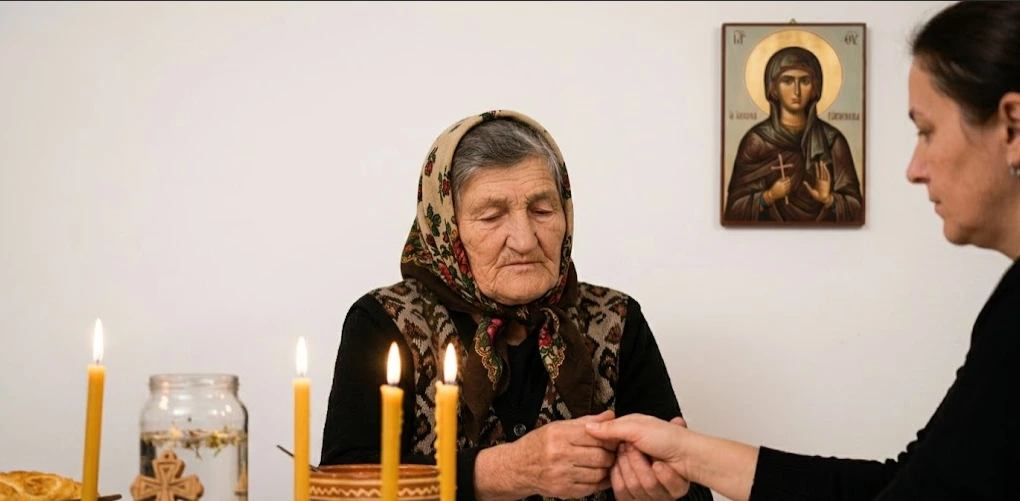
Every working opens with the same phrase: “Bajanje je od mene, a lek od svete Petke” (the spoken charm is mine, but the remedy comes from Saint Paraskeva, because she knows most). This is not a ritual courtesy. It is a precise theological statement: the vračara acts as the instrument of Sveta Petka (Saint Paraskeva), the primary supernatural intercessor in Vlach healing work, invoked above all other saints, with her feast day as one of the main ceremonial dates of the year. This framing is exactly why Vlach magic and Orthodox Christianity have coexisted without contradiction inside the same households for centuries.
The formula is also the vračara’s ethical alibi, positioning her as a clerk in state service rather than an autonomous author of results. The laws come from a higher level, and she has only the authorization to invoke them. A vračara who negotiates with demons is not considered dishonest inside the tradition, and she is considered more useful than one who only makes love charms because the alibi protects her from guilt and protects the client from the illusion that one human being can override fate directly.
How a Session Actually Works
The vračara asks questions that sound like casual conversation, and by the time the exchange ends she has gathered most of what she needs, while the person across from her rarely realizes how much they have communicated. This conversation is also an ethical test, and the vračara listens for discrepancies between what the client requests and what their situation actually implies. A request for love help might conceal a desire to harm a rival, and a request for health might mask a curse the client commissioned and now regrets. Experienced vračare note that open conversation about the person’s difficulties often brings the answer faster than ritual, because the real problem is frequently not supernatural at all. The bajalica (spoken formula) that follows lasts approximately 45 minutes, is repeated three times, and is always delivered in Vlach, never Serbian.
Standard working materials include basil (bosiljak, the primary mediating plant across all ritual categories), water from a nearby stream, honey, a padlock (katanac), and red thread that has been pribajan (activated through spoken formula). Unactivated red thread from a store is just thread. The activation through speech is what orients the object toward its protective function.
Protective Magic: Materials, Rituals, and the Logic Behind Each One
Protection in Vlach practice is not a state you achieve once. It requires specific materials prepared in specific ways, placed correctly, worn correctly, and renewed over time.
Red Thread
Red thread activated by a vračara through spoken formula is the primary personal protective material in the tradition. Red is the color of blood, and blood carries life-force in the Vlach framework, which means the thread is understood to carry that same force once the formula has been spoken over it.
A newborn protection band uses three colors knitted together: red creates the protective shield, white marks the child’s innocence, and black marks the boundary between what the vračara has secured and anything that might attempt to alter it. The colors are not decorative. They are functional designations within the system’s own logic.
Garlic
Garlic is the most cross-functionally used material in Vlach protective practice, appearing in contexts ranging from protecting a newborn to neutralizing hostile magic. A clove on the forehead of a new mother protects both her and the child during the vulnerable forty-day postpartum period. A clove carried in the pocket prevents nausea during travel. A clove at the threshold or inside a crib provides ongoing protection for the space.
At the home entrance, garlic follows a specific directional logic:
• Left side of the door: protection against hostile spirits and spiritual peace for the household
• Right side of the door: prevention of quarrels with neighbors and material wellbeing
• In a stable: protection of animals and livestock from illness and interference
• In a field: protection of crops against disease, pests, and magical harm
When epidemic illness threatens an entire village, the protection is no longer individual. Nine of the oldest women gather in a small room and weave a shirt from the highest quality hemp in a single night, large enough for every resident to pass through. The weaving happens with spoken formula, and the finished shirt is thrown onto the main village crossroads before dawn as a message to the Sumirol that the community has prepared a defense and is not asking for mercy without effort.
One garlic ritual for evil eye removal uses water thrown over the roof of the house, collected as it runs down the eaves, in a hollowed gourd. Basil, frankincense, and nine cloves of garlic each cut twice in the shape of a cross are added to the water, and the formula is spoken: “Pošla [name] stazom, uroka uz put srela. Ne smej se ti jer će se ona nasmejati tebi. Ko je urekao, usekao, o glavi mu bilo. [Name] osta svetla, čista, ko zvezda na nebu, ko rosa na zemlji, ko bosiljak u cvatu.” On the day of the new moon, the nine cloves are removed and placed at nine specific locations through the home and surrounding property.
The Ku Potula Staircase Ritual for Household Conflict
For persistent household conflict, river pebbles are placed on each step of the staircase, one per step, starting from the top and working down to the threshold. The vračara steps on each pebble with the left foot, shakes a cloth in all four directions, and speaks the formula while tying three knots in the cloth after each step:
“Polako, polako, konju nad konjima, jednom se napregni celu carevinu da smiriš. Polako, polako, kako smiruješ krave u stajama, ovce u oborima, pse u krtozima, ptice u gnezdima, ljude u selima, muževe u svojim krevetima, tako i [names] da smiriš.”
(Slowly, slowly, horse above all horses, strain once to quiet the whole empire. Slowly, slowly, as you quiet cows in stables, sheep in pens, dogs in yards, birds in nests, people in villages, husbands in their beds, so quiet [names] in the same way.)
The ritual advances one step per day, continuing only on Thursdays and Saturdays until the threshold is reached. The cloth is then given to the person who commissioned the work, who sleeps wrapped in it until the following Tuesday.
Protecting a Newborn
The first forty days after birth are considered the most dangerous period because the soul is understood to be in transit during that window, the same way a soul is in transit for forty days after death, and the vulnerability at both thresholds follows the same logic.
Hemp (konoplja) placed around the cradle protects specifically against the Babice, spirits that target newborns. While laying the hemp, the vračara speaks: “Čim se dete hrani time se i brani” (by what feeds the child, the child is defended), repeated three times.
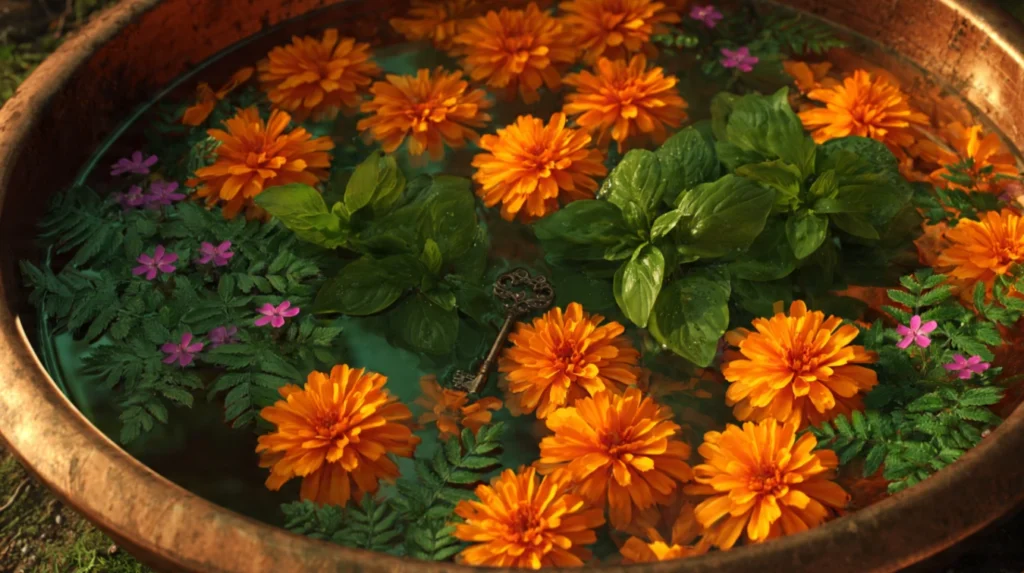
The outside bath ritual performed in the first seven days uses a basin filled with water, marigolds (neven) gathered from nine different gardens, leaves of bosiljak and zdravac, and one metal object. The iron element draws on a principle that appears across many European folk traditions: supernatural forces instinctively avoid metal because it represents a relatively recent human intervention in the world, and that instinctive avoidance is exactly what makes it useful here.
The umbilical cord is preserved in wax after it falls off and kept as a protection amulet for the person’s entire life. Vračare from the Timok region explain this with notable specificity: the cord carries three drops of blood, one from the mother, one from the father, and one from the child, and when dried those three lives’ worth of force are concentrated in it. If it is lost, the person becomes unsettled, unable to hold a job or a relationship for long. It should be buried with the person when they die.
Fire Ritual Against the Sumirol
When the three black-clad illness carriers target a household, the vračara performs a fire ritual at midnight. She marks a circle with corn or wheat grains, lays thin threads of tow along the broken line, and walks the circle three times with light, graceful movements. Then she crouches at the starting point, strikes a match, and lights the tow and coal while speaking the formula three times.
The ash is gathered counter-clockwise and poured into a bottle of water collected from the source before the house. The direction of collection matters because counter-clockwise is the closing motion that seals the working.
Reading the Natural World
Vlach practice treats animal behavior as diagnostic information, not only as a source for materials. The cuckoo is a primary messenger, and hearing it call from the east means a fortunate year while from the west it signals a warning to travel less and think more. The number of days the cuckoo calls before Đurđevdan and after Petrovdan predicts the quality of autumn and the severity of winter.
Killing a cuckoo is considered a grave sin that bars the killer from the afterlife, which means the bird is protected within the ethical structure of the tradition, not merely observed. The swallow is called sestrica and is the only bird allowed to nest under the roof without disturbance. A swallow circling a pregnant woman predicts twins, and a swallow circling an unmarried girl predicts imminent marriage.
For children with delayed speech or weak intuition, a vračara may use a live swallow by carefully pouring water into the bird’s beak and sprinkling that water on the child’s head so the child will speak and think as quickly and clearly as the swallow chirps.
The Evil Eye: How It Works and What Removes It
The evil eye (urok) in Vlach tradition is caused by concentrated envy, resentment, or even excessive admiration, and it can be projected without any conscious intent from the person causing it. What sets the Vlach approach apart from most European evil eye traditions is that the diagnosis identifies not only whether urok is present, but the specific quality it was cast upon, because that source determines the removal materials.
Two Ways to Diagnose the Evil Eye
The Ember Test (Ugrevak): An ember is placed in a bowl of water, and if it sinks to the bottom, urok is confirmed. One sinking indicates it was cast once, while multiple sinkings indicate it was sent repeatedly. After confirming presence, the vračara narrows the source through systematic questioning directed at the ember: male or female, neighbor or relative, young or old. The ember responds to each question by sinking or staying up, and when the questioning is complete the healer knows enough to match the removal to the source.
The Šipurak (Rosehip) Measurement: The person is measured from head to foot with a red thread cut to their exact height. That thread is taken to the nearest wild rose bush and a branch of equal length is cut from it. The branch sits under the person’s bed for forty days on newspaper dampened each morning with warm water. If the branch shrinks in length, urok is confirmed and will resolve on its own. If it does not shrink, the cause is something other than evil eye and the healer adjusts her approach.
Three Types of Evil Eye, Three Types of Removal
The removal ritual depends entirely on what quality drew the projection in the first place:
• Cast because of beauty: Honey, heated and then cooled while the bajalica is spoken. Honey corresponds to the domain of desire and desirability, so the material matches the domain of the problem.
• Cast because of wealth or envy of poverty: Grains of wheat, kernels of corn, and crumbs of bread, corresponding to the material and agricultural domain.
• Cast because of intelligence or professional success: Grains of sand, pinches of earth, or small pebbles, corresponding to the domain of thought and ground-level reality.
A removal formula from the Timok region: “Doletela bela ptica iz belog mora i donela belo mleko u bele kljunice, pa pustila na beli kamen, crk’o puk’o beli kamen, crk’o puk’o ko dete ureko.” (A white bird flew in from the white sea and brought white milk in its white beak, released it on a white stone, the white stone cracked and shattered, cracked and shattered as the one who cast the evil eye on this child.) The formula ends not with harm wished on the sender but with public humiliation, which reflects the tradition’s consistent preference for social mockery over direct retaliation.
A more complete combined formula: “Crkni đavole, ti nemaš tamjan, ti nemaš nož, ja imam tamjan i imam nož, tamjanom te kadim, nožem te sečem, u vodi te gnječim. Voda se penuša a [name] te više ne sluša.” (Perish devil, you have no frankincense, you have no knife, I have frankincense and I have a knife, I smoke you with frankincense, I cut you with a knife, I crush you in water. The water foams and [name] no longer listens to you.) After the formula, frankincense and nine cross-cut garlic cloves are placed in a bottle of water, which is drunk in small amounts over three days while being sprinkled through the home to clear any residual hostile energy from the space.
Love Magic: The Most Documented Category in Vlach Practice
Love magic has more recorded formulas and more varied techniques than any other area of Vlach practice. Several consistent principles organize the whole system.
Numbers follow fixed rules: three is the erotic principle, seven is the number of love, and nine marks contact with higher forces. Colors also follow rules: black absorbs, red limits and protects, and green is excluded from binding work entirely because green carries the meaning of liberation in Vlach symbolism, working directly against any binding intent.
The Honey Ritual at the Stream
The honey ritual for binding is performed before dawn at a stream flowing east to west, placing it in Tartor’s domain and using the water’s movement to carry the working. The vračara wades into the stream, strikes the surface repeatedly with a stem of basil, and applies honey to the lips, eyelashes, eyebrows, and fingers of the person making the request.
The formula: “Slatki mede vodi me do [name], ne daj mu da jede, ne daj mu da pije, ne daj mu da spava, dok mene [name] ne vidi.” (Sweet honey, lead me to [name], do not let him eat, do not let him drink, do not let him sleep, until he sees me.) The formula continues through a sequence of comparisons between desired adhesion and things that naturally stick: dough to hands, burr to wool, bee to flower, a child to its mother.
The Cuckoo Tree Ritual
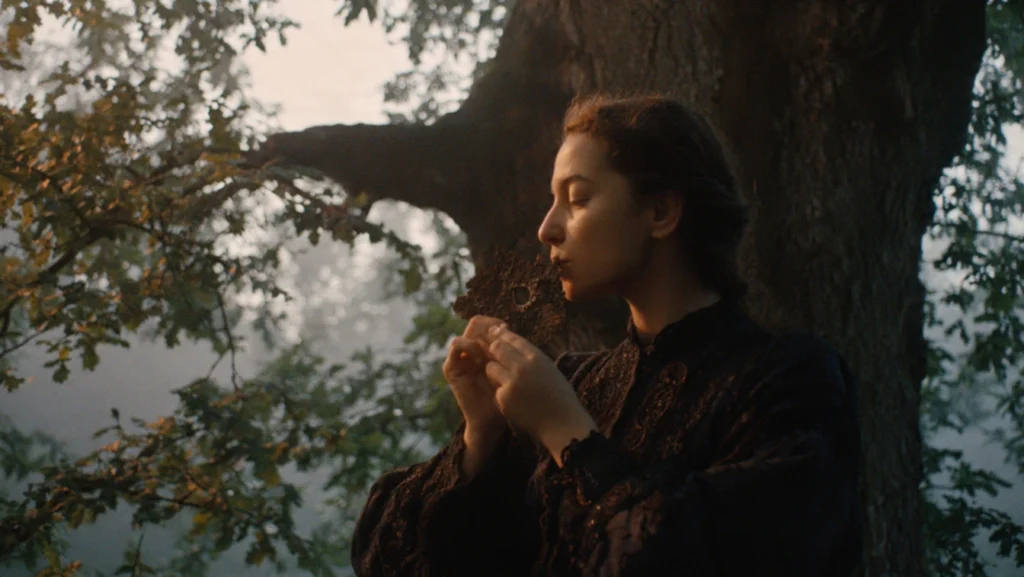
When a cuckoo is calling, the person quietly approaches the tree the bird is calling from, breaks off a small piece of bark, pierces it, and whispers through the hole: “Kao što ti kukavice kukaš tako da i [name] kuka za mnom.” (As you cry, cuckoo, so let [name] cry for me.) When the person later encounters someone they want to draw close, they look at that person through the hole in the bark. The longing sound of the cuckoo is understood to transfer into the wood when the formula is spoken, then release toward whoever is looked at through it.
This ritual belongs to a category of Vlach workings where no specialist is needed, where a person can act independently using the tradition’s logic with materials anyone can find. There are more of these than most accounts acknowledge, and they reveal a system that is not entirely gatekept by the practitioner class.
The Broom Sweeping Ritual
This ritual involves sweeping the house three times while chanting the bajalica, then carrying the gathered dust outside and throwing it in the direction where the desired person lives. The formula: “Ne metem slamu, ne metem đubre već metem sve mraviće, već metem sve stenice. Metlom ih pomeh, po [name] poslah. Kad na njega naiđete da mi ga bockate, podbadate, meni da ga otpravite. Mira nigde da nema, ni sa kim da ne prozbori dok se meni ne pojavi.” (I do not sweep straw, I do not sweep garbage, I sweep all the ants, I sweep all the bugs. I swept them with the broom and sent them to [name]. When you find him, sting him, prod him, send him to me. Let him find no peace, let him speak to no one, until he appears to me.) Three crosses are made at the threshold as the dust is thrown.
The Morning Star Ritual
This higher-level ritual works with Zvezda Danica (the Morning Star, Venus) and is performed at a crossroads when Venus is visible in the eastern sky. The vračara stands with the person making the request and has them stare directly at the star without breaking focus while speaking the formula three times:
“Tražim do ludila u mene zaljubljenog [name]. Pamet sam mu uzela, omađijala sam ga. Mir sam mu uzela, omađijala sam ga. Srce sam mu uzela, omađijala sam ga. Kada spava da ne spava, kada jede da ne jede, kada pije da ne pije, dok mene [name] ne vidi, da se ne smiri.”
(I seek [name] driven to madness in love with me. I have taken his mind, I have enchanted him. I have taken his peace, I have enchanted him. I have taken his heart, I have enchanted him. When he sleeps, let him not sleep. When he eats, let him not eat. When he drinks, let him not drink. Until he sees me, let him find no rest.)
The ritual is repeated on three consecutive evenings. A mirror variant exists but is considered more dangerous because it risks deeper contact with the spirits of the dead, and vračare who teach the morning star version typically advise against the mirror version for anyone working without extensive experience.
The Demon Invocation Ritual
The most powerful love workings involve invoking a demon directly. Performed at midnight at a crossroads or in a clearing, the vračara builds a ritual fire on bare earth surrounded by stones, lit with basil branches. She heats a horseshoe in the fire while chanting and directs all the smoke toward nine types of flowers hung overhead.
The chanting continues until each flower petal has been wetted and dried by the smoke, a process the vračara waits out while entering a semi-trance from the sustained effort. When the flowers are dry enough to grind into powder, she begins the second phase, shifting her voice dramatically between herself and the summoned demon:
“Gvožđe iskovano!” she calls, then answers in a different voice: “Nisam gvožđe iskovano nego đavo zarobljen.” Without hesitation: “Ako si đavo zarobljen da izađeš na suvo i odeš gde te šaljem. U srce [name] da se uvučeš. Da [name] tražiš od grada do grada, od sela do sela, od kuće do kuće, dok do [name] ne dođe. Očima će gledati, ustima govoriti, drugog neće naći.” (Forged iron! I am not forged iron but a captured demon. Come out and go where I send you. Enter the heart of [name]. Seek [name] from city to city, village to village, house to house, until she comes to [name]. She will see with her eyes, she will speak with her mouth, she will find no one else.)
The demon is offered three chickens and a full gourd of wine. The powdered flowers are given to the person who commissioned the work, with instructions to secretly place them in the target’s clothing or sleeping space.
Protecting a Marriage
The Sickle and Tow Ritual: When a spouse is believed to have been made unfaithful through magical interference, a sickle (srp) is wrapped in tow (kučina), the tow is lit over the head of the affected person, and the hostile presence is named and addressed directly: “Otpadniče, krvopijče, kostolomče, mesožderče.” (Apostate, bloodsucker, bonesmasher, flesh-eater.) The formula then names each body part the spirit is being expelled from, working head to toe, before sending it to a distant forest with an offer of food and rest. The ash from the burned tow is mixed with water and the affected person drinks three sips, or if the ritual is performed without their knowledge, the ash-water is mixed into coffee or dark wine.
The Cuckoo Egg Ritual: A cuckoo egg is pierced at the top and blown out. Into the empty shell go hairs cut from under the arms of both the husband and wife, the hole is sealed with wax, and the egg is hidden inside the home or concealed in a wall cavity in the deepest hours of the night. The egg concentrates the couple’s shared biological material into a single sealed object, creating a physical anchor for the bond that is difficult to break without knowing where it is hidden.
The Snail Twins Amulet: Two snails with fused shells (puževi blizanci) and a bat are used together. The tips of both bat wings are carefully cut, preserving enough of each wing that the bat can still fly. The right wing tip is placed in the left snail shell and the left wing tip in the right snail shell, then both shells are sealed with wax and a small chain is threaded through two holes at the top so the amulet can be worn. The directional placement is gender-specific: a man places the right wing tip in the left shell, while a woman does the reverse. The cross-directional placement is what creates the binding function, and vračare consistently warn that this amulet must be guarded more carefully than any other object in the household, because if it falls into hostile hands and is broken, the consequences for the couple are severe.
The Cult of the Dead: The Operational Core of the Whole System
A vračara’s calendar fills with cases that trace back, sometimes many years later, to how someone in the family died. The quality of a death determines what the spirit does afterward, and what the spirit does afterward determines what the living must manage for years or decades to come.
Two Deaths, Two Sets of Obligations
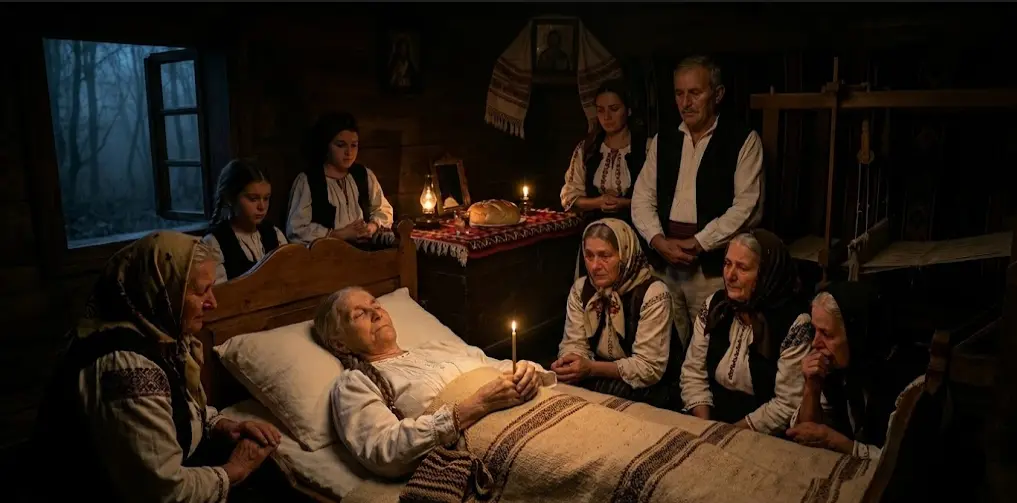
A person who dies at home with a candle in hand and full ritual preparation departs cleanly. This is muarća ku rînd (regular death). A person who dies suddenly away from home, without the final rites, or after an animal crosses their body before burial, does not fully depart. This is muarća fara rînd (irregular death), and the spirit requires ongoing ritual management to provide what the circumstances denied.
For an irregular death, a rajska sveća (heaven’s candle) is constructed the night before burial: a decorated candle holder with small wax flowers, miniature mirrors, and 44 lit candles representing the 44 saints believed to light the road to the other world. The rajska sveća leads the funeral procession, providing symbolically what the death itself failed to provide.
Forty days after death, the family reopens the grave to wash, comb, and re-dress the deceased. Personal items go into the pockets of the fresh clothing, and in many Vlach villages a small wooden structure is built over the grave and furnished with objects from the deceased’s daily life, including in documented contemporary cases a television set. The reasoning from vračare in the Timok region is direct: the deceased on the other side has the same needs as on this side, and unmet needs create a restless spirit that turns back toward the living.
The White Feast and the Women Who Cross Worlds
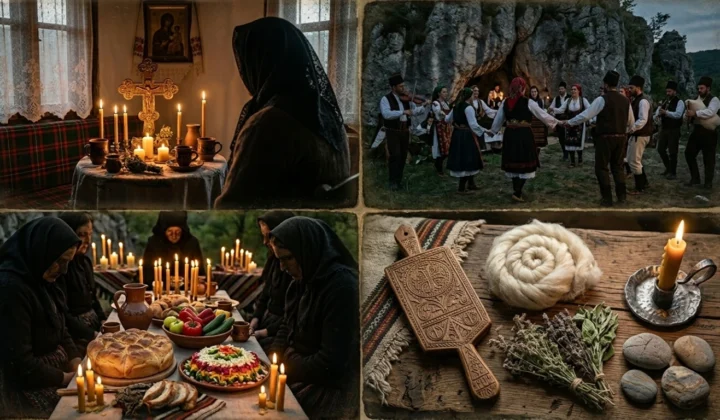
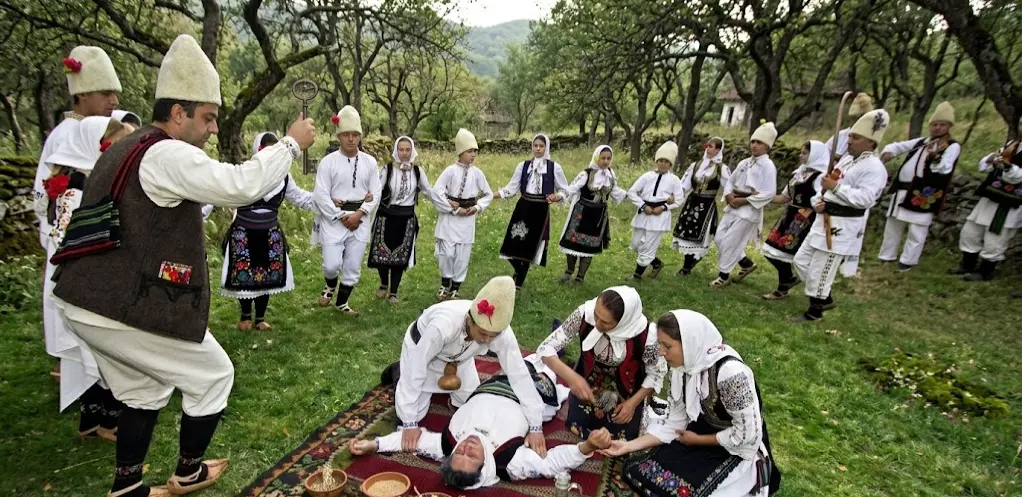
The white feast (alba pomana) is laid at the nearest crossroads with a white cloth, food, drink, candles, and a photograph of the deceased. A circle dance (kolo) begins with the closest family members and others gradually join, continuing until midnight.
Some women enter a trance state during the dance and carry messages between the living and the dead in both directions, with no memory afterward of what was communicated. These women are called rusalje. People present touch the rusalja’s body and direct mental messages to their deceased, while revival is performed by spraying the woman with chewed wormwood, garlic, and vinegar, or by pouring river water over a sword held near her.
The Black Wedding
When an unmarried young person dies, a symbolic wedding is performed before burial. The body is dressed in wedding attire, mourners dress as a wedding party, and an appointed partner wears wedding dress or suit. The kolo is danced clockwise, reversing the normal direction to mark the simultaneous holding of both wedding and funeral. After the burial, the “bride” or “groom” traditionally spends a year in the household of the deceased.
The ritual is a grief practice for completing an unfulfilled life stage, following directly from the tradition’s core logic: an unfinished life creates a restless spirit, and the symbolic completion of what was left undone gives the spirit what it needs to finally depart.
The Twelve Unchristened Days
Between Christmas and Epiphany, the twelve days called nekršteni dani are understood as a period when the earth is open and the souls of the dead rise from their underground places and move through the world of the living. They settle on doorsteps, rooftops, and the edges of wells, and contact with them during these days is understood as unavoidable rather than exceptional.
The karakondžule appear during this period: creatures with pale bulging eyes and elongated arms that operate only until the first cockcrow. If one catches a person, it rides on their back and drives them to dance without rest until dawn, which is why nighttime travel during nekršteni dani is strongly discouraged in Vlach communities. Vračare who work extensively with the dead use these twelve days as the primary period for communicating with spirits who have not fully departed.
The best protections are white garlic, bread crust, or a spindle carried on the person. Unlike other supernatural beings, karakondžule also respond to insults and coarse language, which means a person who senses them nearby may drive them off with forceful curses rather than ritual alone. This is one of the few situations in the tradition where self-help works without a vračara.
Modern Vračare: A Tradition Running Out of Time
The women who still hold the full knowledge are in their seventies and eighties. The transmission route has always been oral, grandmother to daughter to granddaughter, across years of proximity. That route requires young Vlach women staying in the villages, and after the 1990s economic collapse most of them left for Germany, Austria, and France. The apprenticeship that once lasted a decade cannot be completed over summer visits.
The diaspora kept the demand alive. A woman in Frankfurt calls via WhatsApp, the vračara diagnoses by phone and prepares materials, the client travels back to collect them. For cult of the dead obligations there is no remote version, which is why Vlach communities across Western Europe still return home for specific calendar dates regardless of cost or distance.
The online market has grown with the diaspora demand, but most of what gets sold as Vlach magic is just Serbian folk practice with a different label. Real Vlach work requires the Vlach language, and a formula that cannot be spoken in Vlach is not a Vlach formula. That single requirement filters out nearly everything advertised on social media, and the people who know the difference are exactly the ones who can no longer easily find someone to do it.
FAQ
Vlach magic is the folk tradition of the Vlach people of Eastern Serbia, concentrated in the Timok region around Bor, Negotin, and Zaječar. Its entire system rests on two premises: human fate is written at birth and can only be navigated by specialists, and the quality of a death determines whether a spirit can depart peacefully or continues to affect the living. Professional female healers called vračare manage the consequences of both beliefs through spoken formulas in the Vlach language.
Muma Paduri, meaning Forest Mother, is the supreme deity of Vlach folk cosmology, governing land and forest. She appears as either a beautiful woman or an old hag depending on context, protects women and children born outside of marriage, and is the first force invoked by folk healers at the beginning of major rituals. Her partner is Tartor, the water spirit who governs rivers and streams.
A vračara is a professional female folk healer in the Vlach tradition who diagnoses problems through conversation and addresses them by mediating between the human world and Vlach supernatural forces. She does not charge for her work but accepts a gift, because charging would imply she is the author of the result rather than its instrument. Knowledge is transmitted through female family lines and often begins with an involuntary calling through trance and illness.
Yes. Folk healers are still active in Bor, Negotin, Zaječar, Majdanpek, and Kučevo. A survey across the Braničevo region found that 93.4% of respondents had heard of Vlach magic and 46.2% said they believe in it, with researchers noting the actual belief rate is likely higher due to social stigma, and some practitioners now operate through video calls and messaging apps.
In its complete form, yes. The practitioners who carry the full system are elderly, transmission through female family lines has largely broken down, and the operational knowledge that makes the system work cannot be recovered from documentation alone.