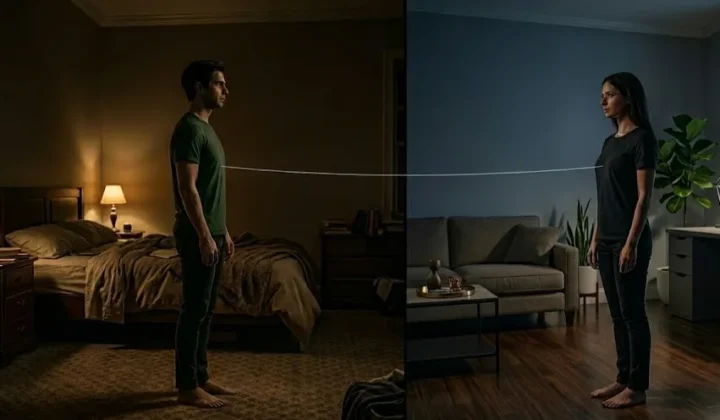
Three years after a relationship ended, you think about that person and feel it before the thought is even fully formed: a tightening in the chest, a weight in the gut, a pull that lands somewhere specific and stays. You understood what happened, probably forgave it, decided to move on, yet something is still connected.
What stays is not the memory or the grief but a structure in your field that keeps running the pattern from that relationship on its own, whether you are thinking about the person or not. Understanding what that means changes how you cut it, and whether the cut holds.
What an Energetic Cord Is
Definition: An energetic cord is a persistent connection between two people that forms through emotional intensity, physical intimacy, repeated contact, or trauma. Unlike the temporary connections that form during any normal interaction and fade within hours, a cord stays and keeps running the specific pattern from that relationship automatically, even years after all contact has ended.
What makes a cord different from a general feeling of attachment is that it carries the actual dynamic from the relationship encoded inside it: your responses, theirs, the loop that formed between the two of you. That loop runs continuously, which is why you can fully understand a relationship and still feel the pull the moment that person’s name comes up. I spent a long time thinking those feelings were just emotional residue I had not finished processing. The idea that something structural was running on its own regardless of what I consciously decided was genuinely strange to sit with, but it is the more accurate description of what is happening.
Cords to people who have died do not end when they die. Whatever pattern ran between you keeps running in your field, and this is part of why grief for certain people can feel like it loops without resolving. The protocol for cutting a cord to someone deceased is the same as for a living person: you are working with the structure in your own field, not with the other person directly.
Does Cord Cutting Remove the Love Too?
Every relationship forms two things at once, and this is what makes the hesitation to do this work understandable. One structure carries the difficult pattern. The other carries what was genuinely there between you: the history, the care, the love that was actually real. A cord cutting technique touches only the first one.
When you cut the cord with someone you love, the love does not go anywhere with it. What leaves is the loop running the damage, and the genuine connection stays intact. Emotional processing is real and useful work, but it operates on a different level than the cord and has no effect on whether the cord is there.
Signs You Have a Cord That Needs Cutting
What separates cord activity from ordinary emotional memory is that the physical reaction is specific and repeatable: you feel fine until something reminds you of this person, and then something happens in a particular place in your body, the same way every time.
Other patterns worth paying attention to:
- Thoughts about the person that loop and will not stop despite genuinely wanting them to
- Mental arguments with someone you have not spoken to in years, often replaying the same territory
- An urge to reach out or check on them that does not match what you actually want
- Energy dropping after indirect contact: their name mentioned, a photo, a mutual friend’s message
- Recurring dreams with the same unresolved feeling each time
- A physical sensation in the same spot whenever this person comes to mind
Of all of these, the consistent physical location is what to pay attention to most. A tightening in the chest, pressure at the solar plexus, or weight in the lower abdomen are all common attachment points for relationship cords. The solar plexus, just above the navel, tends to be where cords from controlling or enmeshed relationships sit, while chest cords more often involve grief and romantic attachment.
When to Do Cord Cutting and How Often
Fresh grief is a different situation, because the connection you feel in that phase is part of processing the loss, not a cord running an old pattern, and cutting too soon removes something you still need to work through. Wait until the acute grief has settled before attempting cord cutting, even if the relationship was difficult.
Regular contact makes the work temporary rather than permanent. If you are still in regular contact with this person, the cord reforms with each interaction because the dynamic that built it is still happening. The energetic work has to run alongside the practical change, not instead of it.
For timing, many practitioners work around the new moon, and there is a practical reason for it beyond convention: the new moon phase is associated with clearing and release rather than growth, which makes it a natural window for removal work. It is not required, but if you find the work harder to ground on other days, trying it at the new moon is worth testing.
A single cord does not always come out in one session. A relationship with years of history behind it has layers, and the first session addresses the most immediate one. For most people, one to three sessions handles a recent or moderate attachment. Something built over a decade may take longer, and that is not a sign the work is not holding.
How to Cut a Cord
The Visualization Protocol
- Ground yourself. Two minutes, eyes closed, attention on your feet and what is beneath them. Breathe slowly until you feel settled. Cord cutting opens your field, and work done from an ungrounded state tends not to hold.
- Locate the cord. Close your eyes and bring the felt sense of this person to mind, not their name or a story, just the quality of being around them. Notice where in your body something responds without directing your attention anywhere. Let it land where it goes. The body’s answer here is more accurate than any guess.
- Notice what the cord contains. Sit briefly with the specific pattern between you. What has run in both directions? I got this wrong for years: I thought the cutting was the work, and I kept wondering why the same patterns kept reassembling around new people. A few moments of honest attention to what the cord encodes matters, because removing the structure without acknowledging what it held leaves the underlying dynamic free to re-form.
- State your intention aloud. Say clearly that you are cutting the cord between yourself and this person, releasing what is not yours back to where it came from. Aloud matters because intention held silently tends to stay that way.
- Cut the cord. Visualize it at the attachment point as something physical: a rope, a tube, a wire, whatever comes without directing it. On the exhale, cut it at the root and see it retract completely.
- Seal the opening. An open attachment point draws a new cord, either with the same person or someone else carrying the same pattern, and most people who say cord cutting did not work skipped this step. Visualize the point where the cord was attached and see it closed: some people see light filling it, some see tissue sealing the way a wound heals. Then ground again, three slow breaths with attention on your feet.
The Candle Ritual
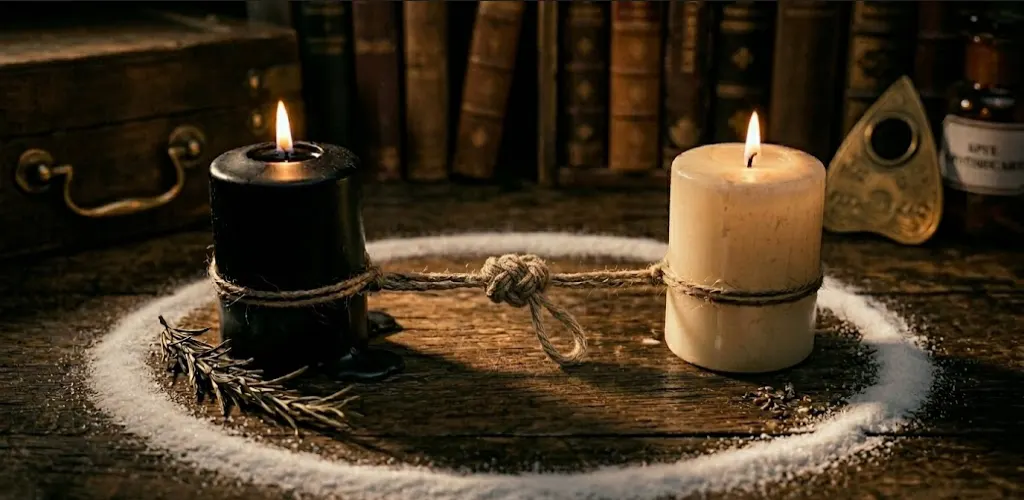
The candle method is the most practiced cord cutting ritual because it gives the whole process a physical form. Two candles represent you and the other person. The string between them represents the cord. When the flames reach the string and burn through it, the cutting happens on a material level alongside the internal one. It is pageantry in the good sense of the word: it makes the invisible work visible.
What you need: two candles of the same size, a piece of natural string or jute twine roughly 30 centimeters long, a fireproof surface, a sharp object to carve with, and a bowl or ring of coarse sea salt.
How to do it:
- Prepare the candles. Use a nail, pin, or small knife to carve your name into one candle and the other person’s name into the second. Keep it simple: first name is enough. This step links each candle to a specific person rather than leaving it abstract.
- Set them up. Fix both candles to the fireproof surface roughly ten centimeters apart. Melt the base slightly if you have no holders. Pour a ring of coarse sea salt around the entire setup. The salt is a boundary, not decoration.
- Tie the string. Wrap the twine around the base of each candle and let it run loosely between them across the surface. The string should be slack enough to lie flat but taut enough to stay in place. This is the physical cord.
- Light both candles and state your intention aloud. Say clearly what you are releasing and why, using both names. Do not rush this. The intention stated at lighting is what the whole ritual works from.
- Let them burn. Do not leave the candles unattended. Watch the flames move toward the string. When the flames reach the twine and burn through it, the cord is cut. Let both candles burn completely down. If you need to stop mid-ritual, extinguish and restart another time rather than leaving it unfinished.
- Dispose of what remains. Wrap the burned string and any remaining wax in paper and put it in the rubbish bin outside your home. Do not keep it. Pour the salt down a drain or into running water.
Black candles are used when the cord involves a pattern you want gone entirely. White candles are used when there is still genuine care for the person. Rosemary placed near the candles during the ritual has a long tradition in European folk practice as a clearing herb, one that supports release without adding heaviness to the work.
The Simple Cord Method
If candles feel like too much or the situation is one you want to handle quietly, a piece of string and a pair of scissors is enough. Cut a length of natural string roughly the length of your arm. Hold it loosely between both hands. Close your eyes and bring the cord to mind at its attachment point in your body. When you feel the connection clearly, cut the string cleanly in one motion. Wrap the cut pieces in paper and put them outside immediately. Follow with the sealing step from the visualization protocol above.
This method works. It is not less serious than the candle ritual. What matters is the clarity of intention and the completion of the sealing step, not how many objects are involved.
Supporting the Work: Walnut and Black Tourmaline
Walnut has a specific reputation in Slavic folk herbalism for cutting energetic ties, distinct from general cleansing. A salt bath clears accumulated residue while walnut works on the attachment itself. After the visualization, run a bath with half a cup of walnut shells or walnut tincture and a handful of sea salt, set your intention before getting in, soak for fifteen minutes with attention on where the cord was attached, then air dry rather than toweling off.
Black tourmaline, placed at the attachment point or carried afterward, is used in crystal work specifically for sealing and protection after cord cutting. The logic is the same as the sealing step in the visualization: you are closing and protecting the opening rather than leaving it exposed. I cannot speak to whether it is the stone itself or the intention that matters, but the practice of placing something at the location after the work is consistent across folk traditions that do not share an origin.
What Happens After Cord Cutting
The First Few Days
The days after a successful cord cutting often feel like withdrawal, and this catches most people off guard. A cord that has run for years becomes part of how your system experiences that relationship, and when the loop stops, the system has to adjust. That adjustment can look like missing the person, an urge to reach out, or grief that arrives without an obvious object.
What makes it disorienting is that it looks and feels exactly like grief for the person. When I first worked through a cord cutting on a relationship I had been in for years, I spent three days convinced I had made a mistake, because I missed a relationship I had spent two years being relieved to be out of. The feeling was real. It was my system adjusting to the absence of a loop it had organized itself around, not evidence that the cord should have stayed.
After Two Weeks
Clarity arrives within one to two weeks for most people: obsessive thoughts drop off, the physical response stops accompanying thoughts of this person, and indirect contact no longer drains your energy. The person you cut the cord with may also reach out unexpectedly around this time, because their end of the connection adjusts too and that occasionally surfaces as an urge to contact you. Whether to respond is a separate question from whether the cord cutting worked.
Why Cord Cutting Sometimes Does Not Hold
When the attachment point is not sealed after cutting, it stays exposed and a new cord forms, either with the same person or someone new carrying the same energy. The cut worked briefly, the pattern came back, and this usually gets attributed to the other person rather than an unsealed opening.
The second situation is cutting while still in regular contact, because each interaction rebuilds the dynamic and the energetic work cannot outpace that.
The third is the one that took me the longest to distinguish clearly: cutting without engaging with what the cord contained. When you remove the structure without looking at the specific pattern it held, that pattern stays active in your field, and new cords form in the same location with new people carrying the same dynamic. Cord cutting removes the cord. The wound the cord was attached to is a different, longer process, and the two are easy to confuse because the relief from cutting can feel, briefly, like healing the wound.
FAQ
Cord cutting removes a persistent energetic attachment between yourself and another person. These attachments form through emotionally intense relationships and keep running the problematic pattern automatically, even years after all contact ends.
Immediate effects are often felt within a day or two: a shift in the physical sensation at the attachment point, fewer looping thoughts. Full clarity, where the energy drop after indirect contact stops, typically arrives within one to two weeks.
Yes, when the full protocol is completed, particularly the sealing step. A properly cut cord does not need to be recut. If the same pattern keeps returning, either the attachment point was not sealed or the cord re-formed because regular contact continued.
Yes. The cord runs in your field, not in the other person, so their death does not end it. The protocol is the same: locate the cord, acknowledge what it contains, cut it, seal the opening. Cords to deceased people are often the most persistent because the relationship cannot change.